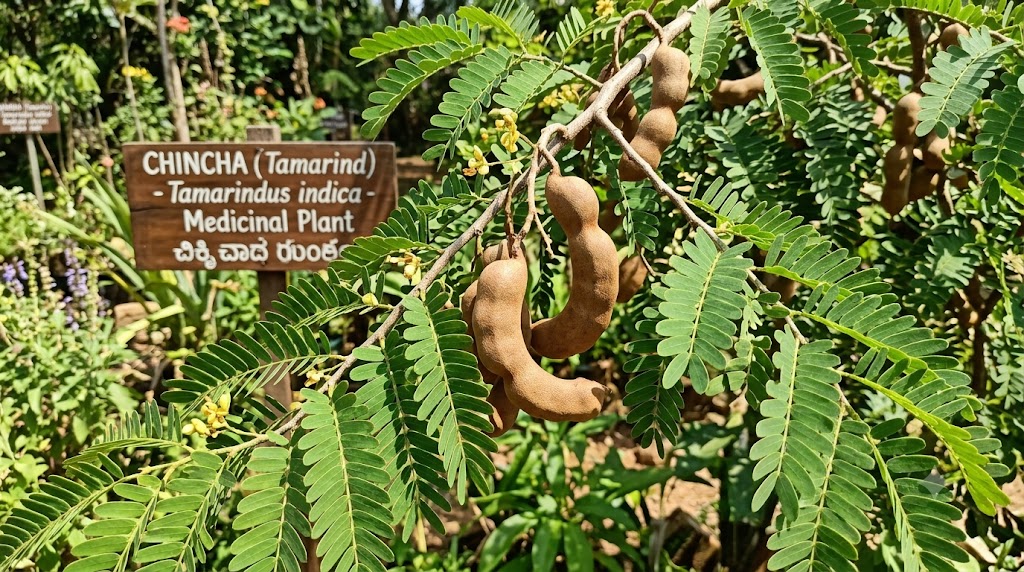
Botanical Name : Tamarindus indica Linn.
Family : Fabaceae
Identification number:– SDACH/HG/ 079
Introduction :
Latin name Tamarindus = the distorted form of the Arabic nametamarindus – hind meaning ‘ripe date of India’; indica Indian
Scientific classification: The tamarind belongs to the subfamily Caesalpinioideae, family Fabaceae (formerly Leguminoseae). It is classified as Tamarindus indica.
Names in different Indian languages :
English : Tamarind tree
Hindi : Amli, imli
Kannada : Huli, amli
Malayalam : Puli, kolpuli, valanpuli
Sanskrit : Amlikaa, chincha
Tamil : Puli, amilam
Telugu : Cintapandu, amlaki, cintacettu
Unani : Tamar
Synonyms :
चिंचा चञ्चला चारीका आम्लिका च कटुत्वचा।
अम्लिका कषायाम्ला स्वादुका हृद्यरोगनुत्॥
Amli, Amlikaa, Suktaa, Chukraa, Chukrikaa, Chinchaa, Chandikaa, Tintidika
Tamarindus occidentalis Gaertn.
Tamarindus officinalis HK.
Morphology :
It is a fast growing tall tree and is known by these names — chincha, tintini, mali, ambalt. chinch, tamarind.
Leaves — compound, teaflet 20 to 40. round in shapa Flowers – in bunches, yellow in colour and boat shaped. Legume— 7 to 12 cm. Long Seeds are called as chinchoke in Marathi.
Distribution & Habitat :
Throughout India
Chemical constituents :
Tartaric. citric. malic, acetic, potassium tartarate. etc. In the seed there is 65% carbohydrates. orientin, vitexin, iso-orientin and iso-vitexin, tamarindienal
Properties :
Guna guru. ruksha:
Rasa amla;
Veerya : ushna:
Vipaka: amla
Karma :
Grahi, deepana, ruchyam, hridyam, sulaghnam kaphaghni
Laxative, carminative, digestive,astingent,cooling,diuretic, antimicrobial, antifungal, anthelmintic, antiviral, antipyretic, anti-inflammatory
Indication :
Pandu, vataroga, vrana, sopha, ajirna
Anaemia, ulcers, wounds, fever, skin disease, cough, piles
Part used :
Whole plant
Dosage :
Leaf juice 10-15 ml
Powder 2-4 g
Decoction 50-100 ml
Uses :
Tamarind and its seeds are applied externally on inflammation. Fruit is very good in taste and is used in anorexia, polydipsia, indigestion and liver disorders- In heart diseases, sherbet is given. Kshara is used in retention of urine and abdominal pain . Pulp and sherbet reduce the complication in fever. In cholera, tablets of traits of tamarind and Semecarpus anacardium + salt are very useful
IUCN Status: Least Concern (LC)
Research Updates (Past 5 Years):
1. 2021 – Tamarindus indica extract showed hepatoprotective activity in CCl₄-induced liver injury models.
2. 2020 – Antioxidant and lipid-lowering activity of tamarind pulp evaluated in hyperlipidemic rats.
3. 2023 – Clinical study on tamarind leaf extract in managing joint inflammation and osteoarthritis symptoms.