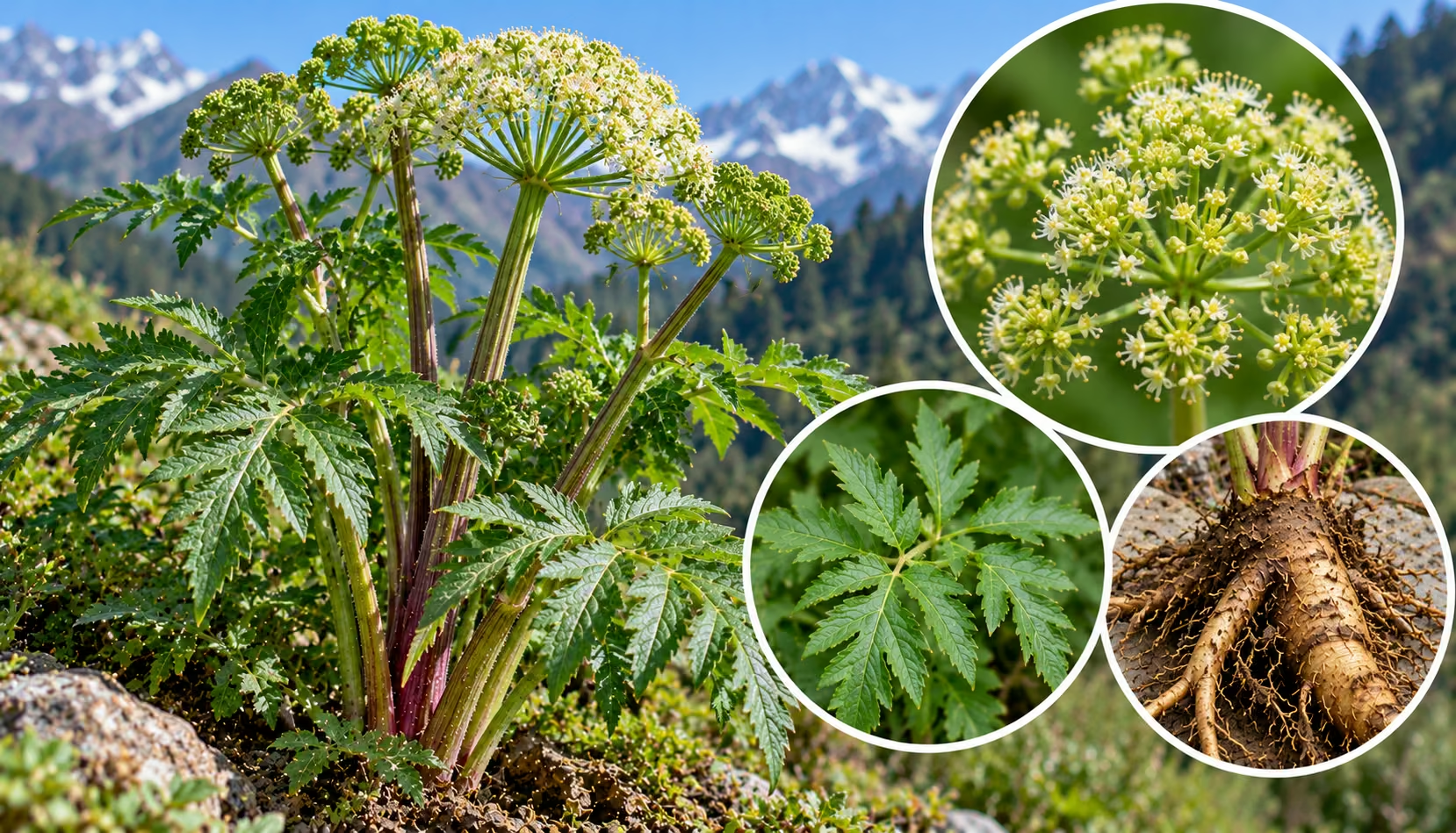
Sanskrit name: Choraka
Botanical name: Angelica glauca Edgew.
Family name: Apiaceae (Satapushpa Kula)
Identification No.– SDACH/HG/201
Vernacular names:
- Hindi: Choraka
- English: Smooth Angelica, Himalayan Angelica
- Urdu: Chora
- Kashmiri: Choraka
Synonyms- चोरकः शङ्कितश्चण्डो दुष्पत्रः क्षेमको रिपुः
Shloka from Bhav Prakash:
चोरकः कटुको तिक्तो लघुश्चोष्णो विशेषतः।
दीपनः पाचनः कफवातहरः कृमिनाशनः॥
Classification :
Bhav Prakash- Karpuradi varga
Habitat & Distribution: Grows in temperate to alpine regions of the Western and Central Himalayas. Found in Jammu & Kashmir, Himachal Pradesh, Uttarakhand, Sikkim, Nepal, and Bhutan at altitudes of 2,000–3,500 meters. Prefers moist slopes, forest clearings, and streamside habitats.
Morphology- A stout, erect, aromatic perennial herb up to 2.5 m tall. Stem grooved, hollow, purplish. Leaves large, triangular, thrice pinnate. Inflorescence compound umbel; flowers small, yellowish-white. Roots thick, tapering, with strong aromatic odor.
Varieties: No officially described varieties. Related species like Angelica archangelica used in similar applications.
Substitute/ Adulterant: Common substitutes include Angelica archangelica. Adulterants may include roots of other Apiaceae family members.
Phytochemicals: Contains volatile oils rich in β-phellandrene, limonene, (Z)-ligustilide, α-pinene, β-caryophyllene, α-terpineol, coumarins like bergapten and xanthotoxin.
Raspanchaka
Rasa: Tikta (bitter), Katu (pungent)
Guna: Laghu (light), Tikshna (sharp)
Virya: Ushna (hot)
Vipaka: Katu (pungent)
Prabhava: Krimighna
Dosha shamakta: Kapha-Vata hara
Karma- Rogaghnata: Krimighna, Jvaraghna, Shothahara, Deepana, Pachana, Vatanulomana, Shwasahara
Amayika Prayoga/Therapeutic Uses
External: Applied as paste for wounds, fungal infections, and inflammation
Internal: Used for digestive disorders, worm infestation, cough, asthma, and fever
Part used: Root
Dose: Churna: 1–3 g
Yoga/Formulations: Mahasudarshan Churna, Krimimudgar Rasa, Shwasakuthar Rasa
IUCN Status: Endangered
Research updates:
- Khan A, Lone SH, Ahmad S, Ahamad SR. Bronchodilator potential of Angelica glauca essential oil in experimental asthma models. Phytomedicine Plus. doi:10.1016/j.phyplu.2022.100129.
- Devi N, Dey A. Pharmacological overview and conservation perspectives of Angelica glauca: An endangered medicinal plant of the Himalayas. Journal of Herbal Medicine. doi:10.1016/j.hermed.2021.100497.
- Negi VS, Maikhuri RK, Phondani PC, Rawat LS. Ethnobotany and conservation strategies for Angelica glauca in Western Himalaya. Indian Journal of Traditional Knowledge. doi:10.56042/ijtk.v20i4.36637.