Sanskrit Name: Asana
Identification No.: SDACH/HG/274
Botanical Name: Pterocarpus marsupium Roxb.
Family Name: Fabaceae (Leguminosae
Vernacular Names
Hindi name- Vijayasara, Vijaysar, Beejasaar, Beejsar, Bij Sar
English name- Indian Kino tree, Malabar Kino tree
Tamil name – Vegai, Venga katal
Telugu name- Vegisa, Peddagi
Malayalam name- Venga
Kannada name- Banga, Bange mara
Bengali name – Peetashal, Piyasal
Marathi name – Vivala, Bibala
Gujarati name – Biyo
Oriya name Piashala
Urdu name – Bijasar
Synonyms
बीजकः पीतसारश्च पीतशालक इत्यपि ।
बन्धूकपुष्पः प्रियकः सर्जकश्चासनः स्मृतः ॥२८॥
Classification According to Ayurvedic Texts:
Susruta- Salaasaradi gna
Vabhata- Asanadi Gana
Kaiyadeva Nighantu – Oshadhi Varga
Dhanvantari Nighantu – Amradi Varga
Bhavaprakasha – Vatadi Varga
Rajanighantu – Prabhadradi Varga
Habitat & Distribution
Native to India, Nepal, and Sri Lanka, Pterocarpus marsupium thrives in the dry deciduous forests of the Western Ghats, Central India, and sub-Himalayan regions, at elevations up to 1200 meters.
Morphology:
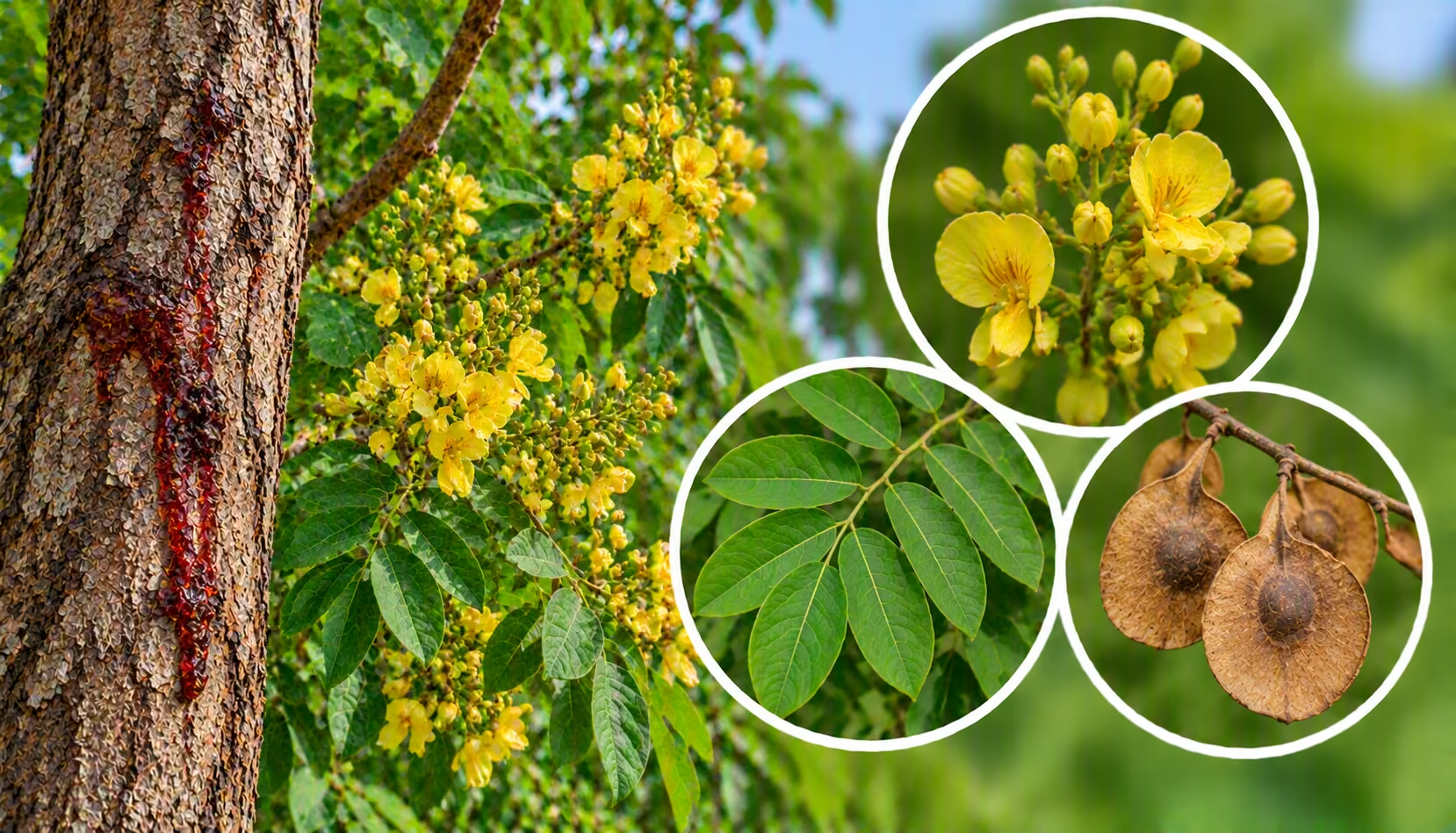
A medium to large deciduous tree, reaching heights up to 30 meters. The bark is greyish-brown, exuding a ruby-red resin known as ‘kino’. Leaves are compound, alternate, and imparipinnate. Flowers are yellow, arranged in panicles. Fruits are flat, winged pods containing one to two seeds.
Varieties:
No distinct varieties documented.
Substitute/Adulterant:
Terminalia tomentosa, Dried juice of Butea monosperma (Bengal kino): Used as a substitute and adulterant of Indian kino.
Phytochemicals:
Pterocarpol, Marsupol, Maesupin, Carpusin (Marsupsin), (-) epicatechin, Propterol, Pterosupin, Marsupinol, Lupeol. Resin contains Kino tannic acid, Pyro catechin, epicatechin. Kino tannic acid is found in heartwood.
Rasapanchaka:
- Rasa: Tikta , Kashaya
- Guna: Laghu, Ruksha
- Virya: Sheeta
- Vipaka: Katu
- Prabhava: Madhumeha hara
- Dosha Shamakta: Kapapitta shamaka
- Karma (Therapeutic Actions):
Antidiabetic, hepatoprotective, anti-inflammatory, antioxidant, antimicrobial, astringent.
Amayika Prayoga/Therapeutic Uses:
- External: Paste of bark applied on wounds, ulcers, and skin diseases.
- Internal: Decoction used in managing diabetes, diarrhea, and bleeding disorders.
Part Used: Heartwood, bark, resin.
Dose: Powder: 3–6 g; Decoction: 50–100 ml.
Yoga/Formulations:
- Vijaysar Churna
- Asanadi Kwatha
IUCN Status: Pterocarpus marsupium is listed as Near Threatened under criteria C1.
Research Updates
- 2024: Comprehensive review underscored the plant’s antioxidant and anti-inflammatory properties, validating its traditional uses.
- 2025: Recent research focused on the antidiabetic potential of P. marsupium bark extract, demonstrating significant glucose-lowering effects.