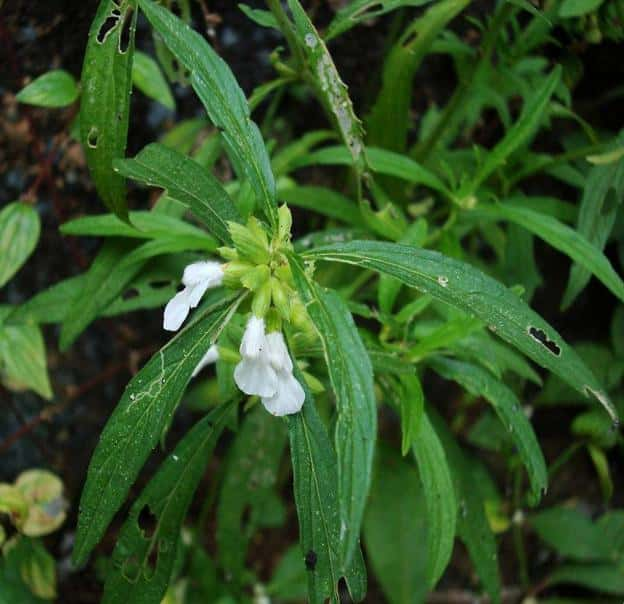
Botanical Name: Leucas aspera Spreng.
Family : Labiatae; Lamiaceae
Identification No.: SDACH/HG/012
Introduction :
Drona puspi used in kamala, krimi sopha etc. one of the plant belong to dasa pushpa
Names in different Indian languages:
Hindi : Guma,chota halkkusa
Telugu : Tummi,tummacettu
Tamil : Tumbai,Tumbari.
English : White Dead Nettle
Marathi : Tuba
Gujarati : Kubo
Kanada : Tumbe
Malayalam : Tumba
Sanskrit : Dronpushpi
Folk : Guumaa,Halkusa
Synonyms:
Phalepushpaa, Kutambaka, Ksavapatra, Chatrini, Gumã, Nahula
Varieties & adulterants – (CV – controversy, AD – adulterants):
1. Dronã (L. aspera)
2. Mahã Dronã (L. cephalotus)
3. L. indica
4. L. lavandulifolia
5. L. linifolia
Morphology:
Annual, stout herb with hairs about 20- 50 cm high.
Leaves—simple, entire, ovate or ovate-lanceolate, subacute, crenate-crenate-serrate, pubescent
Flowers— white, small, sessile, borne in large globose dense terminal whorls, white coloured; calyx tubular; corolla-tubular.
Fruits nutlets, obovoid-oblong, smooth, brownish.
Flowering and fruiting during August-December.
Habitat & Distribution:
Common throughout India.
Chemical composition:
Laballenic acid,beta – sitosterol.
Properties:
Rasa: Katu
Guna: Guru, Ruksa
Virya: Usna
Vipaka: Katu
Karma : Kapha-vatahara, Jvarahara, dipäña,pachana, jwarahara, Thermogenic, laxative, expectorant, anti bacterial, anti inflammatory, Carminative, antihistaminic, antipyretic, febrifuge, antiseptic.
Part Used : Whole plant, leaves, flowers
Dosage: Fresh juice 10-20. ml.
Indications:
Visama Jvara, Jvara, Agnimandya, Kãmalã, Paksãghata, Prameha, Visaroga, Arsas,gulma,
Useful in psoriasis, skin itching , cough, fever, amenorrhoea, dushta peenasa, jaundice, anorexia, dyspepsia, fever, helminthic manifestation, respiratory , skin diseases.
Amayika Prayoga (Therapeutic Uses):
Internal uses:
Digestive system: Being an appetizer, carminative, laxative and antiparasitic. its juice is used in flatulence, abdominal pain, constipation, and worms juice is used as an eye-ointment in jaundice.
Circulatory system : Blood purifier, alleviates oedema, hence useful in blood disorders and oedema. Juice is used as nasal drops in headache due to cold,
Respiratory system : It is an expectorant. Its decoction or hot infusion is useful in cold, cough and dyspnoea.
Reproductive system : Being an emmenagogue. it is used in amenorrhoea and dysmenorrhoea.
Skin : Useful in skin disorders. It eliminates vitiated doshas from the skin by its diaphoretic action. Juice is used for massage.
Temperature: Febrifuge because of its diaphoretic property), mainly in typhoid and fever induced by vata-kapha.
Satmikaran : Antidote effective in snake bite.
Srotogamitwa:
Dosha : Vitiates vata and pitta. alleviates kapha.
Dhatu : Amadhatu (digestive), rakta (jaundice), rasa (fever).
Mala : Purisha (cathartic) (anti parasitic), sweda (fever).
Organs: Respiratory system (asthma).
IUCN Status:
Not evaluated (commonly found, not threatened).
Research Updates (Past 5 Years):
1. Antimicrobial Activity (2020): Studied against Staphylococcus aureus and E. coli.
2. Wound Healing (2021): Ethanol extract showed significant wound contraction in rats.
3. Anti-diabetic (2022): Hypoglycemic effects observed in animal models.