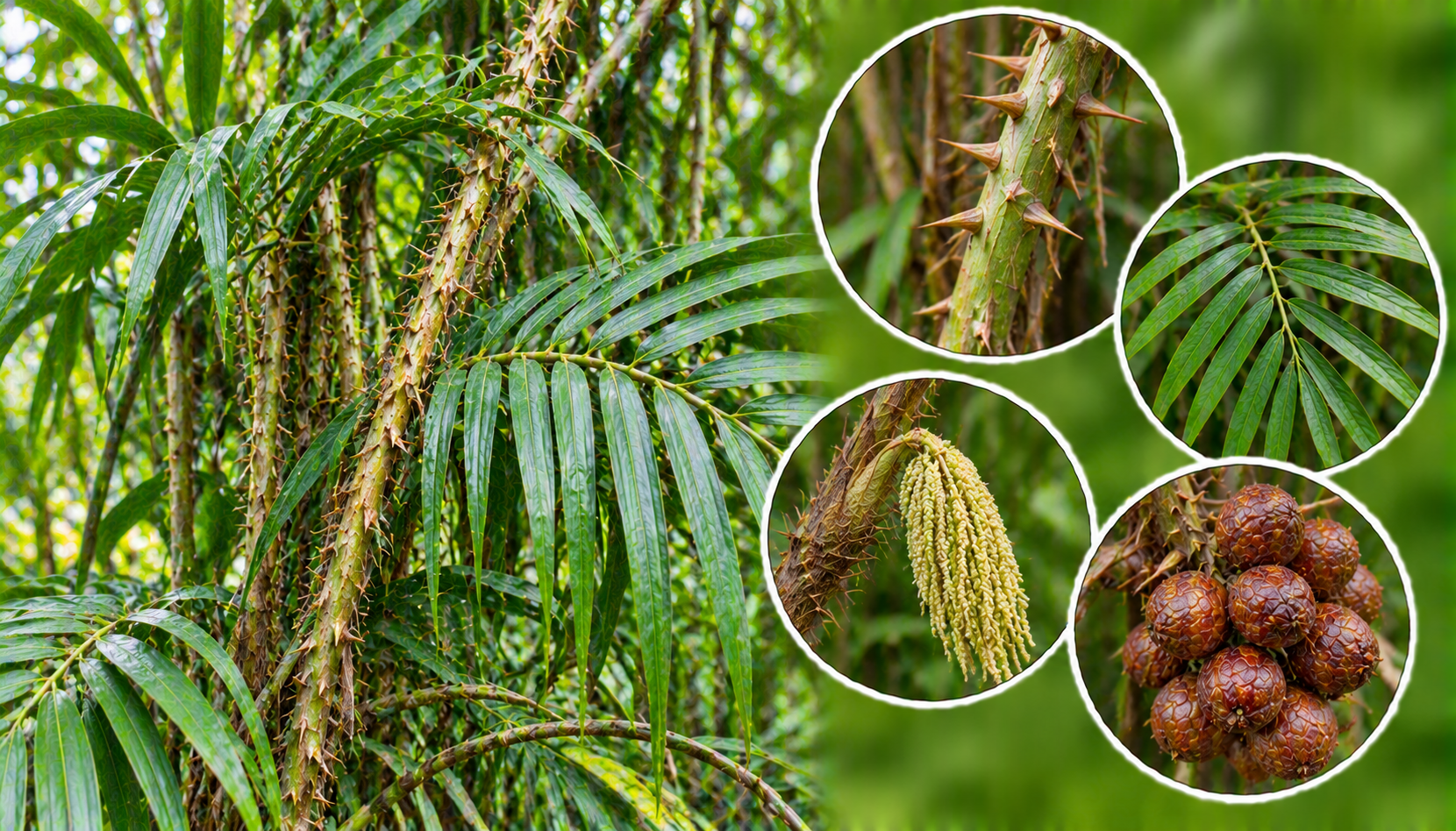
Calamus rotang L.
Etymology – Its generic name derives from Greek calamos = reed, with reference to its slender stem much like bamboo canes. Its specific name refers to the native name for the material obtained from the stem (rattan).
Area of origin – South-western Asia
Botanical description – Climbing palm exhibiting a slender stem ranging from a few millimetres to some centimetres in diameter, flexible, sometimes more or less armed with spines. Its leaves are pinnate, alternately arranged at regular intervals along the stem, 60-80 cm long, consisting of linear-lanceolate segments, 15-30 cm long, armed with two ranks of spines on upper face. Its sheath and thin petiole are armed with whitish spines, whose function is that of support and climbing organs. Flowers, unisexual on dioecious plants, are clustered in showy unbranched inflorescences, enveloped by spiny spathes. In other species (for example Calamus ciliaris) some inflorescences are sterile and they form a kind of spiny whip by which the plant easily climbs over nearby trees. Its fruits are subrounded, thoroughly covered with glossy, red-brown scales.
Uses – Its slender and cylindrical stem, properly worked, is the source of the well known rattan, a valuable and expensive material, much appreciated for the making of furniture, walking-sticks, umbrellas and wickerwork. However, similar products are often made out of stems of many other plants, mostly Gramineae (particularly Bamboos), Juncaceae (rushes) or, finally, out of tender and slender branches of willows (wicker).