
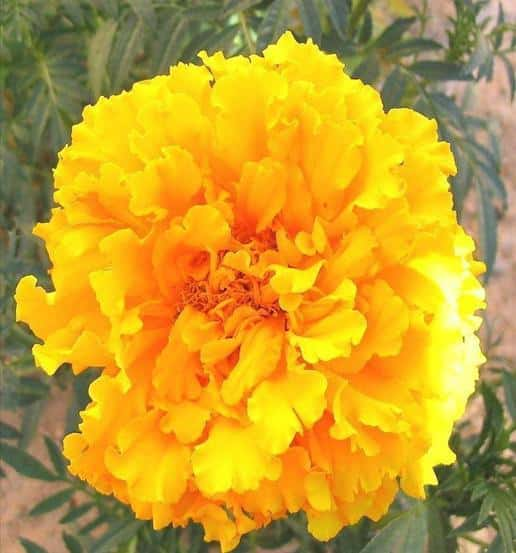
Botanical Name: Tagetus erecta
Family : Compositeae
Identification No.- SDACH/HG/042
Introduction :
Latin name : Tagetus = marigold, tages an Etruscan God; erecta = straight.
Sanskrit names : Zandu, Salpushpa, Zenduk.
Morphology :
This is a small plant. Its stalk and branches are angular and bear bristle hairs.
Leaves – regularly placed, foliated and with hairs.
Flowers – dark yellow. Seeds- black and oblong. flowering – in October (around Dassera).
Many varieties are found.
Habitat : Though imported from Mexico, it is found all over India.
Properties :
Guna : laghu, ruksha
Rasa: tikta, kashaya
Virya : sheeta
Vipaka Katu
Dosha : kaphapittashamak.
Part used : Flowers or leaf juice.
Dosage : Juice 10 to 20 gms.
Amayika Prayoga/Therapeutic Uses:
- The paste of the leaf is applied over the area affected with boils, carbuncles, muscle pain and rheumatism.
- Cold infusion of the whole plant is given in a dose 30-40 ml to treat bronchitis, asthma and cough.
- The paste of the leaf and flowers are applied over the external pile mass to reduce it.
- The distillate obtained from the flowers is used to treat asthma. 4-5 drops are added with a glass of hot water and consumed.
- The cold infusion prepared from the leaves and flowers is given in a dose of 50-60 ml to treat burning micturition.
- The paste prepared from the leaves and flowers are applied over fresh wounds to control bleeding or in wounds associated with pus as treatment.
- Nasya (Nasal administration) of the fresh juice of the leaf is done in epistaxis.
- The paste of the leaf is fried in clarified butter or oil and consumed to control bleeding in piles, excessive blood flow during menstruation.
IUCN Status:
Not Evaluated (Cultivated widely)
Research Updates (Past 5 Years):
1. 2020: Antimicrobial properties of Tagetes erecta against skin pathogens.
2. 2021: Lutein extraction for eye health benefits.
3.2022: Wound-healing efficacy in animal models.