Shri Dhanwantry Ayurvedic College

Author: Khushal

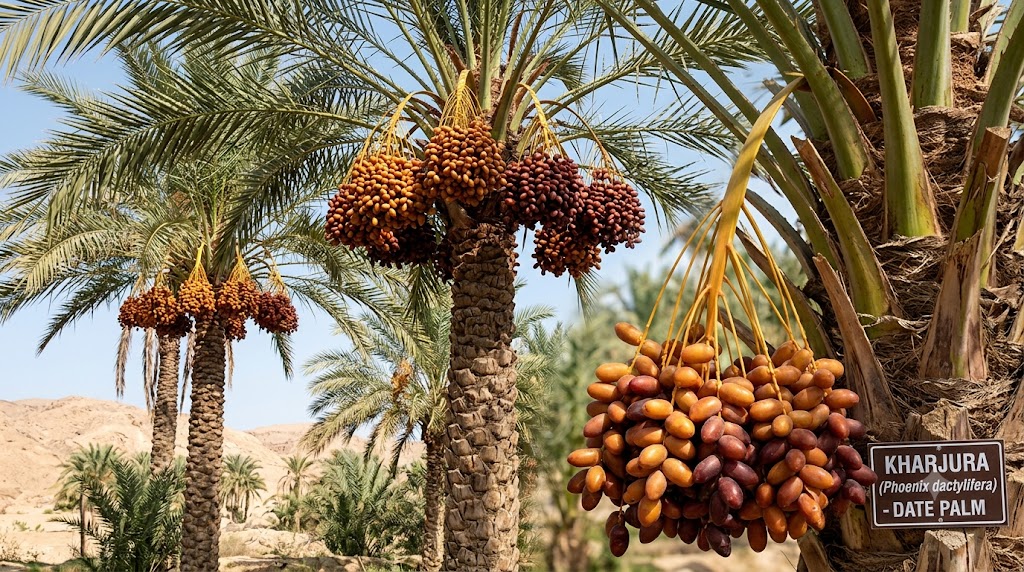
  • Kharjura

    Kharjura

    Botanical Name : Phoenix dactylifera Linn.

    Family : Palmae; Arecaceae.

    Identification No.: SDACH/HG/103

    Introduction :

    Latin name: Phoenix = Gk. name of the tree; sylvestris = sylvisticus = of the wood lands.

    Names in different Indian languages :

    English : Edible date palm

    Hindi : Khajur

    Kannada : Khajuri

    Malayalam : Ittapana

    Sanskrit : Khajur

    Tamil : Perichchankay

    Telugu : Karjurakaya

    Unani : Khurmaa, Khajuur, Chhuharaa

    Scientific Classification : Date palms belong to the family Arecaceae (formerly Palmae). The common date palm is classified as Phoenix dactylifera, the sugar date palm as Phoenix sylvestris, the blue date palm as Phoenix zeylanica, and the pygmy date palm as Phoenix roebelenii.

    Classification according to Charak, Sushruta, Vagbhata & Bhav Prakash:

    • Charaka: Phala Varga

    • Sushruta: Phala • Bhav Prakash: Madhura Skandha

    Synonyms :

    खर्जूरः पिण्डखर्जूरो मधुरः स्निग्धशीतलः |वृष्यः पित्तहरः श्लेष्मलो बलकरः परः ||

    Kharjoor; Kharaskandho, Dushpradharsha, Durarooha, Nihshreni, Kashaya,Yavaneshta, haripriya.

    Varieties :

    Phoenix sylvestris

    English name: Date.

    Botanical Description :

    It is a tree growing to a height of 12 to 15 mtrs. Its trunk is straight, grayish and the stalk of the leaves is attached to the trunk.

    Leaves – 15 to 17.5 cm. long. Leaflets – 15 to 30cm. long and 2.5 cm. wide, pointed at the tips and arranged opposite to each other. There is one leaflet at the lip of each teal. Each leaf has at its base a thorn which is 10 cm. long. Only the female khajoor plant bears fruits.

    Fruits – 2.5 to 3 cm. long, round and yellowish in colour. On ripening, they become red in colour. The fruit contains an oblong seed, flowers bloom in summer and later on fruiting occurs. Juice obtained horn its trunk is called khajuri. When the juice ferments after some time, it becomes an alcoholic beverage. Jaggary is prepared from its juice.

    Types: 1) Khajoor 2) Pindakharjoor (fruit is big, fleshy. Gostan khajoor). Besides, other varieties like Rajakharjoori, Madhukharjoorl. Bhookharjoort, Sulemani khajoor etc. are also described In the nighantus.

    Habitat :

    All over India. Pindakharjoor is basically from North Africa, Egypt. Syria and Arabasthan. But now a days, it is also cultivated in Punjab and Sindh.

    Chemical composition :

    Pindakharjoor contains iron, mucilagenous substance and calcium.

    Properties :

    Guna: snigdha, guru;

    Rasa: madhur;

    Virya: sheeta;

    Vipaka: madhur;

    Dosha: vatapittashamak.

    External uses :

    Roots are analgesic. In toothache, decoction of the roots is used for gargling or root powder is applied on the tooth,

    Internal uses :

    It alleviates vata and acts as a nervine tonic and a tranquilizer. It is useful in fainting, giddiness, intoxication, lower backache and sciatica. It reduces polydipsia, vomiting, diarrhoea, weakness of the heart, cough, asthma, hiccups, seminal weakness and dysuria. In fever, its sherbat is given. Its sherbat is also useful in various debilitating diseases like tuberculosis and fever. Kharjuri is useful in tuberculosis.

    Dose :

    Fruits – 5 to 7; juice – 50 to 100 ml.

    Date Palm :

    Date Palm, common name for several related trees found in tropical regions. The common date palm is native to northern Africa, southwest Asia, and India and is cultivated extensively in hot, dry regions throughout the world. The trunk is straight and rough and grows to a height of up to 18 m (up to 60 ft). It bears a head of waxy-green, barbed leaves, about 3 m (about 9 ft) long, and a number of branching spikes that, on the female tree, bear 200 to 1,000 dates each. A cluster of dates weighs up to 12 kg (up to 25 lb), and the annual yield of a single tree may reach 270 kg (600 lb). The tree begins to bear about the eighth year, reaches maturity at 30 years, and begins to decline at about 100 years. From earliest times, fertilization has been aided by cutting off the male flower cluster just before the stamens ripen and suspending it among the flowers of the female tree.

    In many parts of northern Africa, Iran, and Arabia, date palms are the main wealth of the people, and dates are the chief article of food. The fleshy part of the fruit contains about 58 percent sugar and 2 percent each of fat, protein, and minerals. Leaf stalks are used for basketry and wickerwork, leaves are woven into bags and mats, and fiber from both is made into cordage.

    Another species, the sugar date palm, or toddy palm, is cultivated in India for its sap. The sap may be boiled down to form jaggery, or gur, a crude sugar; or it may be used as a fresh beverage, or to make palm wine, from which arrack, a rumlike liquor, may be distilled. Date palms are often cultivated in the southern United States for ornamental effect in regions too cool for the fruit to ripen. The blue date palm grows in clumps and has silvery blue foliage; the pygmy date palm is a dwarf species that is also popular in the north as a greenhouse plant or houseplant.

    Research updates:

    1. Evaluation of antioxidant and hepatoprotective effects of Phoenix dactylifera fruit extract – 2021

    2. Cardioprotective potential of date palm fruits in high-fat diet-induced models – 2022

    3. Antidiabetic and lipid-lowering effects of Kharjura in type 2 diabetes – 2023
    About Kharjura

    Botanical Name

    Phoenix dactylifera L.

    Family

    Arecaceae (Palmae)

    Identification No.

    SDACH/HG/103

    Parts Used

    Fruits, Roots

    Habitat

    India, Egypt, Saudi Arabia, Iraq, Iran, Pakistan

    IUCN Status

    Not Evaluated

    Plant Photos
    Ayurvedic Properties

    Rasa

    Madhura

    Guna

    Snigdha, Guru

    Virya

    Sheeta

    Vipãka

    Madhura

    Contact Now

    Have queries? Contact Us.

    Have queries? We’re here to help you every step of the way.

    Contact us to get the right guidance for your academic journey at Shri Dhanwantry Ayurvedic College.
  • Peruka

    Peruka

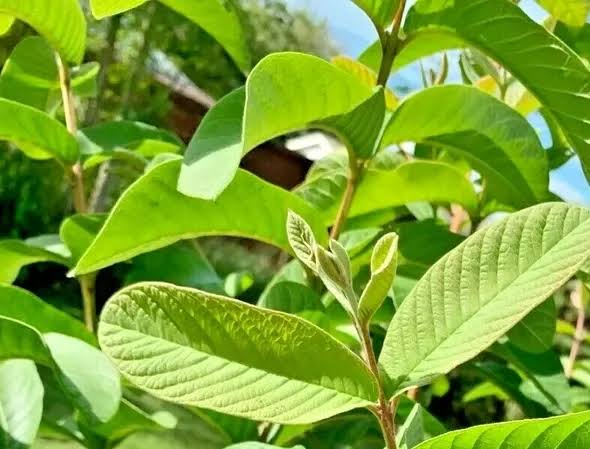
    Botanical Name : Psidium guajava Linn.

    Family : Myrtaceae

    Identification No.: SDACH/HG/102

    Names in different Indian languages :

    English : Common guva

    Hindi : Amrud, safed saphari

    Kannada : Balehanu, keli

    Malayalam : Pera, koyya

    Sanskrit : Perukah

    Tamil : Koya

    Telugu : Jampandu

    Synonyms :

    Amaruuda

    Uses :

    antidiarrhoeal, dysentery, diabetes, cough and cold,  anthelmintic, hepatitis

    Chemical :

    linoleic acid, vitamin C, flavonol morin, morin-3-O-lyxoside, morin-3-O-arabinoside, quercetin and quercetin-3-O-arabinoside

    HABITAT & DISTRIBUTION-

    Grown throughout India upto 1500 m and is cultivated commercially in almost all states including Uttar Pradesh, Bihar, Maharshtra, Assam, West Bengal, Andhra Pradesh and Tamil Nadu

    Morphology-

    Much branched small or medium sized tree upto 8 m high. Bark smooth, pale pinkish or buff with greyish patches. Leaves 10-15 cm long, simple, opposite, oblong or elliptic-oblong, pellucid-punctate, glabrous above, pubescent beneath.

    IUCN Status : Least Concern

    Research updates – 

    1. Folklore practices of Peruka (Psidium guajava Linn.) in different diseases

    2. Randomized controlled clinical study to evaluate the efficacy of peruka churna pratisarana in management of mukhapaka in children

    About Peruka

    Botanical Name

    Psidium guajava L.

    Family

    Myrtaceae

    Identification No.

    SDACH/HG/102

    Parts Used

    Fruit, Leaves, Bark, Roots

    Habitat

    India

    IUCN Status

    Least Concern

    Plant Photos

    Ayurvedic Properties

    Rasa

    Kashaya, Madhura, Amla

    Guna

    Tikshna, Guru

    Virya

    Sheeta

    Vipãka

    Madhura

    Contact Now

    Have queries? Contact Us.

    Have queries? We’re here to help you every step of the way.

    Contact us to get the right guidance for your academic journey at Shri Dhanwantry Ayurvedic College.
  • Kashtadaru

    Kashtadaru

    Botanical Name : Polyalthia longifolia Thw.

    Family : Annonaceae

    Identification No.: SDACH/HG/101

    Introduction :

    This ornamental tree mainly used as adulterant for asoka and devadaru. Actually there is no confusion which plant is asoka, but pharmacy industry considered as ulkalam as one of the synonyms of asoka, and Polyalthia longifolia considered as ulkalam. Then they made use of this plant as asoka. Better to avoid usage of this plant because it causes the cardiac depression.

    Sanskrit Synonyms-

    काष्टदारुः लघुरुक्षस्तिक्तः सकटुको अहिमः । दीपनः कृमिहृत् मेहे ज्वरे कुष्ठे च शस्यते ॥

    Names in different Indian languages :

    English : Mast tree, Fake Asoka tree, False Devadaru, Cemetry tree

    Hindi : Debdari, asoka

    Kannada : Assoti

    Malayalam : Aranamaram

    Tamil : Asogu, nettilingam

    Telugu : Asokamu

    Varieties & adulterants – (CV – controversy, AD – adulterants) :

    Ulkatah  -CV

    Kastadaruh -CV

    used for adulterant as asoka

    Morphology :

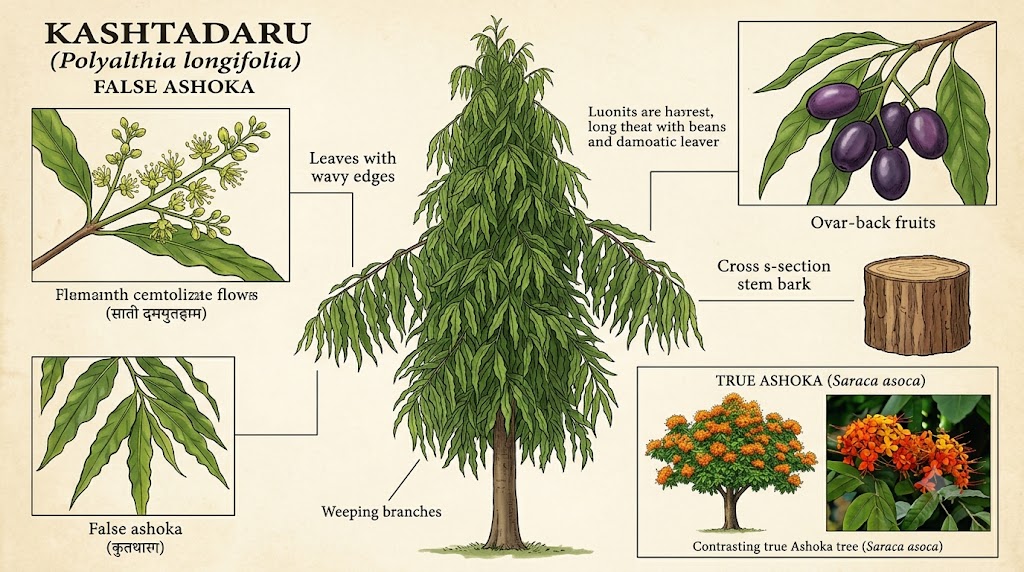
    Evergreen ornamental tree, grows 6-10 m height

    Leaves –simple, alternate, undulate margins

    Flower – yellowish

    Fruit- berry

    Distribution & Habitat :

    All over India

    Chemical constituents :

    Clerodane diterpenes, polyalthialdoic acid and kolavenic acid, cytotoxic aporphine alkaloid, liriodenine,

    Karma :

    Febrifuge, cardiac depressing

    Indication :

    Fever, skin disease

    Part used :

    Bark 

    Dosage :

    Powder 2-4 g Decoction 50-100 ml

    IUCN Status: Not Evaluated

    Research Update:

    Uzama D, Ahmadu R, Bwai DM, Thomas SA. Phytochemical Screening and Antibacterial Activity Of Polyalthia Longifolia Crude Extracts.


    About Kashtadaru

    Botanical Name

    Polyalthia longifolia Thw.

    Family

    Annonaceae

    Identification No.

    SDACH/HG/001

    Parts Used

    Bark

    Habitat

    India

    IUCN Status

    Not Evaluated (NE)

    Plant Photos

    Ayurvedic Properties

    Rasa

    Katu, Tikta

    Guna

    Laghu, Ruksha

    Virya

    Ushna

    Vipãka

    Katu

    Contact Now

    Have queries? Contact Us.

    Have queries? We’re here to help you every step of the way.

    Contact us to get the right guidance for your academic journey at Shri Dhanwantry Ayurvedic College.
  • Putranjiva

    Putranjiva

    Botanical Name : Putranjiva roxburghii Wall

    Family : Euphoriaceae

    Identification No.: SDACH/HG/100

    Introduction :

    Latin name : Putranjiva = name of the plant, roxburghii= from Roxburgh – scientist’s name.

    Rosaries of hard stones are used for protecting children from infections. Due to this misleading nomenclature, the “conception-promoting” property has been attributed to the drug in folk medicine.

    Names in different Indian languages :

    English : Child-life tree, Indian Amulet Plant, Spurious Wild Olive

    Hindi : Jivputrak, jiyapota

    Kannada : Aman, putranjiva

    Malayalam : Putranjivi, puttilanji, ponkalam

    Sanskrit : Putranjivah

    Tamil : Karuvilai, kattuppacceri maram

    Telugu : Putranjivika, kuduru

    Folk : Jiyaapotaa

    Synonyms :

    “पुत्रजीवः पुत्रदो जीवको वंशलोचनः। 

    सुतजीवी च पुत्र्यश्च पुत्रदा च प्रकीर्तिता॥” 

    Putranjiva, Putrajivaka, Putrajiva, Yashtipushpa, Arthsaadhana

    Drypetes roxburghii  (Wall.) Hurusawa.

    Morphology :

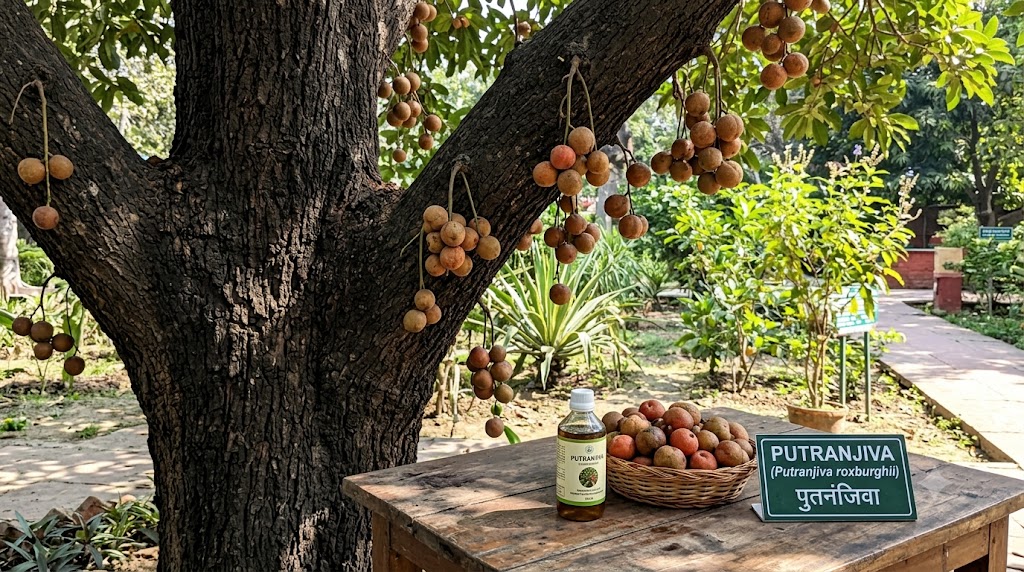
    A medium sized tree, grows 8-12 m height

    Leaves – simple, alternate, elliptic –oblong

    Flowers- unisexual, axillary

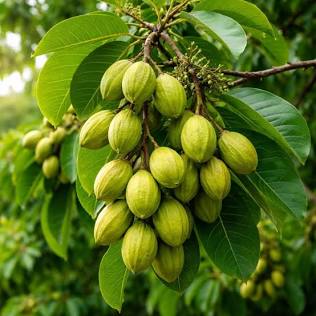
    Fruit – drupe

    Distribution & Habitat :

    Throughout India

    Chemical constituents :

    Isopropyl, 3-butyl isothiocyanates, glucoputranjivin, glucocochlearin, glucojiaputin

    Properties :

    Guna : guru, ruksha;

    Rasa : madhur, lavanna, katu;

    Vipaka katu;

    Virya : sheeta;

    Karma :

    Cakusya, vrishya, vistambi , garbadah, varnaya

    Laxative

    Indication :

    Dah, trishna, slipada, vrana

    Skin diseases, cough, cold

    Part used :

    Whole plant

    Dosage :

    Leaf juice 10-15 ml

    Powder 2-4 g

    Decoction 50-100 ml

    Therapeutic Uses (Amayika Prayoga): 

    External: 

    – Seed oil massage for muscle pain 

    – Leaf paste for skin conditions 

    Internal: 

    – Seed powder (1-3g) for fertility issues 

    – Decoction for respiratory conditions 

    Formulations (Yoga): 

    – Putrajivak Leha 

    – Putrajivak Ghrita 

    IUCN Status: Least Concern 

    Research Updates (Last 5 Years): 

    1. 2020: Fertility-enhancing properties studied 

    2. 2021: Anti-inflammatory activity confirmed 

    3. 2023: Seed oil analyzed for phytoconstituents

    About Putranjiva

    Botanical Name

    Putranjiva roxburghii Wall.

    Family

    Putranjivaceae

    Identification No.

    SDACH/HG/100

    Parts Used

    Whole plant

    Habitat

    India

    IUCN Status

    Least Concern

    Plant Photos

    Ayurvedic Properties

    Rasa

    Madhura, Lavana, Katu

    Guna

    Guru, Ruksha

    Virya

    Sheeta

    Vipãka

    Katu

    Contact Now

    Have queries? Contact Us.

    Have queries? We’re here to help you every step of the way.

    Contact us to get the right guidance for your academic journey at Shri Dhanwantry Ayurvedic College.
  • Putranjiva

    Haritaki

    Botanical Name : Terminalia chebula Retz.

    Family : Combretaceae.

    Identification No.: SDACH/HG/099

    Introduction :

    It used for the management of dysurea and constipation, respiratory problems, certain skin disorders, eye diseases etc. The purgative principle is in the pericarp of the fruit.

    Names in different Indian languages :

    English : Chebulic Myrobalan, Black Myrobalan

    Hindi : Harad, hara

    Kannada : Harra, alaekayi

    Malayalam : katukka

    Sanskrit : Haritaki, pathya, abhaya

    Tamil : katukkay

    Telugu : Karakkaya, karitaki

    Unani : Harad, Halelaa siyaah, Halelaa zard, Halelaa Kaabuli

    Synonyms :

    हरीतकी हरीतिका हेमवती अभया पथा। 

    कायस्था पूतना अमृता विजया जीवन्तिका॥ 

    Kaayasthaa, Pathyaa, Shreyasi, Shivaa,Jivanti, Puutanaa,Vijayaa, Abhayaa, Rohini, Chetaki, Amritaa, , Jayã, Haimavati

    Classification according to Charaka, Susrutha & Vagbhata :

    Charaka

    Jvaraghna, Arsoghna, Kãsaghna, Kusthaghna, Prajãsthãpana

    Susrutha

    Amalakyadi, Parusakädi, Triphalã

    Vagbhata

    Parusakãdi, triphala

    Varieties & adulterants – (CV – controversy, AD – adulterants) :

    1. Vijayã –  sarva roga (all diseases)

    2. Rohini – Vrana (wound healing)

    3. Pütanã – Pralepa (external application)

    4. Amrtã – purification procedures

    5. Abhayã – Netra rogas (eye  diseases)

    6. Jivanti – Sarva roga (all diseases)

    7. Cetaki. – Sarva roga (all diseases)

    8. Niranjana

    9. Vanaja

    10. Parvatiya

    11. T. pallida –  South India (adulterant )

    12. T. citrina – Assam(adulterant )

    13. Baja haritaki

    14. Chambhari haritaki

    15. Survari haritaki

    Morphology :

    It is a large tree, with rust-coloured or silvery hairs over the younger branchlets etc.

    Leaves- simple, mostly sub opposite, distant, ovate or oblong-ovate, 10-20 cm. long, deciduous in the cold season.

    Flowers- dull-white or yellowish, with a strong offensive smell, in spikes from the upper axils and in small terminal panicles.

    Fruits-obovoid or ellipsoidal from a broad base, glabrous, more or less 5-ribbed when dry.

    (Flowers in April-May and fruits in November-January)

    Distribution & Habitat :

    Abundant in Northern India, also occurs in Bihar, West Bengal, Assam, Central India and South India.

    Chemical constituents :

    Shikimic, gallic, triacontanoic , palmitic acids, beta-sitosterol, daucosterol, chebulic acid , gallic acid, ellagitannin, terchebulin, punicalagin , teaflavin

    Properties :

    Rasa –Pañca rasa (except Lavana), Kasaya mainly

    Guna -Laghu, Rüksa

    Virya- Usna

    Vipãka -Madhura

    Majja – Madura rasa, snayu – amla rasa, patra – tikta rasa, twak – katu rasa, asthi – kasaya rasa

    Karma : Tridosahara, Anulömana, Rasãyana, Prajãsthapãna, Caksusya, Hrdyã, Lekhana

    Purgative, thermogenic, anti inflammatory, digestive, carminative, diuretic, anodyne.

    Indication :

    Prameha Kustha Vrana Chardi Vãtarakta Mütra Kricchra, Netra roga, Krimi, Hrdroga, Asmari, Klaibya, Kãsasvãsa etc

    flatulence, constipation, fever, cephalgia, diarrhoea, dysentery, cyst, digestive disorders, cardiac disorder, vomiting, leprosy , enlarged liver and spleen, cough and bronchial asthma

    Due to its ruksha properties, it should not be used in patient who am low, malnourished, debilitated, who have lost considerable amount of blood (through blood letting), and pregnant women.

    Vijaya – in all diseases: rohini – used in healing of wounds: abhaya – in diseases of the eyes: jeevanti – useful in all diseases.

    The fruit of haritaki contains five rasas

    1) Madhur (sweet) – the fruit pulp.

    2) Amla (sour) – the bulky portion of the fruit.

    3) Tikta bitter) – seed.

    4) Katu – the coveting of the fruit.

    5) Kashaya (astringent) – the hard portion of the seed.

    Thus haritaki is pancharasatmak. Haritaki is a medicinal herb yet the Ayurvedic texts emphasize the use of haritaki as a medicine which has to be taken regularly. Regularizing the normal functions of the body is also an important function of haritaki. Survari haritaki. chamhhari (or rangari) haritaki and bala haritaki are the types of haritaki used in practice.

    Part used : Fruit

    Dosage :

    Leaf juice 10-15 ml

    Powder 2-4 g

    Decoction 50-100 ml

    Internal uses :

    Nervous System : Useful in weakness of the nerves and brain as well as in vata disorders and diminished vision.

    Digestive System : Useful in loss of appetite, pain in the abdomen, constipation, gulma, ascites, haemorrhoids, hepatomegaly, splenomegaly and parasites. It relieves constipation in chronic abdominal diseases and also helps in digestion of “ama”. The bark of haritaki, if eaten after chewing it property in the mouth, improves digestion. Powdered haritaki reduces constipation. A fine powder of haritaki is used as a tooth powder. It strengthens the gums.

    Circulatory system : Since haritaki is raktagami (exhibiting much action on rakta dhatu). it is used in weakness of the heart, vatarakta and other disorders of the blood.

    Respiratory System : Rhinitis (due to constipation), cough, hoaziness  of voice, hiccups and dyspnoea are relieved by haritaki as it reduces congestion:

    Reproductive System : Useful in shukrameha, leucorrhoea and acts as a uterine tonic.

    Urinary System : Useful in dysuria, retention of urine, calculus (Haritakyasthi siddha dugdha) and kaphaj prameha.

    Skin : Useful in erysipelas and other skin disorders, haritaki prevents accumulation of pus in skin diseases and acts as a rasayana. Haritaki  oil is extremely helpful in healing of wounds (especially in burns).

    Temperature : Useful in typhoid fever and also chronic fever.

    Restorative effect : Haritaki acts as a rejuvenator (by clearing the body of various malas). But for producing its rasayan effects, it needs various supportive drayas in different seasons, Varsha (monsoon) . saindhav, sharad – sugar, hemeint (winter) . sunthi, shishir – pippali, vasant (spring) – honey and greeshma (summer) Purgative induced by haritaki is relieved on its own. Baja haritaki is useful in haemorihoids. It helps in clearing the bowels.

    Important Yogas or Formations :

    Abhayädi modak, Abahayarishta, Pathyadivatl, Pathyadikadha, Waghrihalitald leha, Agastiharitaki leha, Gandharvaharitaki churna, Abhayarista, Kamsa Haritaki, Pathyádi kvãtha, Triphalã ctrna, Triphala ghiita, Citraka Haritakã, Vaivanara cürna, Harikakileha, Agastya Haritaki.           

    Amayika PrayogaTherapeutic Uses :

    (1) Ajirna- Haritaki is taken with Nimba (V.S.)

    (2) Prameha- Haritaki powder should be given with honey (A.S.Ci.14).

    (3) Amlapitta- Haritaki and Drãksã are taken together (V.M.)

    (4) Upadamsa- Application of paste of Haritaki and Rasãñjana (R.M.)

    IUCN Status: Least Concern 

    Research Updates (Last 5 Years): 

    1. 2021: Neuroprotective effects studied 

    2. 2022: Anti-cancer potential of chebulinic acid 

    3. 2023: Clinical trials for digestive disorders 

    About Haritaki

    Botanical Name

    Terminalia chebula Retz.

    Family

    Combretaceae

    Identification No.

    SDACH/HG/099

    Parts Used

    Fruit, Bark, Leaves

    Habitat

    India, Nepal, Bangladesh, Sri Lanka, Myanmar, Thailand, Vietnam, Laos, Cambodia, China

    IUCN Status

    Least Concern

    Plant Photos

    Ayurvedic Properties

    Rasa

    Pancha Rasa (except Lavana), Kashaya Pradhana

    Guna

    Laghu, Ruksha

    Virya

    Ushna

    Vipãka

    Madhura

    Contact Now

    Have queries? Contact Us.

    Have queries? We’re here to help you every step of the way.

    Contact us to get the right guidance for your academic journey at Shri Dhanwantry Ayurvedic College.

  • Madhuka

    Madhuka

    Botanical Name : Madhuca indica J. F. Gmel.

    Family : Sapotaceae

    Identification No.: SDACH/HG/098

    Introduction :

    Latin name : Mudhuka = from the Sanskrit name – madhuk; indira = Indian or Bassia = after Fernando Bassi, Curator of the Botanical garden of Bologna, Italy; latifolia = broad leaves.

    Names in different Indian languages :

    English : Indian butter tree, Mahwa tree.

    Hindi : Mahva, mohva

    Kannada : Erappe

    Malayalam : Ilippa, irippa

    Sanskrit : Madhukah

    Tamil : Ieluppai.

    Telugu : Ippa

    Unani : Mahuaa

    Synonyms :

    “मधुको गुडपुष्पश्च मधुपुष्पो मधूलकः। 

    मधुस्रावी तथा मोदप्रदो माकन्द इत्यपि॥” 

    Teekshnasar, Vanaprastha, Madhusrav, Dholaphala, Swadupushpa. Madhushthil, Madhuuka, Madhupushpa, Gudapushpa

    Madhuca longifolia (Koen.) Macb. var. latifolia (Roxb.) Cheval.

    Bassia latifolia Roxb.

    Varieties & adulterants – (CV – controversy, AD – adulterants) :

    One of the varieties called jalamadhuk grows in marshy land. The sweet portion of the flowers gets quickly converted to alcohol. The flowers are used to make liquor

    Morphology :

    It is an evergreen tree growing to a height of 10-16 mtrs. Bark – blackish or greyish in colour, torn, but the wood is brownish.

    Leaves – 8 to 15 cm. in length, simple, oblong-oval, with 10 to 12 veins, ends in bunches

    Flowers – white, juicy and contain a sugar-like substance.

    Fruits – berry , oblong, 1/2 inch long, initially green and then turning to yellow.

    Fruit contains 1-4 red coloured seeds. The tree flowers in summer and fruits in rainy season.

    Distribution & Habitat :

    Western Ghats

    Chemical constituents :

    alpha- and beta-amyrin acetate, n-hexacosanol, beta-D-glucoside ,  beta-sitosterol , free sitosterol.

    Properties :

    Rasa: madhur, kashaya;

    Guna: guru, snigdha;

    Virya: sheeta(dry flowers are ushna);

    Vipaka – Madhur

    Karma : krimisodanam, vrisyam, balym, rasayana stimulant, demulcent, laxative, anthelmintic, bechic, emetic

    Indication : krimi, trishna, jwara, vrana pneumonia, skin diseases, piles, tonsilitis, gum troubles, diabetes, ulcers, gout

    Part used :

    Bark, flower, fruit, seed

    Dosage :

    2-4 g bark powder

    Uses :

    Massage done with the oil prepared from madhuk is analgesic. flower juice is rubbed on the skin in dermatoses and is used as nasal drops in pittaj headache, flower pulp is given along with milk in nerve disorders as a nervine tonic. Decoction of the flowers or it is used in oedema, diarrhea, dysentery and thirst and it is a carminative and astringent. Juice of fresh flowers is used in bleeding disorders. It is used in bronchitis and asthma as an expectorant and in hiccups. Flowers are aphrodisiac and galactogouge and hence used in seminal debility and reduced breast milk secretion. The pulp of the seeds is used to prepare vaginal suppository for inducing menstrual bleeding. Madhuk is also useful in dysuria. Fever and burning .

    Important Yogas or Formations :

    madhukasava       

    Therapeutic Uses (Amayika Prayoga): 

    External: 

    – Flower paste for skin inflammation 

    – Seed oil for massage in arthritis 

    Internal: 

    – Flower decoction (50-100 ml) as general tonic 

    – Bark powder (1-3 g) for diabetes 

    IUCN Status: Least Concern 

    Research Updates (Last 5 Years): 

    1.2020 Hypoglycemic effects confirmed 

    2. 2022: Wound healing activity of bark extracts 

    3. 2023: Flower antioxidants studied for anti-aging

    About Madhuka

    Botanical Name

    Madhuca indica J. F. Gmel.

    Family

    Sapotaceae

    Identification No.

    SDACH/HG/098

    Parts Used

    Bark, Flowers, Fruits, Seeds

    Habitat

    India

    IUCN Status

    Least Concern

    Plant Photos

    Ayurvedic Properties

    Rasa

    Madhura, Kashaya

    Guna

    Guru, Snigdha

    Virya

    Madhura

    Vipãka

    Madhura

    Contact Now

    Have queries? Contact Us.

    Have queries? We’re here to help you every step of the way.

    Contact us to get the right guidance for your academic journey at Shri Dhanwantry Ayurvedic College.
  • Koshamra

    Koshamra

    Botanical Name : Schleichera oleosa (Lour.) Oken.

    Family : Sapindaceae.

    Identification No.: SDACH/HG/097

    Introduction :

    Its seed oil very much useful in skin disease. This tree is an important host of Kusmi lac.

    Names in different Indian languages :

    English : Lac tree, Macassar Oil tree, Honey tree, Ceylon Oak

    Hindi : Kusum

    Kannada : Sagade, kendala, jendalacekota

    Malayalam : Puvam

    Sanskrit : Lakshaa vrksha, mukulakah, raktamrah

    Tamil : Puvathipuvam, Pulaachi, pumarata

    Telugu : Posuku, busi, kodalipulusu, botanga, madakapulusu, sagadipusuku

    Synonyms :

    “कोशाम्रः कुसुमः प्रोक्तः पिच्छिलः क्षीरसन्निभः। 

    फलास्थिः कठिनो यस्य स तु कोशाम्र उच्यते॥ 

    Koshaamra, Kshudraamra, Lakshaa vrksha, Ghanaskandha

    Schleichera trijuga Willd & Klein.

    Morphology :

    A medium sized tree grows 10-15 m heigh,

    Leaves –compound, paripinnate, alternate, leaflets –large, elliptic,

    Flower – small, yellowish, racemes

    Fruit – berry

    Distribution & Habitat :

    All over India, in forests

    Chemical constituents :

    Oleic, gadoleic, stearic, arachidic, behenic, palmitoleic andpalmitic acids. , gallo-tannic acid

    Properties :

    RASA-kashaya, tikta

    GUNA-guru

    VIRYA- amla-ushna

    VIPAKA-katu

    Karma : ruchyam, deepana, pachana, grahi astringent

    Indication :

    Krimi, kusta, keshyam (phala majja) , sopha,, rakta pitta

    Hair fall, rheumatism , alopecia, malaria, boils, nostalgia, pruritius, itch and acne

    Part Used :

    Bark, leaves, seed, oil

    Dosage :

    Leaf juice 10-15 ml

    Powder 2-4 g

    Decoction 50-100 ml

    Therapeutic Uses (Amayika Prayoga): 

    External: 

    – Seed oil for skin diseases and hair growth 

    – Bark paste for wounds and ulcers 

    Internal: 

    – Bark decoction (50-100 ml) for diarrhea 

    – Seed powder (1-3 g) for parasitic infections 

    Formulations (Yoga): 

    – Koshamra Taila (for skin diseases) 

    – Kusumadi Churna (digestive disorders) 

    IUCN Status: Least Concern 

    Research Updates (Last 5 Years): 

    1. 2021: Wound healing activity confirmed in bark extracts 

    2. 2022: Antimicrobial properties against skin pathogens 

    3. 2023: Seed oil studied for hair growth promotion

    About Koshamra

    Botanical Name

    Schleichera oleosa (Lour.) Oken.

    Family

    Sapindaceae

    Identification No.

    SDACH/HG/097

    Parts Used

    Bark, Leaves, Seeds, Seed Oil

    Habitat

    India

    IUCN Status

    Least Concern

    Plant Photos

    Ayurvedic Properties

    Rasa

    Kashaya, Tikta

    Guna

    Guru

    Virya

    Amla-Ushna

    Vipãka

    Katu

    Contact Now

    Have queries? Contact Us.

    Have queries? We’re here to help you every step of the way.

    Contact us to get the right guidance for your academic journey at Shri Dhanwantry Ayurvedic College.

  • Muchukunda

    Mundane

    Botanical Name : Pterospermum canescens Roxb.

    Family : Sterculiaceae

    Identification No.: SDACH/HG/096 

    Introduction :

    Latin name: Pterospermum = Pteron = wing. spermum= seed : suberifolium = cock like leaves

    Names in different Indian languages :

    Hindi : Muchukunda

    Kannada : Toddagiringa

    Malayalam : Chittilaplavu, Muchukundam

    Sanskrit : Muchukunda

    Tamil : Sempulavu

    Telugu : Lolagu

    Synonyms :

    मुचुकुन्दः कनकाह्वयः पुष्पदन्तोऽथ कर्णिकः। 

    तथा चाम्रपर्णी प्रोक्ता वातघ्नी मधुरा स्मृता॥” 

    Kshatravruksha, Chitrak. Prativishnuk. Bahupatra, Supushpa. Adhyarhi. Lakshmanav. Raktaprasav,vasu

    Pterospermum uberifolium Lam. non-Roxb.

    Morphology :

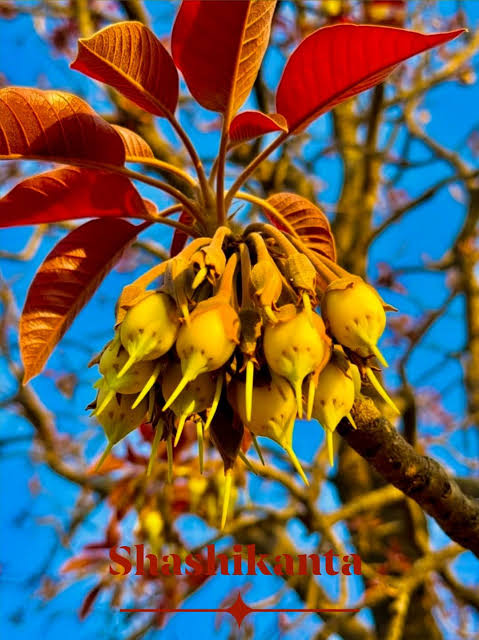
    A tree with scented, brown flowers.

    Leaves – large, shield-like, (thus called kshatravruksha) upper surface green. lower is white. Shows vertical cracks on the bark. Trunk is brownish in colour. Branches – closely packed. Seeds are winged. Flowering occurs in summer.

    Distribution & Habitat :

    Throughout India

    Chemical constituents :

    arachidic, linoleic, myristic, oleic, palmitic and stearic acids, beta-sitosterol,

    Properties :

    Guna: ruksha

    Rasa: kashaya, katu, tikta

    Vipaka: katu

    Virya: ushna

    Karma :

    Rakta prasadana, sopha hara carminative, digestive,astingent,

    Indication :

    Kasa, swasa, sira peeda, raktapitta

    migraine

    Part used :

    Whole plant, mainly flowers

    Dosage :

    Leaf juice 10-15 ml

    Powder 2-4 g

    Decoction 50-100 ml

    Amayika Prayoga

    External uses :

    Its local application is soothing and alleviates burning sensation in headache, bleeding piles and chicken pox.

    Internal uses :

    Analgesic in vata diseases. Muchkunda is useful as an astringent in brood and bile related disorders. It controls bleeding in piles when given as a powder of flowers along with honey and sugar. It is also useful in bronchitis, asthma and skin diseases.

    Formulations (Yoga): 

    – Muchukundadi Kwatha (for wounds) 

    – Kanakahwya Lepa (skin conditions) 

    IUCN Status: Least Concern 

    Research Updates (Last 5 Years): 

    1. 2020: Wound healing activity confirmed in animal studies 

    2. 2022: Anti-inflammatory flavonoids isolated 

    3. 2023: Traditional use in eye diseases validated

    About Muchukunda

    Botanical Name

    Pterospermum canescens Roxb.

    Family

    Sterculiaceae

    Identification No.

    SDACH/HG/096

    Parts Used

    Whole plant, mainly flowers

    Habitat

    India

    IUCN Status

    Least Concern

    Plant Photos

    Ayurvedic Properties

    Rasa

    Kashaya, Katu, Tikta

    Guna

    Ruksha

    Virya

    Ushna

    Vipãka

    Katu

    Contact Now

    Have queries? Contact Us.

    Have queries? We’re here to help you every step of the way.

    Contact us to get the right guidance for your academic journey at Shri Dhanwantry Ayurvedic College.

  • Bakuchi

    Bakuchi

    Botanical Name : Psoralea corylifolia Linn.

    Family : Papilionaceae; Fabaceae

    Identification No.: SDACH/HG/095

    Introduction :

    It show two important properties Visaghna and kushtaghna.

    Names in different Indian languages :

    Hindi : Bavachi, baci

    Telugu : Bãvanchalu, bogivittulu

    Tamil : Karpokarisi, karpogam, Karpoogaarisi

    English : Psoralea seed

    Kanada : somaraji

    Malayalam : Karkokil, karkokilari

    Bengali : Habuch

    Sanskrit : Bakuci

    Unani : Baabchi, Bakuchi

    Synonyms :

    बाकुची सोमराजी च अवल्गुजा कुष्ठनाशिनी। 

    पूतिफली कृष्फल च बभ्रुः शिम्बफला तथा॥ 

    Somaraaji, Somavalli, Somavallik, Soma, Chaandri, Vaakuchi, Baakuchi, Avalguja

    Classification according to Charaka, Susrutha & Vagbhata :

    Charaka

    Tikta skandha

    Susrutha

    Vagbhata

    Varieties & adulterants – (CV – controversy, AD – adulterants) :

    1. Sveta & Krisna varieties

    2. Somaraji

    Morphology :

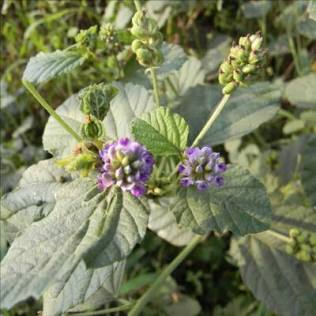
    It is an erect annual herb, 1-1.5 m. in height.

    Leaves- simple,broadly elliptic, inciso-dentate, clothed with white hairs on both surface, main nerves 5.

    Flowers- in axillary long peduncled heads, bluish-purple or yellow.

    Fruits- pod, indehiscent, ovate, mucronate, dark chocolate to almost black, 3.5-4.5 mm x 2.0-3.0 mm.

    Seeds- oblong, smooth, adhering to the pericarp.

    (Flowers and fruits during April-June).

    Distribution & Habitat :

    Found all over India on roadsides and in waste places.

    Chemical constituents :

    chalcones, flavones, isoflavones, furanocoumarins , coumesterol, psoralen, isopsoralen, bavachinin

    Seeds- Raffinose, psoralen, isopsoralen (angelicin), Corylifolean, Corylifolean, Corylifolin, Coryfolinin psoralidin, isopsoralidin, bakuchiol, bavachin, isobavachin, methylbavachin, bavachinin, isobavachalcone, neobavaisoflavone, bavachromene, corylidin, barachalacone, bakuchalcone.

    Fruits- Corylin, corylinal etc.

    Properties :

    Rasa- Katu, Tikta

    Guna- Laghu, Rüksa

    Virya- Usna

    Vipãka -Katu

    Karma : Kapha-vãtahara, Rasayana, Kesya, Tvacya, Kusthaghna, Balya, deepana, pachana, vishaghna

    Diuretic, laxative, dermatitis, ulcers, anthelmintic

    Indications :

    Kustha, Krimi, Pãndu, svitra

    leucoderma, vitiligo, leprosy, psoriasis, inflammatory diseases of the skin, scabies,            

    Part Used :

    Seeds

    Dosage :

    Powder 2-4 g

    Amayika Prayoga/Therapeutic Uses: 

    External uses :

    It is useful in skin diseases for wound healing and improves hair growth. Powdered bakuchi or oil prepared from it is used locally in leucoderma, dermatoses, wounds and alopecia. A mixture of bakuchi, karanja and lime juice is used in eczema. Oil of bakuchi and karanja + vaseline is used in chronic skin diseases, White spots of leucoderma turn red in colour after prolonged application of bakuchi.

    Internal uses :

    Nervous System : Since it is a nervine tonic, it is useful in vata disorders.

    Digestive System : By its katu and ushna properties it acts as deepana, pachana, anuloman, anthelmintic arid liver stimulant. Hence it is used in indigestion, ama and constipation. It is useful in all types of worms especially round worms, Being a liver stimulant it is useful in piles.

    Circulatory System : Since it stimulates the heart and the circulatory system, it is used in cardiac. failure and oedema produced by it.

    Respiratory System: Used in cough and asthma since it reduces kapha by its katu rasa and ushna veerya.

    Urinary System : Useful in diabetes.

    Reproductive System : Since it is a stimulant and an aphrodisiac, it is used in impotency.

    Skin : Diaptioretic and kusthaghna. Its oil has a’ specific irritant action on the skin and mucous membrane. On applying the oil on leucoderma, the skin becomes reddish and occasionally blisters may occur. But it does not create any alterations in the normal colour of the skin. The oil acts in leucoderma by activating the melanoblastic cells of the skin leucoderma, the oil must be so applied that it only produces a change a colour and not blisters.

    Temperature : Febrifuge, used in chronic fever.

    Satmikaran : It is a bitter tonic and hence used in anaemia and post-pyrexial debility.

    Purification : The seeds of bakuchi are purified by keeping them in cow’s urine or juice of ardrak for seven days.

    Special action : Bakuchi is the best medicine for leucoderma.

    So far as is known P. corylifolia is the only drug that has a dual action i. e. action on both Rouget’s cell and the melanoblastic cells of the skin. In leucoderma the melanoblastic cells are not functioning properly and their stimulation by the oil leads them to form and exuded pigment which gradually diffuses into decolorized areas The oil Bakuchi changes white skin, grey hair, rough, scaly, discolored skin. nails, hairs, etc. to normal color

    Important Yogas or Formulations :

    Bakuci Rasãyana, Somaraji Rasãyana,

    Avagujãdi lepam, Mahãnila tailam, Khadirarista.

    Therapeutic Uses :

    (1) Sadyovrana- Bãkuci leaf paste is applied over cut wound to arrest  bleeding (Vai. Ma.)

    (2) Bãdhirya- Powder of Musali and Bäkuci is given (V.S.)

    (3) svitra- Seed powder of Bãkuci (4 parts) and Haritala (1 part) are grinded with cows urine is given orally (V.M.).

    IUCN Status: Least Concern 

    Research Updates (Past 5 Years): 

    1. 2020: Clinical trial on Bakuchi oil for vitiligo repigmentation 

    2. 2021: Bakuchiol as natural alternative to retinol in cosmetics 

    3. 2023: Anti-microbial activity against skin pathogens 

    About Bakuchi

    Botanical Name

    Psoralea corylifolia L.

    Family

    Fabaceae (Papilionaceae)

    Identification No.

    SDACH/HG/095

    Parts Used

    Seeds

    Habitat

    India

    IUCN Status

    Least Concern

    Plant Photos

    Ayurvedic Properties

    Rasa

    Katu, Tikta

    Guna

    Laghu, Ruksha

    Virya

    Ushna

    Vipãka

    Madhura

    Contact Now

    Have queries? Contact Us.

    Have queries? We’re here to help you every step of the way.

    Contact us to get the right guidance for your academic journey at Shri Dhanwantry Ayurvedic College.