Shri Dhanwantry Ayurvedic College

Author: Khushal

  • Patha

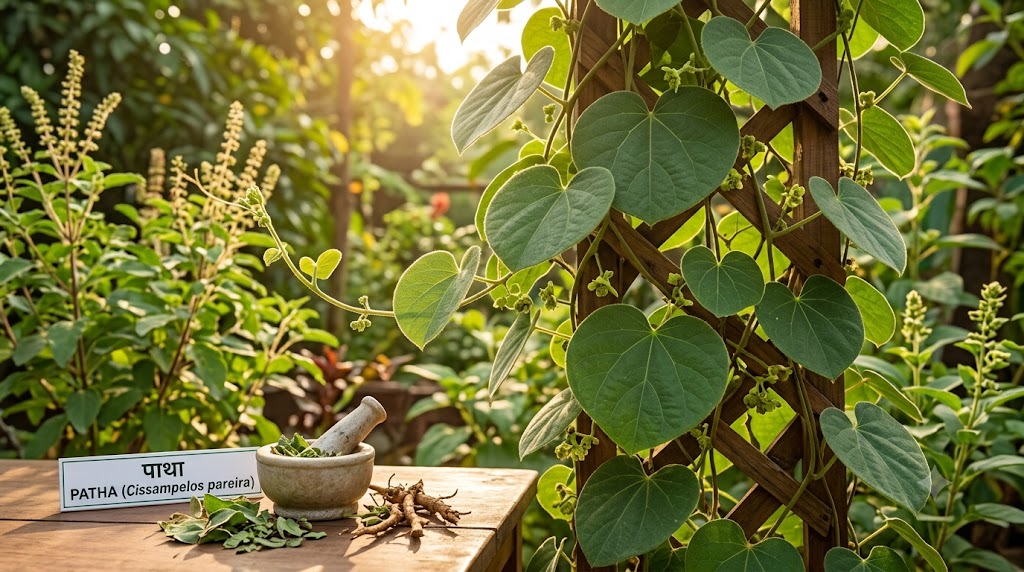
    Patha

    Botanical Name : Cissampelos pareira Linn

    Family : Menispermaceae

    Identification No.: SDACH/HG/083

    Introduction :

    In North india Cissampelos pareira used as patha, in south Cyclea peltata used as patha. It is one of the best brain tonic used in Ayurveda along with other drugs. In the Vedic literature Pãthã is described as ‘Pãtã’

    Names in different Indian languages :

    English : Velvet-Leaf Pareira, PareiraBrava.

    Malayalam : malathaghi

    Tamil : Paadakkizhangu, Appatta.

    Unani : Paathaa

    Synonyms :

    पाठा गजवाहिनी च चन्द्रिका चन्दनोपमा।

    अम्लपित्तहराः श्रेष्ठा दीपनी चोष्णवीर्यका॥

    Paathaa, Ambashthaa, Varatiktaaa, Vriki, Aviddhakarni,Piluphalaa, Shreyashi

    Classification according to Charaka, Susrutha & Vagbhata :

    Charaka

    Sandhãniya, Jvarahara, Stanyasödhana

    Susrutha

    Mustãdi, Aragvadhadi, Pippalyadi, Ambasthadi, Brahatyadi, Patolädi

    Vagbhata

    Mustadi, Aragvadhadi, Ambasthdi, Patolädi, Vatsakãdi

    Varieties & adulterants – (CV – controversy, AD – adulterants) :

    1. Cyclea peltata  – [AD]

    2. C. burmani – [AD]

    3. Stemphania hernandifolia – [AD]

    4. Rivea hypocrateriformins – [AD]

    5. R. ornata. – [AD]

    6. Raja patha – Cyclea peltata

    7.  laghu patha –  Cissampelos pariera

    8. Cyclea peltata – south India

    9. Stephania hernandifolia

    Morphology :

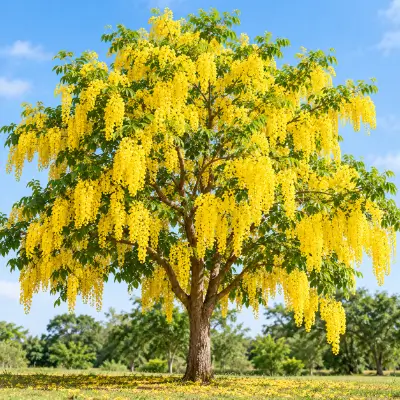
    It is a climbing shrub; branches pubescent.

    Leaves- peltate, 3.8-10 cm diameter.

    Flowers- minute, yellowish. Male flowers in axillary cymes, peduncle 18mm long. Sepals 4, hairy, obovate- oblong. Petals combined into a cyathiform corolla, half the length of the sepals. Filaments longer than Corolla. Female flowers in elongate, solitary or twin, axillary racemes; pedicles very short; bracts foliaceous or nearly sessile, orbicular or reniform. Sepal 1, ovate-oblong. Petal 1, sub rotund.

    Fruit drupe, subglobose, hairy, red, endocarp transversely ridged. Distribution- Found throughout tropical & subtropical India.

    C. peltata- It is a climber, Leaves- peltate, hairy,

    Flowers- very small. Male flowers in panicles, very long.

    Fruit- drupe. reniform.

    Note— The species of this plant are easily distinguished by the cup-shaped calyx and corolla. Cissampelos has the corolla alone cup-shaped.

    Distribution & Habitat :

    All over India

    Chemical constituents :

    Hayatine, methiodide and methochloride, cissamine, pareirine, cycleanine,bebeerine, hayatidin, (+) quercitol

    Properties :

    RASA-tikta

    GUNA-laghu, tikshna

    VIRYA-ushna

    VIPAKA-katu

    Karma : Vata-Kaphahara, Visaghna, Grãhi, Balya

    Amayika Prayoga / Therapeutic Uses

    External uses :

    Being wound healer. antidote and Kushthaghna, paste of leaves and root is used in purities, skin disorders and snake poison. Juice or powdered roots are used as a nasya.

    Internal uses :

    Digestive System : Being an appetizer, digestive, laxative, astringent and anthelmintic, it is useful in anorexia. indigestion, abdominal pain, diarrhoea and dysentery

    Circulatory System : It is a blood purifier and has anti-inflammatory properly, so it is used in blood disorders, heart disorders and inflammation.

    Respiratory System : Being an expectorant, is is used in cough and dyspnoea.

    Reproductive System : Since it purifies breast milk it is used in various disorders ot breast milk secretion.

    Urinary System : diuretic, hence useful in dysuria and haematuria.

    Skin : Kushthaghna, Useful in skin disorders.

    Temperature : Being febrifuge and refrigerant, it is used in jwara. fever related diarrhoea and burning disorders.

    Satmikaran : Antidote and tonic – bitter tonic.

    Indication :

    Atisãra, Chardi, süla, Jvara, Kustha, Kandü, Krmi, Hrdroa, Gulma, Yöni röga.

    Root astringent, antispasmodic (used for cramps, painful menstruation), analgesic, antipyretic, diuretic, antilithic and emmenagogue. Prescribed for diarrhoea, dysentery, piles, urogenital affections (cystitis, nephritis, menorrhagia)

    Part Used :

    root

    Dosage :

    1-2 gm

    Important Yogas or Formations :

    Pusyanuga curna,saddharana yoga, padathi kashaya                       

    Therapeutic Uses :

    (1) ArthaVabhedaka – Root juice of Pãtha shall be used as Nasya (G.N.)

    (2) Lavanameha— Decoction of Pãthã and Aguru is useful (S.S.Ci. 11)

    (3) Arsas— Pãthã is taken with butter-milk (A.H.Ci.8)

    (4) Root paste is applied topically on scabies and eruptions on the body.

    (5) Also used for preventing miscarriage.

    IUCN Status: Not Evaluated (NE)

    Research Updates (Past 5 Years)

    1. 2020 – Antidiarrheal activity of Cissampelos pareira root extract confirmed in animal models

    2. 2021 – Demonstrated immunomodulatory and anti-inflammatory potential

    3. 2022 – In vitro antimicrobial efficacy against intestinal pathogens
    About Patha

    Botanical Name

    Cissampelos pareira L.

    Family

    Menispermaceae

    Identification No.

    SDACH/HG/083

    Parts Used

    Root

    Habitat

    India, Nepal, Bangladesh, Pakistan, Sri Lanka

    IUCN Status

    Not Evaluated

    Plant Photos
    Ayurvedic Properties

    Rasa

    Tikta

    Guna

    Laghu, Tikshna

    Virya

    Ushna

    Vipãka

    Katu

    Contact Now

    Have queries? Contact Us.

    Have queries? We’re here to help you every step of the way.

    Contact us to get the right guidance for your academic journey at Shri Dhanwantry Ayurvedic College.

  • Udumbara

    Udumbara

    Botanical Name : Ficus racemosa Linn.

    Family : Moraceae

    Identification No.: SDACH/HG/082

    Introduction :

    Udumbara is one of the few extensively described plants in the vedic literature. Atharva veda quotes that Udumbara Mani dhãrana enhances the strength of human body.

    Scientific classification: Figs constitute the genus Ficus, of the family Moraceae. The common commercial fig is classified as Ficus carica, Ficus racemosa, the sycamore fig as ficus sycomorus, and the pipal, or sacred fig, as Ficus religiosa. The common rubber plant is classified as Ficus elastica, and the banyan tree, or Indian fig, as Ficus bengalensis. The two figs native to the subtropical United States are classified as Ficus aurea and Ficus citrifolia.

    Names in different Indian languages :

    English: Cluster Fig

    Hindi: Gular, umar

    Kannada: Atti

    Malayalam: Atti

    Sanskrit: Udumbarah, sadaphalah

    Tamil: Attiu

    Telugu: Udambarah, paidi

    Unani: Anjir-e-Aadam, Anjir-e-Ahmak, Gular

    Synonyms :

    Sadaaphala, Hema-daudhaka, Jantuphala, Yagyaanga.

    Ficus glomerata Roxb.

    Classification according to Charaka, Susrutha & Vagbhata :

    Charaka

    Mütrasangrahaniya, Kasãya skañdha

    Susrutha

    Nyagrodhadi gana

    Vagbhata

    Nyagrodhãdi

    Varieties & adulterants – (CV – controversy, AD – adulterants) :

    1. Udumbara (F. glomerata)

    2. Kãhodumbara/Kakodumbara (F. hispida)

    3. Nadyodumbara-F. carica   [CV]

    Ficus krishnae

    Ficus virens

    Morphology :

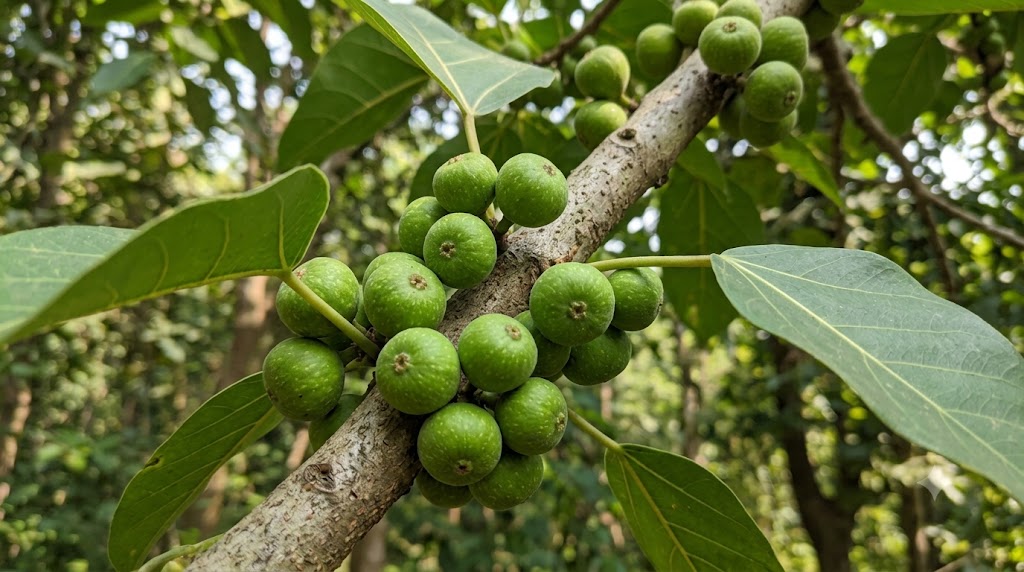
    A moderate to large deciduous tree, 10 – 12 m. high.

    Bark— smooth, reddish-grey.

    Leaves— 3-veined, elliptic, ovate or ovate-lanceolate.

    Fruits— borne in large clusters on short leaflet branches derived from the trunk and main branches, subglobose or pyriform, 2.5-5.5 cm diameter red when ripe.

    Habitat & Distribution :

    Almost throughout India.

    Chemical composition :

    Gluacol,beta-sitosterol, lupeol acetate, friedelin,  phytosterols

    Tree contains tannins,wax, rubber and ash which contains silica and phosphoric acid.

    Leaves & Fruits— gluacol

    Fruits— beta Sitosterol, lupeol acetate, friedelin, phytosterols etc.

    Bark—beta  sitosterol, ceryl behenate, lupeol, friedelin

    Properties :

    Rasa Kasäya

    Guna Guru, Rüksa

    Virya sita 

    Vipãka Katu

    Karma : Pitta-kaphahara, Vrana ropana-swedhana, varnya

    astringent, carminative, digestive, stomachic

    Indications— svitra, Vãtarakta, Vrana, Rakta vikãra, Murchã, Kandabhagna, Dãha, Yoniroga, Raktapitta, Atisära etc

    menorrhagia, leucorrhoea, urinary disorders, skin diseases, swellings, boils, haemorrhages, diarrhoea, dyspepsia, dysentery

    Parts used :

    Bark, fruit, latex and roots.

    Dosage :

    powder 5-10 g. decoction  50 -100 ml., latex 5-10 drops

    Amayika Prayoga / Therapeutic Uses

    External uses :

    Reduces oedema – its latex is used as liniment for swelling and pain. For wound healing its raw stem is used in the form of liniment. A thick decoction of bark is applied locally for stomatitis. Topical use reduces burning sensation. Extract of bark is used as mouthwash and gargling in pharingitis and stomatitis udumbarsar.

    Internal uses :

    Digestive system : Agnisadak and astringent. Ripe fruits are anthelmintic. Because of the astringent property, decoction of bark is given in dysentery and diarrhoea associated with bleeding per rectum and spruce raw fruits are given as cooked vegetables. The latex with sugar is used for infantile diarrhea and teething problems. In case of bhasmak roga. the powder or bark is given with human milk and water. Fruit juice is given for hiccups.

    Circulatory system : Udumbar is raktagarni, so bark and fruits are used in haemorrhagic disorders. Hall a leaf is given with betel leaves for treating jaundice.

    Reproductive system : Decoction of the bark is useful in menorrhagia and leucorrhoea. In Uttar basti a decoction is given. It is also used for fetal nutrition. Its latex along with sugar or sugar preparation known as batasa is recommended in sperm debility. Regular consumption of ripe fruits causes sterility.

    Urinary system : It is an antidiuretic. In prameha . the decoction of bark and ripe fruits is given. In diabetes, juice of fruits or roots is given.

    Temperature : Ripe fruits being refrigerant, are given for treating fever.

    Parts used : Bark, fruit, latex. It is believed that water is found near the udumbar tree which may mean that udumbar free grows near a water source. Ripe fruits are very good in healing, burning sensation and wounds. The burning sensation on the fingers of Narasimha when he tore open Hiranyakashyapu’s stomach was ameliorated by the fruits of udumbara.

    It is believed that water is found near the udumbar tree which may mean that udumbar tree grows near a water source. Ripe fruits are very good in healing, burning sensation and wounds. The burning sensation on the fingers of Narasimha when he tore open Hiranyakashyapu’s stomach was ameliorated by the fruits of udumbara.

    Important Yogas or Formations :

    udumbarãdi taila, Pañcavalkaja Kvãtha

    Therapeutic Uses :

    (1) Garbhapata— Udumbara fruit decoction is mixed with säli rice powder and sugar is administered with honey (R.M.).

    (2) Hikkä— Ash of Udumbara bark is mixed with honey and ghee and given (S.S.Ut. 50).

    (3) Prameha pitikã— Udumbaraksira is applied external, (G.N.).

    (4) Pumsavana— Vandãka growing on Udumbara tree is given with goats milk — (V. D.).

    IUCN Status: Least Concern (LC)

    Research Updates (Past 5 Years):

    1. 2021 – Anti-diabetic and nephroprotective effect of Ficus racemosa bark in streptozotocin-induced rats.

    -incision models.

    3. 2022 – Antibacterial and anti-inflammatory effects of fruit extract studied for urinary tract infections.


    About Udumbara

    Botanical Name

    Ficus racemosa Linn.

    Family

    Moraceae

    Identification No.

    SDACH/HG/082

    Parts Used

    Bark, Fruit, Latex, Roots

    Habitat

    India

    IUCN Status

    Least Concern

    Plant Photos

    Ayurvedic Properties

    Rasa

    Kashaya

    Guna

    Guru, Ruksha

    Virya

    Sita

    Vipãka

    Katu

    Contact Now

    Have queries? Contact Us.

    Have queries? We’re here to help you every step of the way.

    Contact us to get the right guidance for your academic journey at Shri Dhanwantry Ayurvedic College.

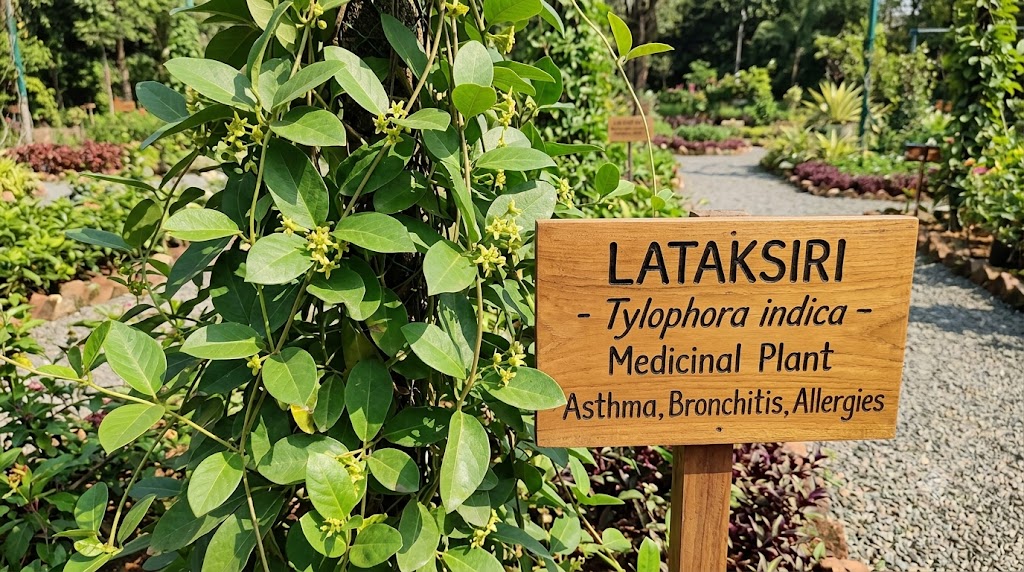
  • Lataksiri

    Lataksiri

    Botanical Name : Tylophora indica (Burm. f.) Merrill.

    Family : Asclepiadaceae

    Identification No.: SDACH/HG/081

    Introduction :

    In folk it is used for whooping cough and asthma.

    Names in different Indian languages :

    English : Emetic Swallow Wort, Indian Ipecacuanha, Country Ipecacuanha

    Hindi : Jamgli pikvam, antamul

    Kannada : Nipaladaberu, antamula

    Malayalam : Vallippala

    Sanskrit : Lataksiri

    Tamil : Nay Palai, Nangilaippiratti, nancharuppan

    Telugu : Vettipala, verripala, tellayadala, kakapala

    Synonyms :

     लताक्षीरी क्षीरीदुग्धा स्तन्यदा बलदा स्मृता।

    श्वेतगन्धा गुरु स्निग्धा मधुरा शीतला शुभा॥

    Antamuula, Muulini, Arkaparni.

    Tylophora asthamatica Wight & Arn.

    Morphology :

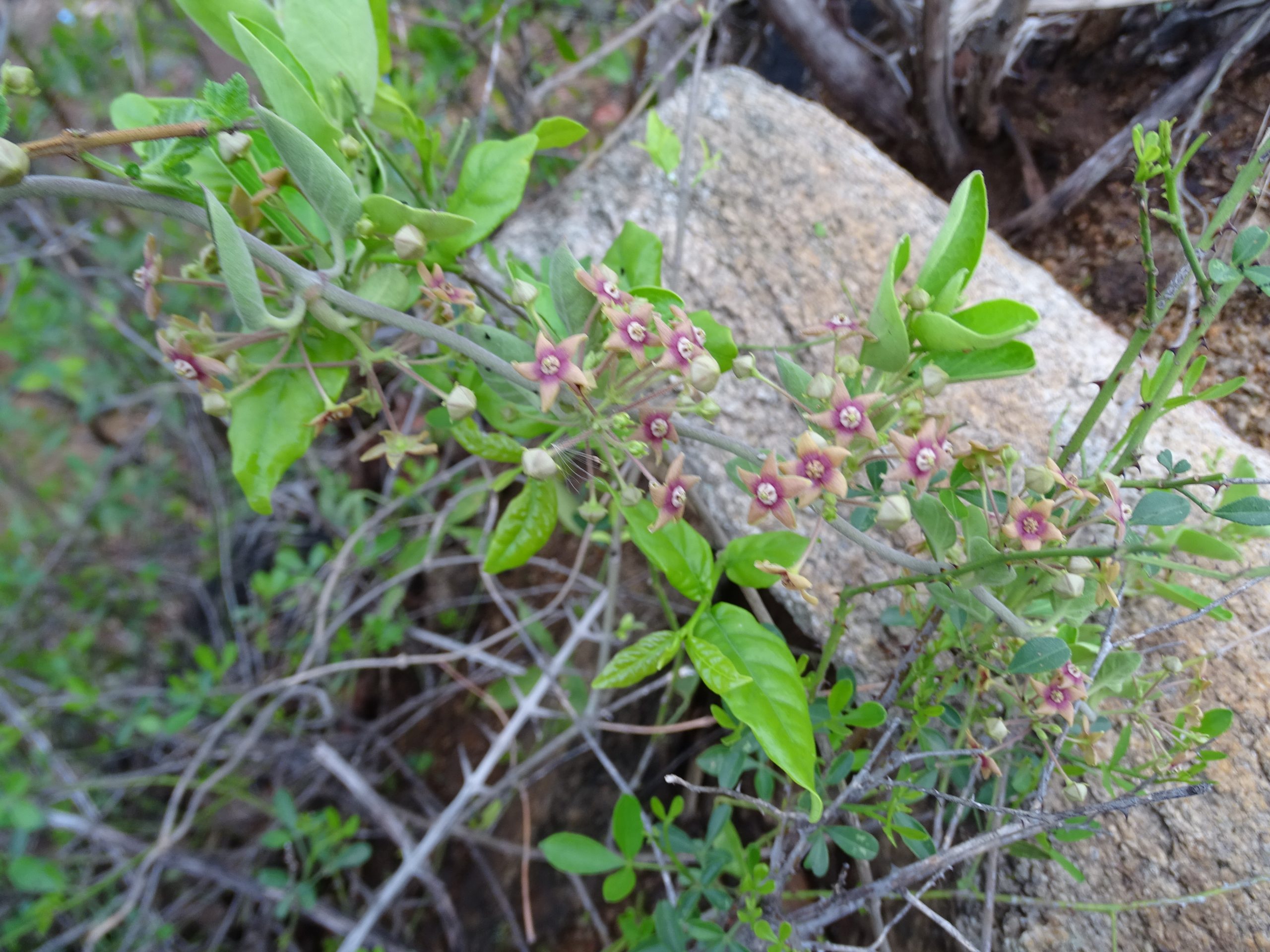
    It is a lactiferous slender, climber

    Leaves – simple, opposite, oblong-ovate

    Flower- yellowish, umbel

    Fruits – fusiform

    Distribution & Habitat :

    All over India

    Chemical constituents :

    tylophorine, tylphorinine, desmethyl tylophorine,desmethyl tylophorinine, kaempferol. tylophorinidine and gamma-fagarine.

    Karma :

    Anti cancerous, emetic, aromatic, purgative, expectorant

    Chemical named Desmethyltylophorine gave good results in leukemia.

    Indication : Asthma, gout, ulcer, piles, whooping cough

    Part used : Whole plant

    Dosage :

    Leaf juice 10-15 ml

    Powder 2-4 g

    Decoction 50-100 ml

    Therapeutic Uses :

    Decoction useful in whooping cough.

    IUCN Status: Least Concern (LC)

    Research updates:

    1. Singh et al. (2022). Tylophora asthmatica leaf extract shows significant anti-asthmatic activity via mast cell stabilization. Journal of Ethnopharmacology.

    2. Roy et al. (2021). Evaluation of immunomodulatory effects of Tylophora indica in experimental models. Phytomedicine.

    3. Kumar et al. (2020). Comparative phytochemical profiling of Tylophora species using HPTLC and LC-MS. Indian Journal of Natural Products.

    About Lataksiri

    Botanical Name

    Tylophora indica (Burm. f.) Merrill.

    Family

    Asclepiadaceae

    Identification No.

    SDACH/HG/081

    Parts Used

    Whole plant

    Habitat

    India

    IUCN Status

    Least Concern

    Plant Photos

    Ayurvedic Properties

    Rasa

    Tikta

    Guna

    Laghu, Ruksha

    Virya

    Sita

    Vipãka

    Madhura

    Contact Now

    Have queries? Contact Us.

    Have queries? We’re here to help you every step of the way.

    Contact us to get the right guidance for your academic journey at Shri Dhanwantry Ayurvedic College.

  • Lataksiri

    Lataksiri

    Botanical Name : Tylophora indica (Burm. f.) Merrill.

    Family : Asclepiadaceae

    Identification No.: SDACH/HG/081

    Introduction :

    In folk it is used for whooping cough and asthma.

    Names in different Indian languages :

    English : Emetic Swallow Wort, Indian Ipecacuanha, Country Ipecacuanha

    Hindi : Jamgli pikvam, antamul

    Kannada : Nipaladaberu, antamula

    Malayalam : Vallippala

    Sanskrit : Lataksiri

    Tamil : Nay Palai, Nangilaippiratti, nancharuppan

    Telugu : Vettipala, verripala, tellayadala, kakapala

    Synonyms :

     लताक्षीरी क्षीरीदुग्धा स्तन्यदा बलदा स्मृता।

    श्वेतगन्धा गुरु स्निग्धा मधुरा शीतला शुभा॥

    Antamuula, Muulini, Arkaparni.

    Tylophora asthamatica Wight & Arn.

    Morphology :

    It is a lactiferous slender, climber

    Leaves – simple, opposite, oblong-ovate

    Flower- yellowish, umbel

    Fruits – fusiform

    Distribution & Habitat :

    All over India

    Chemical constituents :

    tylophorine, tylphorinine, desmethyl tylophorine,desmethyl tylophorinine, kaempferol. tylophorinidine and gamma-fagarine.

    Karma :

    Anti cancerous, emetic, aromatic, purgative, expectorant

    Chemical named Desmethyltylophorine gave good results in leukemia.

    Indication : Asthma, gout, ulcer, piles, whooping cough

    Part used : Whole plant

    Dosage :

    Leaf juice 10-15 ml

    Powder 2-4 g

    Decoction 50-100 ml

    Therapeutic Uses :

    Decoction useful in whooping cough.

    IUCN Status: Least Concern (LC)

    Research updates:

    1. Singh et al. (2022). Tylophora asthmatica leaf extract shows significant anti-asthmatic activity via mast cell stabilization. Journal of Ethnopharmacology.

    2. Roy et al. (2021). Evaluation of immunomodulatory effects of Tylophora indica in experimental models. Phytomedicine.

    3. Kumar et al. (2020). Comparative phytochemical profiling of Tylophora species using HPTLC and LC-MS. Indian Journal of Natural Products.

    About Lataksiri

    Botanical Name

    Tylophora asthmatica (L.f.) Wight & Arn.

    Family

    Asclepiadaceae

    Identification No.

    SDACH/HG/081

    Parts Used

    Leaves, Root

    Habitat

    India

    IUCN Status

    Not Evaluated (NE)

    Plant Photos

    Ayurvedic Properties

    Rasa

    Tikta

    Guna

    Laghu, Ruksha

    Virya

    Sheeta

    Vipãka

    Madhura

    Contact Now

    Have queries? Contact Us.

    Have queries? We’re here to help you every step of the way.

    Contact us to get the right guidance for your academic journey at Shri Dhanwantry Ayurvedic College.

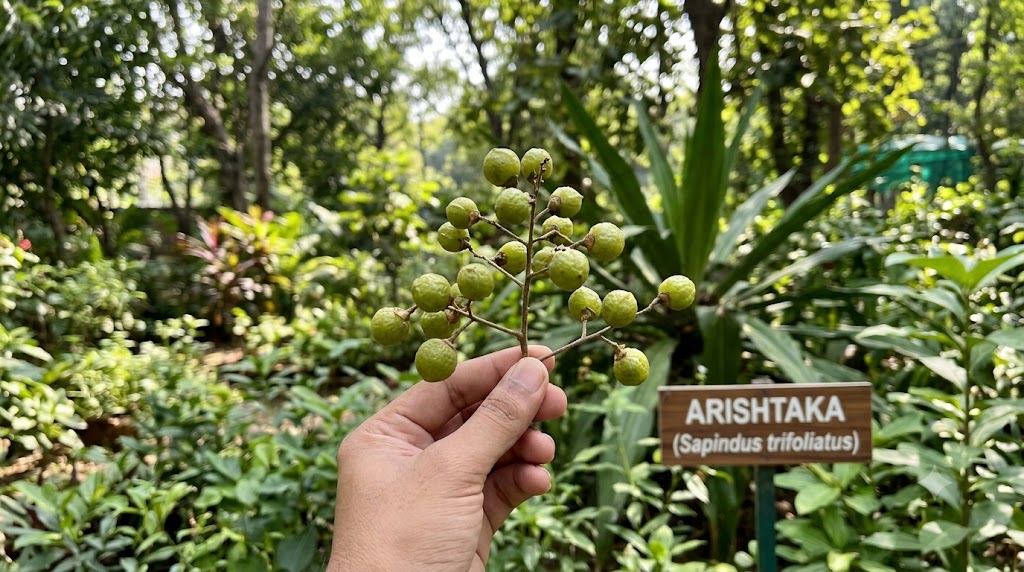
  • Arishtaka

    photo genrate

    Arishtaka

    Botanical Name : Sapindus mukorossi Vahl.

    Family : Sapindaceae

    Identification No.: SDACH/HG/080

    Introduction :

    Sapindaceae (a group from which soap is derived).

    Latin name : Sapindus = which yields soap; trifoliate = having three leaves,

    Soapberry, common name for a medium-size family of mostly woody flowering plants widely distributed in tropical areas, and for its representative genus.

    The soapberry family includes important tropical timber, such as akee, native to West Africa. This species has been introduced in the West Indies, where the ripe fruit is fried and eaten with fish (the unripe fruit is highly toxic). Several tropical fruits, such as the litchi, are members of the soapberry family. The representative genus contains about 13 species; 2 occur in the United States, and the fruits of both are poisonous.

    Flowers of the order to which the soapberry family belongs are characteristically functionally unisexual, small, and insect pollinated. The order contains about 5400 species placed in 15 families; the two largest are the rue family, with about 1700 species, and the soapberry

    Names in different Indian languages :

    English: Soapnut tree of South India.

    Hindi: Reethaa

    Kannada: Kugatemara, antawala

    Malayalam: Urunci, uruvanchi

    Sanskrit: Arishtaka, phenilah

    Tamil: Puvamkottai, Mani pungu.

    Telugu: Kunkutikaya, kumkuticettu, phenilamu

    Unani: Reethaa

    Synonyms :

    अरिष्टकः फेनिलश्च कठोरः कुथरोऽपि च।

    वायसानक इत्युक्तः सुतुम्बुरु इति स्मृतः॥

    Arishtaka, Phenila, Raktabeeja, Reethaakaranja, Garbhapaatana.

    Sapindus trifoliatus auct. non Linn.

    Morphology :

    This tree is 8 to 10 mtrs. high and has many branches with leaves and leaflets- 2, 3 pair-oblong-lanceolate,

    Flowers are white. Fruits are round, t occur in spring.

    Distribution & Habitat :

    Throughout India

    Chemical constituents :

    Saponin , genins, methylhedragenate, sapindic acid ,methyl oleanolate

    Properties :

    Guns: laghu, snigdha, tikshna;

    Rasa : katu, tikta;

    Vipaka katu;

    Veerya: ushna;

    Prabhav : vamak (emetic);

    Karma :

    Garba padi, vamanakam, lekhana

    astringent, emetic, detergent, anthelmintic

    Indication :

    Kushta, kandu, visha

    migraine, epilepsy , hysteria,  gout, rheumatism and paralysis

    Part used :

    Whole plant

    Dosage :

    Leaf juice 10-15 ml

    Powder 2-4 g

    Decoction 50-100 ml

    External use : Anti-inflammatory.

    Internal uses : It purifies vitiated kapha and pittá by emetic and purgative actions whereas alleviates vata by snigdha and ushna properties. Seed is intoxicant, while fruit rind has oxytropic action. In migraine, its water or powder is used as a nasya. In morphine poisoning, it is given orally to induce emesis.

    IUCN Status:

    Sapindus mukorossi – Least Concern (LC)

    Sapindus trifoliatus – Not Evaluated (NE)

    Research Updates (Past 5 Years):

    1. 2021 – Evaluation of antifungal and antidandruff activity of Sapindus mukorossi extract.

    2. 2020 – Saponin-rich fractions showed significant anti-inflammatory and anti-psoriatic effects in in vivo models.

    3. 2023 – In vitro study on antibacterial and cytotoxic properties against skin pathogens and cancer cells.


    About Arishtaka

    Botanical Name

    Sapindus mukorossi Vahl.

    Family

    Sapindaceae

    Identification No.

    SDACH/HG/080

    Parts Used

    Whole plant

    Habitat

    India

    IUCN Status

    Least Concern

    Plant Photos

    Ayurvedic Properties

    Rasa

    Katu, Tikta

    Guna

    Laghu, Snigdha, Tikshna

    Virya

    Ushna

    Vipãka

    Katu

    Contact Now

    Have queries? Contact Us.

    Have queries? We’re here to help you every step of the way.

    Contact us to get the right guidance for your academic journey at Shri Dhanwantry Ayurvedic College.

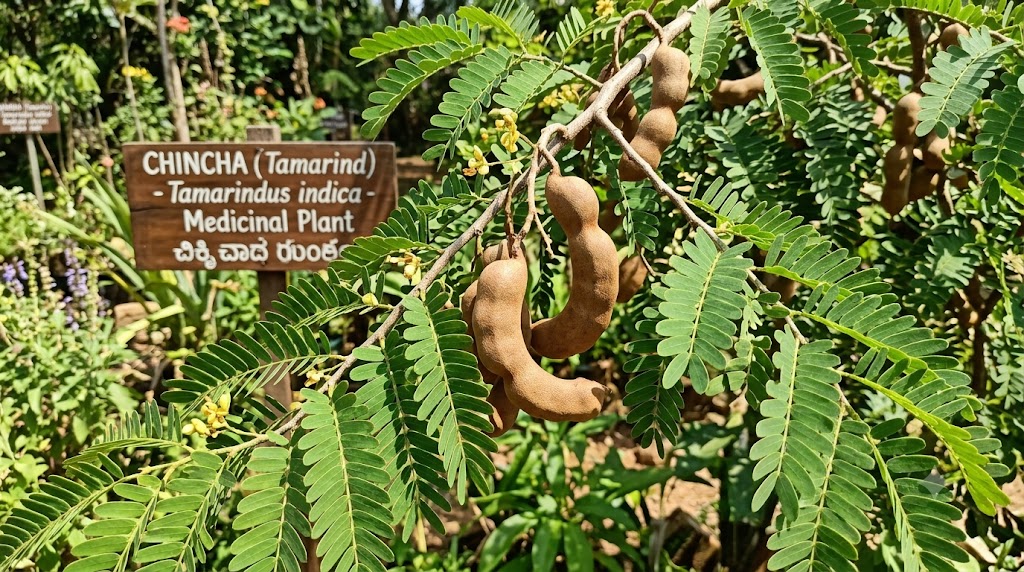
  • Chincha

    Chincha

    Botanical Name : Tamarindus indica Linn.

    Family : Fabaceae

    Identification number:– SDACH/HG/ 079

    Introduction :

    Latin name Tamarindus = the distorted form of the Arabic nametamarindus – hind meaning ‘ripe date of India’; indica Indian

    Scientific classification: The tamarind belongs to the subfamily Caesalpinioideae, family Fabaceae (formerly Leguminoseae). It is classified as Tamarindus indica.

    Names in different Indian languages :

    English : Tamarind tree

    Hindi : Amli, imli

    Kannada : Huli, amli

    Malayalam : Puli, kolpuli, valanpuli

    Sanskrit : Amlikaa, chincha

    Tamil : Puli, amilam

    Telugu : Cintapandu, amlaki, cintacettu

    Unani : Tamar

    Synonyms :

    चिंचा चञ्चला चारीका आम्लिका च कटुत्वचा।

    अम्लिका कषायाम्ला स्वादुका हृद्यरोगनुत्॥

    Amli, Amlikaa, Suktaa, Chukraa, Chukrikaa, Chinchaa, Chandikaa, Tintidika

    Tamarindus  occidentalis Gaertn.

    Tamarindus  officinalis HK.

    Morphology :

    It is a fast growing tall tree and is known by these names — chincha, tintini, mali, ambalt. chinch, tamarind.

    Leaves — compound, teaflet 20 to 40. round in shapa Flowers – in bunches, yellow in colour and boat shaped. Legume— 7 to 12 cm. Long Seeds are called as chinchoke in Marathi.

    Distribution & Habitat :

    Throughout India

    Chemical constituents :

    Tartaric. citric. malic, acetic, potassium tartarate. etc. In the seed there is 65% carbohydrates. orientin, vitexin, iso-orientin and iso-vitexin, tamarindienal

    Properties :

    Guna guru. ruksha:

    Rasa amla;

    Veerya : ushna:

    Vipaka: amla

    Karma :

    Grahi, deepana, ruchyam, hridyam, sulaghnam kaphaghni

    Laxative, carminative, digestive,astingent,cooling,diuretic, antimicrobial, antifungal, anthelmintic, antiviral, antipyretic, anti-inflammatory

    Indication :

    Pandu, vataroga, vrana, sopha, ajirna

    Anaemia, ulcers, wounds, fever, skin disease, cough, piles

    Part used :

    Whole plant

    Dosage :

    Leaf juice 10-15 ml

    Powder 2-4 g

    Decoction 50-100 ml

    Uses :

    Tamarind and its seeds are applied externally on inflammation. Fruit is very good in taste and is used in anorexia, polydipsia, indigestion and liver disorders- In heart diseases, sherbet is given. Kshara is used in retention of urine and abdominal pain . Pulp and sherbet reduce the complication in fever. In cholera, tablets of traits of tamarind and Semecarpus anacardium + salt are very useful

    IUCN Status: Least Concern (LC)

    Research Updates (Past 5 Years):

    1. 2021 – Tamarindus indica extract showed hepatoprotective activity in CCl₄-induced liver injury models.

    2. 2020 – Antioxidant and lipid-lowering activity of tamarind pulp evaluated in hyperlipidemic rats.

    3. 2023 – Clinical study on tamarind leaf extract in managing joint inflammation and osteoarthritis symptoms.

    About Chincha

    Botanical Name

    Tamarindus indica Linn.

    Family

    Fabaceae

    Identification No.

    SDACH/HG/079

    Parts Used

    Whole plant

    Habitat

    India

    IUCN Status

    Least Concern

    Plant Photos

    Ayurvedic Properties

    Rasa

    Amla

    Guna

    Guru, Ruksha

    Virya

    Ushna

    Vipãka

    Amla

    Contact Now

    Have queries? Contact Us.

    Have queries? We’re here to help you every step of the way.

    Contact us to get the right guidance for your academic journey at Shri Dhanwantry Ayurvedic College.

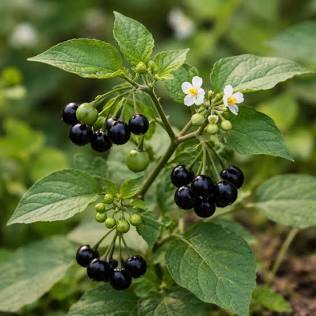
  • Kakamachi

    Kakamachi

    Botanical Name : Solanum nigrum Linn.

    Family : Solanaceae

    Identification no. – : SDACH/HG/078

    Introduction :

    Latin name : Solanum = comforting, having sedative qualites; nigrum = niger – black.

    Nightshades make up the genus Solanum, and the family Solanaceae, in the order Solanales. Horse nettle is classified as Solanum carolinense, European bittersweet as Solanum dulcamara,silverleaf nightshade as Solanum elaeagnifolium, and black nightshade as Solanum nigrum. Buffalo bur is classified as Solanum rostratum, the common potato as Solanum tuberosum, the eggplant as Solanum melongena, and the Jerusalem cherry as Solanum pseudocapsicum. The sweet potato, classified as Ipomoea batatas, and the morning glory, classified as Ipomoea purpurea, belong to the family Convolvulaceae. Jacob’s ladder, classified in the genus Polemonium, and the common annual phlox, classified as Phlox drummondii, belong to the family Polemoniaceae.

    Names in different Indian languages :

    English : Black Nightshade

    Hindi : Mako, gurkkamai

    Kannada : Kakarundi

    Malayalam : Manattakkali, karintakali, karintakkali

    Sanskrit : Kaakamaachi

    Tamil : Manittakkali

    Telugu : Kamanci, kacci, kaccipandu, gajjucettu

    Synonyms :

    Kaakaahya, Kaakamaataa, Dhvankshamaachi

    Solanum rubrum Mill.

    Morphology :

    This is a shrub with irregular branches and grows upto a height of 30 cm. to 1 mt.

    Leaves- simple, alternate, glabrous, 5cm. to 7cm. in length and 2.5cm to 3.75cm in breadth.

    Flowers – small and white, cyme

    Fruits – berry, small, spiral. smooth. green when unripe but turn blue on ripening, in bunches. The plant flowers in rainy season an fruits in spring.

    Distribution & Habitat :

    All over India

    Chemical constituents :

    solasonine, alphaand beta-solanigrine, alpha-and betasolamargine; steroidal sapogenins, diosgenin and tigogenin; solasodine and solasodine.

    Properties :

    RASA-kashaya

    GUNA- laghu, snigdha

    VIRYA-anushna

    VIPAKA-katu

    Karma : hridya, dipana, pachana, vrisyam, rasayana, virechana

    anti-inflammatory, antispasmodic, sedative, diuretic, laxative, antiseptic, expectorant

    Indication :

    Kasa, swasa, krimi, kusta, vrana

    Part used :

    Whole plant

    Dosage :

    Leaf juice 10-15 ml

    Powder 2-4 g

    Decoction 50-100 ml

    Precaution : Large dose causes vomiting, diarrhoea, thirst, abdominal colic, headache, delirium, seizures, coma and sometimes even death.

    Antidote : The treatment should be done similar to dhatura poisoning.

    Uses :

    It is used extensively in inflammation, osteoarthritis, wounds.. liver enlargement and ascites. Its decoction is used for gargling in stomatitis, throat infection and tonsillitis. Warm decoctions used locally in earache. Its juice is used for nasal administration in nasopharyngeal diseases and ineye disorders. Being a digestive, it is used in loss of appetite, common cold, liver diseases, piles,ascites, dysentery, splenomegaly, heart disease and oedema (used as a vegetable). The powder of the fruit is used in hoarseness of voice, cough and asthma. It can also be useful in renal disorders, gonorrhoea, dysuria, skin disorders and chronic fever.

    Therapeutic Uses :

    Leaf juice with honey useful in cough.

    IUCN Status: Not Evaluated (NE)

    Research Updates (Past 5 Years):

    1. Hepatoprotective activity of Solanum nigrum leaf extract in paracetamol-induced hepatotoxicity in rats (2021).

    2. Anticancer potential through apoptosis induction in liver cancer cell lines (2020).

    3. Anti-inflammatory and antioxidant evaluation of methanolic fruit extract (2022).

    About Kakamachi

    Botanical Name

    Solanum nigrum Linn.

    Family

    Solanaceae

    Identification No.

    SDACH/HG/078

    Parts Used

    Whole plant

    Habitat

    India

    IUCN Status

    Not Evaluated (NE)

    Plant Photos

    Ayurvedic Properties

    Rasa

    Kashaya

    Guna

    Laghu, Snigdha

    Virya

    Anushna

    Vipãka

    Katu

    Contact Now

    Have queries? Contact Us.

    Have queries? We’re here to help you every step of the way.

    Contact us to get the right guidance for your academic journey at Shri Dhanwantry Ayurvedic College.

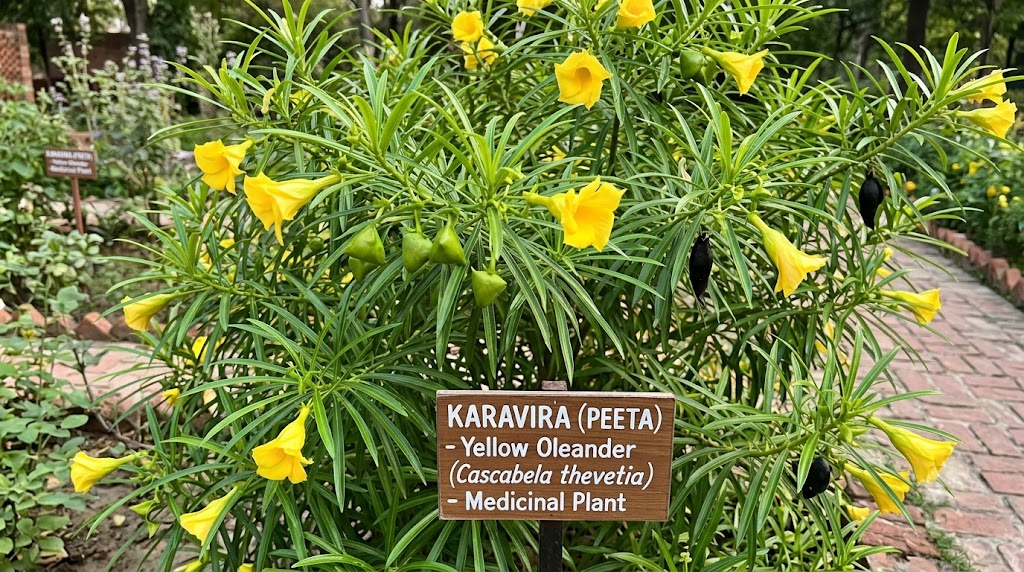
  • Karavira(Peeta)

    photo genrate

    Karavira(Peeta)

    Botanical Name: Cassia fistula Linn.

    Family: Caesalpiniaceae

    Identification No.: SDACH/HG/001

    Introduction: In Vedic literature the dried branches of Aragvadha are used for ritual performance Several external applications containing Aragvadha are mentioned in  Ayurveda ( psoriasis etc.)

    Scientific classification: Sennas belong to the subfamily Caesalpinioideae, family Fabaceae (formerly Leguminosae). Alexandrian senna is classified as Cassia acutifolia. The species from which tinnivelly, or Indian senna, is obtained is classified as Cassia angustifolia

    Names in different Indian languages:

    English : Indian Laburnum,Purging Cassia,Golden Shower

    Hindi: Amaltas,girimala

    Kannada: Phallus,kakke,kakke mara

    Malayalam: Konna,kanikonna

    Sanskrit: Aaragvadha

    Tamil: Sarakkonrai

    Telugu: Rela,kondrakaya,aragvadamu

    Synonyms:

    Chaturaangula, Kritamaala, Kritmaalaka, Karnikaara, Shampaaka, Praagraha, Raajvrksha, Nripapaadapa, Raajadruma, Vyaadhighaataka, Aarevata.

    Cassia rhombifolia Roxb

    Classification according to Charaka, Susrutha & Vagbhata:

    Charaka: Kusthaghna, Kandüghna, Tiktaskandha, Virechana

    Susrutha: Aragvadhadi, Syamadi, Slesmasamsamana, Adhobhagahara

    Vagbhata: Aragvadhãdi, syãmadi

     Varieties & adulterants – (CV – controversy, AD – adulterants):

    1.Karnikara

    2.Pãlevatam

    3. Madhura (sweet)

    4. Amla (sour)

    5. praravata-  Psidium guyava

    6. Garcinia mangostan.

    Cassia roxburghii – AD

    Morphology:

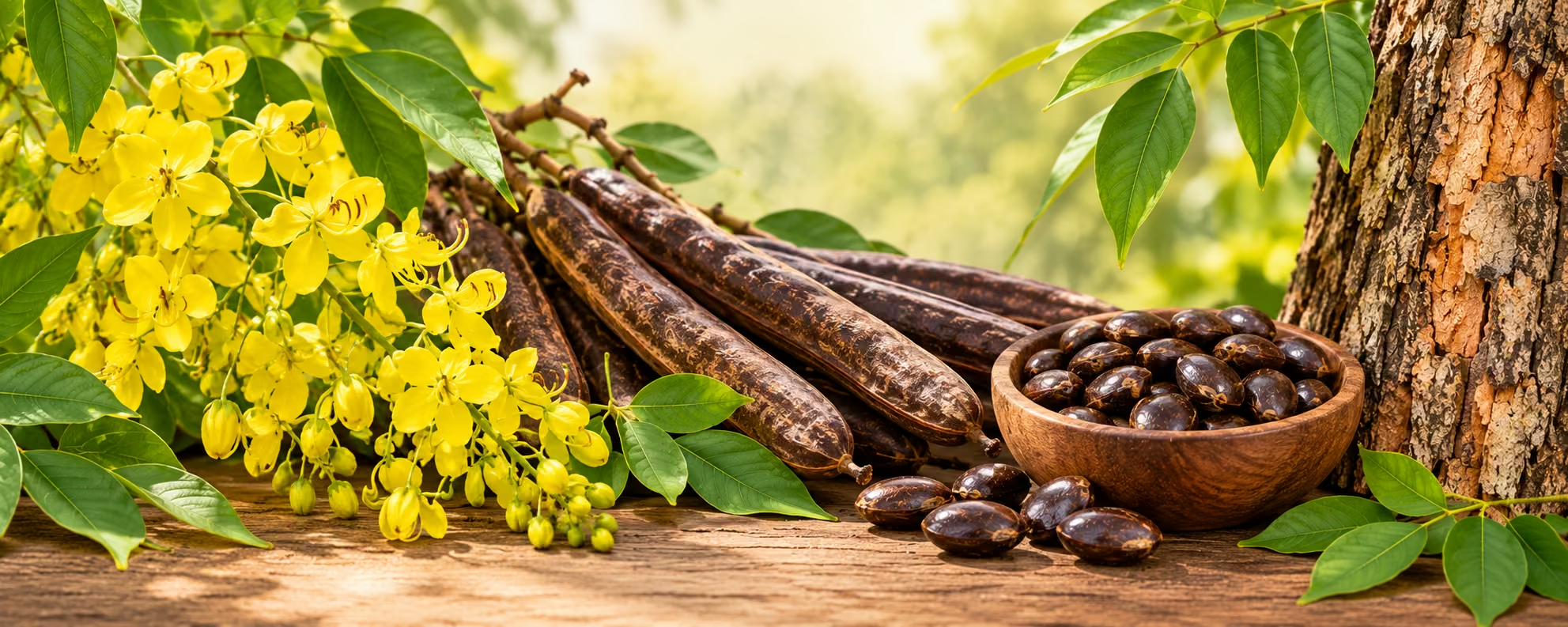
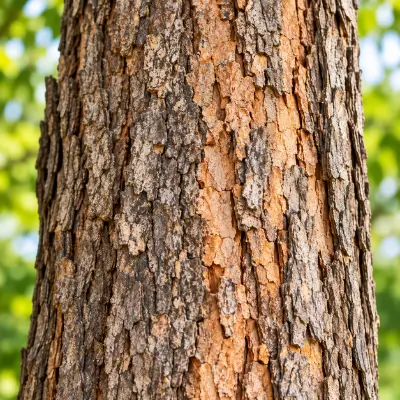
    It is moderate-sized tree, 10-12 m. in height.

    Bark- greenish-grey, smooth when young then brick-red.

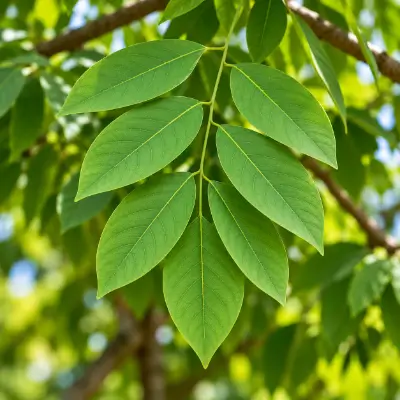
    Leaves- paripinnate, 4-8 pairs, ovate, acute, bright green, glabrous above, silvery pubescent beneath. 10-15 cm long

    Leaflets 4-8 pairs, about 2-5 cm, acuminate, ovate-lanceolate.

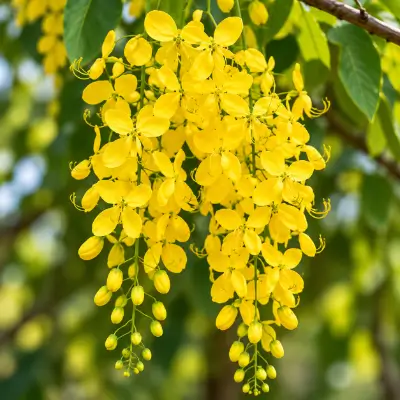
    Flowers- in lax pendulous racemes, yellow, fragrant.

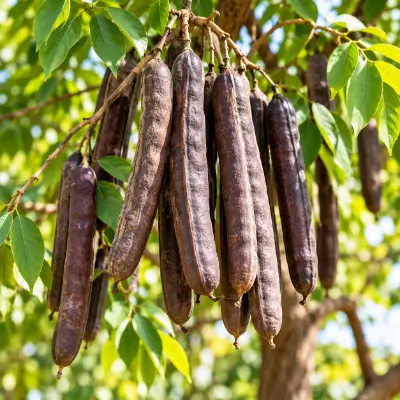
    Pods- cylindrical, pendulous, indehiscent, 25-30 cm long and 2-3.0 cm diam.

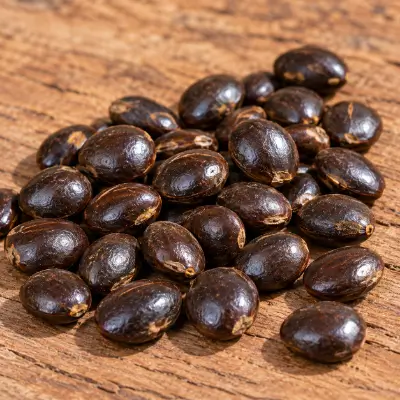
    Seeds- numerous, small, flat, smooth, yellowish-grey

    surrounded by black pulp when ripen pulp will be sweet.

    (Flowers in March-May and fruits in May).

    Habitat  & Distribution:

    All over India, Srilanka, Nepal

    Chemical composition:

    Anthraquinone glycosides, sennosides A and B, rhein

    Pulp glucose 60%, glutin. pectin, dyes, calcium oxalate. minerals. gum and water.

    Seeds- sugars, galactomannan

    Flowers- fistulin, leucopelargonidin tetrarner, kaempfer oil

    Pods- fistulic acid  Bark & Heart wood- barbl Oil, fistucacidin, etc.

     Leaves- Rhein, sennosides A & B

    Properties:

    Rasa :  Madhura

    Guna : Madura, Guru, Snigdha

    Virya : Sita

    (Usna: Dhanvañtari Nighandu)

    Vipãka: Madhura

     Karma : Kapha-pittahara , kushtaghna, arsoghna, vrana hara

    Laxative, blood purifier, febrifugal, astringent, antibilious.

    Indications:

     Kustha, Prameha, Hrdroga, Amavãta, Gandamãlã, Kãmalã, Udara, Udãvarta, Vatarakta, Sula, Jvara

    Constipation, colic, chlorosis and urinary disorders,gout, skin disease, psoriasis, fever

    External uses:

     It is anti-inflammatory,analgesic.

    The pulp and leaf paste are used in nodular oedema & gout. rheumatoid arthritis etc.

    The decoction is used for gargling in diseases of oral cavity and throat,

    Leaf paste is used in skin disease and itching.

    Internal uses:

    Nervous system: It is analgesic by vatahara property, so useful in vata diseases.

    Digestive system: It is bitter so improves taste, It is a liver stimulant and purgative by snigtha properties. It is a mild purgative drug and is useful in constipation and jaundice.

    Circulatory system: It is cardioprotective, antiinflammatory, purifies blood so useful in heart disease, haemorrhagic ditorders, gout and swellings.

    Respiratory system: As it is madhur, snigdha, removes kapha and soothes internal organs by mridu property, in dry cough and dyspnoea flower’s avaleha is given.

    Urinary system: Diuretic by sheeta properly. It  soothes the urinary tract. Seeds are antidiabetic

    Skin: Kushthaghna and refrigerant, so used in skin disease and burning.

    Temperature: It is antipyretic, so used in fever and purgation. Its bitter taste works in digestion and is pittashamak. Bark of root is used in fever.

    Srotogamitwa:

    Dosha : Pitta. kaphaghatna ,liver stimulant

    Mala: Purgative.

    Parts used: 

    Root bark, leaves, flowers,fruit pulp

    Dosage:

    Decoction of root bark 75-100 ml.

     Flower paste 6-10 g

    Important Yogas or Formulations:

    Aragvadhadi taila, Arngvadhadi leha, Aragvadharishta..

    Therapeutic Uses:

    1. Kãmalã- Aragvadha (fruit pulp) is given with the juice of sugarcane or vidari or Amalaki after fortifying with Trikatu. (A.H.)

    2. Gandamãlã- Root bark of Aragvadhã is grinded with rice-water and used for Nasya and lepa (V.M.)

    3. Kustha- Leaves of Aragvadhä are made into paste with Amãlaka and applied externally.

    IUCN Status  – Least Concern (Not threatened)

    Research Updates (Past 5 Years)

    1. Antidiabetic Activity (2021): Study confirmed hypoglycemic effect of C. fistula pulp extract.

    2. Antimicrobial (2022): Pod extract showed efficacy against Staphylococcus aureus.

    3. Hepatoprotective (2023): Bark extract reduced liver toxicity in animal models.

    About Karavira(Peeta)

    Botanical Name

    Thevetia neriifolia Juss.

    Family

    Apocynaceae

    Identification No.

    SDACH/HG/077

    Parts Used

    Root bark, leaves

    Habitat

    Mexico, Brazil

    IUCN Status

    Not Evaluated

    Plant Photos
    Ayurvedic Properties

    Rasa

    Tikta, Kashaya, Madhura

    Guna

    Laghu, Snigdha

    Virya

    Sheeta

    Vipãka

    Madhura

    Contact Now

    Have queries? Contact Us.

    Have queries? We’re here to help you every step of the way.

    Contact us to get the right guidance for your academic journey at Shri Dhanwantry Ayurvedic College.
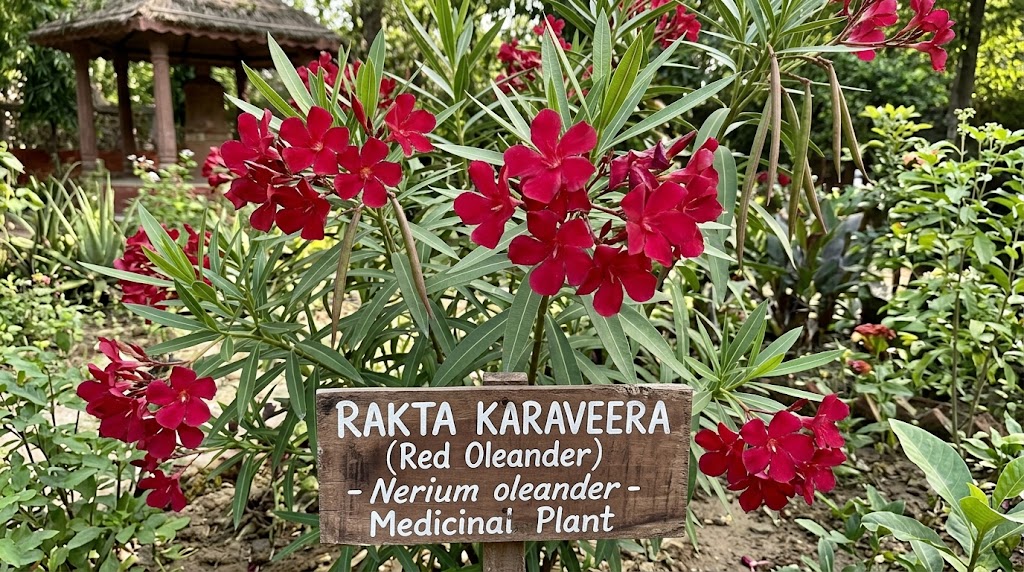
  • Rakta Karaveera

    Rakta Karaveera

    Botanical Name : Nerium indicum Mill

    Family : Apocynaceae

    Identification No.: SDACH/HG/076 

    Introduction :

    It is used for brushing the teeth. Karavira flowers are described in Mahãbhya.. Caraka advocated Karavira for Snãna (bathing) and Pãna (internal administration). Suruta indicated Karavira Ksära in Asmari treatment.

    Names in different Indian languages :

    English : Indian oleander, White oleander

    Hindi : Kaner, karber, karu vira

    Kannada : Kanagilu, paddale, dhavekaneri

    Malayalam : Arali, kanaviram, karaviram

    Sanskrit : Karavirah

    Tamil : Arali, Alari, Aatrulari, Karaviram.

    Telugu : Ganneru, kasturipattu

    Unani : Kaner Safed, Diflaa, Samm-ul-maar, Khar-zaharah

    Synonyms :

    Viraka, Ashvamaaraka, Hayamaaraka, Gauripushpa, Divyapushpa, Shatakumbha, Siddhapushpa (white-flowered var.). Raktapushpa, Raktaprasava, Ravipriya (red-flowered var.) 

    Nerium odorum Soland

    Nerium oleander Linn

    Classification according to Charaka, Susrutha & Vagbhata :

    Charaka

    Kuthaghna, Tiktaskañdha

    Susrutha

    Lãksãdi, sirovirecana

    Vagbhata

    Lãksãdi

    Varieties & adulterants – (CV – controversy, AD – adulterants) :

    1. Sevta,

    2. Rakta,

    3. Pita (yellow)

    4. Krsna – T. peruviana

    Thevetia peruviana

    Morphology :

    A large glabrous erect shrub with milky juice, about 1-3 m high. Leaves— thrice in a whorl, linear-lanceolate, dark green and shining above, thickly coriaceous.

    Flowers— red, rose-coloured, white or yellow; fragrant.

    Fruit— Cylindric, straight, hard follicles, 10-15 cm long, rigid. Flowers and fruits usually during April-June.

    Distribution & Habitat :

    Cultivated as or namental shrub in gardens throughout India.

    Chemical composition :

    pregnanolone glycosides, neriodorin ,glucoside, rosaginine, an essential: oil, a crystalline principle like digilalin. nereine, tannic acid and wax. Leaves contain an alkaloid oleandrine, glucoside, pseudoqurarine, nereine and neriantine.

    Karabin, neriodorein, neriodorin, -sitostero1, neriodin, neriodorin, nerium D, nerioum E (anhydrooleandrin), digitaloside, nerioside, obandrin, digitoxigenin, oleañdroside, rutin, plumericin etc.

    Properties :

    Rasa Katu-Tikta

    Guna Laghu, Rüksa

    Virya Usna

    Vipãka Katu

    Karma : Kapha-Vatahara, Kusthaghna, Vranahara, Cakusya

    Anthelmintic, stomachic, diuretic, Cardioactive, diuretic, anti-inflammatory, antifungal, insecticidal, toxic

    Part Used :

    Root/root bark

    Dosage :

    Powder 30-125 mg

    Indications :

    Indralupta, Pãlitya, Dusta vrana, Upadama, Kustha, Krmi, Kandü, Netra roga

    asthma, arthragia, ulcers, ringworm, scabies, haemorrhoids, pruritus, skin disease

    External use :

    It cures skin disorders, cleanses and heals wounds and reduces swelling. The application of root paste is helpful in skin disorders, cancer, ulcers and ringworm infection. Leaf juice is put in the eyes in eye disorders. (Care must he taken as it is a poisonous plant).

    Internal use :

    Digestive system : Stimulant or appetite and useful in appetite, digestive disorders and constipation.

    Circulatory system : In a low dose it provides energy to the heart. But in higher dose, it is lethal to the heart. Nerium is a blood purifier. It is useful in oedema. weakness and dyspnoea induced due to cardiac debility.

    Urinary system : It increases the blood flow in the kidneys, thus increasing the urine quantity and flow, It is used in dysuria and stones.

    Skin : Diaphoretic and useful in clearing skin infection. It can be used in very chronic skin diseases.

    Temperature : Febrifuges. mainly episodic fever. The action of 1 ratti lie. 120 mg.) of the bark of yellow nerium is same as 15 ratti of the bark of Cinchona. In malaria, after the temperature comes to normal.

    Satmikaran : It is a powerful poison, this should be kept in mind.

    Higher dose Causes toxicity, feeble pulse, cardiac arrest, respiratory arrest and then leads to death.

    Antidote After stomach wash, cow’s ghee should be given.

    Parts used : Roots, bark of the root.

    It is better to avoid internal use of this plant.

    Important Yogas or Formations :

    Karavirãdi taila, Hayamarãdi taila, Karavira yoga, sveta Karaviryadi taila,

    Important research work going on :

    1) cardio tonic activity

    2) insecticidal activity

    3) CNS-depressant effects

    4) anti cancerous activity

    5) bradycardia

    6) antipyretic effect and anti-inflammatory activity.  

    Therapeutic Uses :

    (1) Indralupta— The affected are should be pasted with Karavira juice (A.H. Ut. 24/29).

    (2) Kustha— Oil prepared with Karavira root and aconite along with cow’s urine is useful .

    (3) Apasmãra— The powder of sveta karavira leaves is used for Nasya

    IUCN Status: Not evaluated

    Research updates (past 5 years): 

    1. 2020: Antimicrobial activity against skin pathogens 

    2. 2021: Oleandrin as potential anticancer agent (in vitro) 

    3. 2022: Toxicology and safe handling review 


    About Rakta Karaveera

    Botanical Name

    Nerium indicum Mill.

    Family

    Apocynaceae

    Identification No.

    SDACH/HG/076

    Parts Used

    Root, Root Bark

    Habitat

    India

    IUCN Status

    Not Evaluated (NE)

    Plant Photos

    Ayurvedic Properties

    Rasa

    Katu, Tikta

    Guna

    Laghu, Ruksha

    Virya

    Ushna

    Vipãka

    Katu

    Contact Now

    Have queries? Contact Us.

    Have queries? We’re here to help you every step of the way.

    Contact us to get the right guidance for your academic journey at Shri Dhanwantry Ayurvedic College.
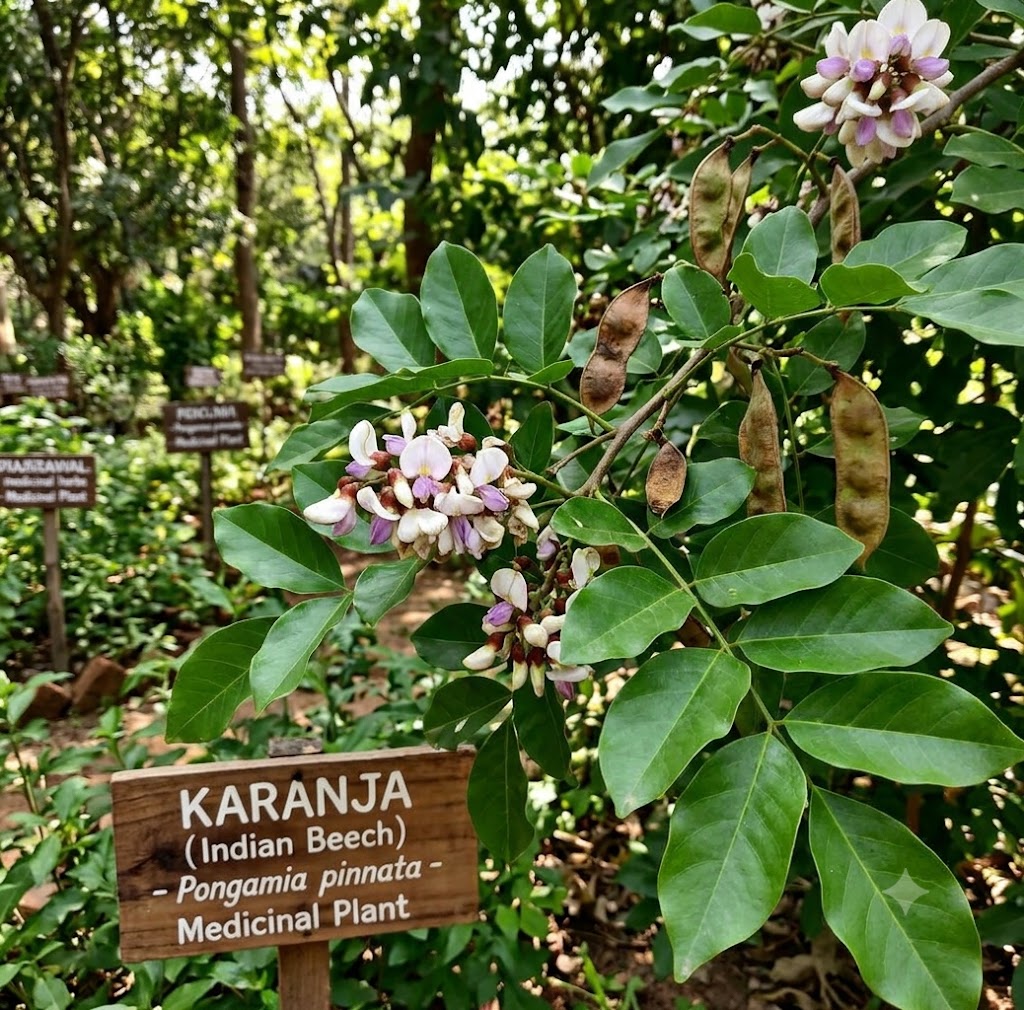
  • Karanja

    Karanja

    Botanical Name : Pongamia pinnata Pierre.

    Family : Papilionaceae; Fabaceae

    Identification No.: SDACH/HG/075 

    Introduction :

    We come across the references about Karañja in RigVeda and Atharvaveda. Karañja sticks  described as the best among the tooth sticks in susthra stana.

    Names in different Indian languages :

    Hindi : Karanj, Dithouri

    Telugu : Kanugacettu

    Tamil : Pongum; ponkamaram

    English : Indian beech, pongam oil tree

    Gujarati : Kanajhi

    Malayalam : Ungh, pongh

    Kannada : Hongemara

    Sanskrit : Karanjah

    Synonyms :

    Cirabilvaka, Naktamãlã, Gucchapuspaka, Ghrtapura, Snigdhapatra

    Pongamia  glabra Vent.

    Derris indica (Lam.) Benett.

    Classification according to Charaka, Susrutha & Vagbhata :

    Charaka

    Kandüghna, Katuka skañdha

    Susrutha

    Aragvadhãdi, Varunãdi, Arkãdi, Syamãdi, Kaphasamamana

    Vagbhata

    Aragvadhãdi, Varunãdi, Arkãdi, Syamadi

    Varieties & adulterants – (CV – controversy, AD – adulterants) :

    1. P.glabra Vent

    2. Karañja

    3. Püti Karanja.

    4. Kantaka Karañja— Karanja, Naktamãla, Karaja, Ciribilvaka

    5. Ghrta Karañja— Prakirya, Pütika, Pütikaranja, Somavalka

    6. Karañji— Udakirya, Sakgrandha, Hástivãruni, MarkatiKarabhañjikã

    7. Udakirya (Karanja visesa)

    8. Angãravallika

    9. Cirabilva

    10. Valli Karaiija

    11. Guccha Karañja

    12.  Ritha karanja

    Morphology :

    It is a medium-sized glabrous tree, growing about 20 m. bark greyish green or brown.

    Leaves- Compound, imparipinnate; leaflets 5-7, elliptic , ovate.

    Flowers- in axillary racemes, fragrant, pinkish white, tinged with pink or violet; peduncle as long as the rachis.

    Fruits- pods, compressed, woody, glabrous, elliptic obliquely oblong, 5-8 cm long and 2 -3 cm. broad.

    Seeds- 1-2, elliptic or reniform, wrinkled, about 2.0 cm long and 1-2 cm. broad with reddish-brown leathery testa

    (Flowers and fruits during May- June).

    Distribution & Habitat :

    Throughout India upto 1200 m., also cultivates . Found in central and South India, Sri Lanka.

    Chemical composition :

    chromenoflavones, chromenochalcones, coumarones, flavone glucosides, sterols, triterpenes ,  phenylalanine dipeptide

    Seeds contain 27% bitter and dark (sherry) coloured fixed oil (pongamia oil). Bark contains bitter alkaloid, resin, mucilage and sugar. Karanjin, pongapIn, 3-meth- oxypongapin, pongaglabrone, kanjone, pongol, g.matin, lonchocarpm,isolonchocarpin, karanja chromene, porgachromene, isopongaflavone, pongamol, glabrin, ovalitenone, kanugin, cemethoxy, kanugin, pongamin, neoglabrin etc

    Properties :

    Rasa -Tikta, Katu, Kashäya

    Guna –Laghu, Tiksna.

    Virya- Usna

    Vipaka – Katu

    Karma : Kapha-vãta hara, Sothahara, Bhedana,sophahara, vranahara

    Laxative, digestive, carminative,

    Indications :

    Yoniroga, Kustha, Udavarata, Gulma, Arsas, Krimi,vrana , Unmãda etc.

    scabies, herpes, leucoderma, flatulence, dyspepsia, diarrhea , skin disease,  cough, bleeding piles, ulcers , beri beri

    Fruit- Prameha, Arsas, Krimi, Kustha etc.

    Oil- Netra roga, Vãta roga, Kustha, Kandü,  etc.

    Part Used :

    Root bark, stem bark, leaves, seeds, twigs (as tooth brush), seed oil.

    Dosage :

    Fresh juice 10-20 ml; seed powder 3-5g. bark powder 5g

    External use :

    Bark, leaves and seeds are antiseptic, antipmritic and analgesic. Oil derived from the seeds has antiparasitic, wound healing and analgesic properties. used nausea Also useful in various skin diseases and wound& Oil is used for massage in vata disorders, Poultice of leaves removes the bacteria from wounds. Paste of flowers is applied in alopecia.

    Internal uses :

    Digestive system : it improves appetite and digestion. It is purgative, anthelmintic and liver Ionic due to ushna and tikshna properties. Leaves and bark are used in loss of appetite, digestive disorders, constipation. helminlhiasis. and haemorrhoids.

    Circulatory system : Being bitter, it enhances blood flow and its ushna guna reduces swellings. Effective also in rheumatoid arthritic swelling.

    Respiratory system : Being Kaphaghna & kasahara. it is used in cough: especially in whooping cough, powdered seeds in water used.

    Urinary system : Useful in urinary disorders as it reduces the quantity of urine by pungent and hot nature. Flowers are used in ikshumeha.

    Reproductive system : Its ushna and tikta guna makes it keep the uterus in good condition.

    Skin : Kushthaghna. effective in all skin disorders. Karanja oil is the best treatment for fatty ulcers of skin.

    Important Yogas or Formulations :

    Karanjadi churna, Karanjadya ghrit, Karanjadi tailam.

    Important research work going on :

    (1) Antibacterial activity

    (2) Antibacterial activity

    (3) Action on lipid metabolism.

    (4) Antifungal activity

    (5) Hypoglycemic effect

    Therapeutic Uses :

    (1) Grañthi visarpa- Paste of Karañja bark may be applied locally (C.S.Ci.21).

    (2) Rakta pitta—Seed powder of Karañja should be given with sugar & hones (S.S.Ut.45).

    IUCN Status: Least Concern. 

    Research Updates: 

    1. Biofuel and medicinal uses (2020, Renew. Energy) 

    2. Antimicrobial seed oil (2021, J. Ethnopharmacol.) 

    3. Anti-diabetic karanjin (2023, Phytomedicine) 


    About Karanja

    Botanical Name

    Pongamia pinnata Pierre.

    Family

    Fabaceae (Papilionaceae)

    Identification No.

    SDACH/HG/075

    Parts Used

    India, Sri Lanka

    Habitat

    India, Sri Lanka, Nepal

    IUCN Status

    Least Concern

    Plant Photos

    Ayurvedic Properties

    Rasa

    Tikta, Katu, Kashaya

    Guna

    Laghu, Tikshna

    Virya

    Ushna

    Vipãka

    Katu

    Contact Now

    Have queries? Contact Us.

    Have queries? We’re here to help you every step of the way.

    Contact us to get the right guidance for your academic journey at Shri Dhanwantry Ayurvedic College.