Shri Dhanwantry Ayurvedic College

Author: Khushal

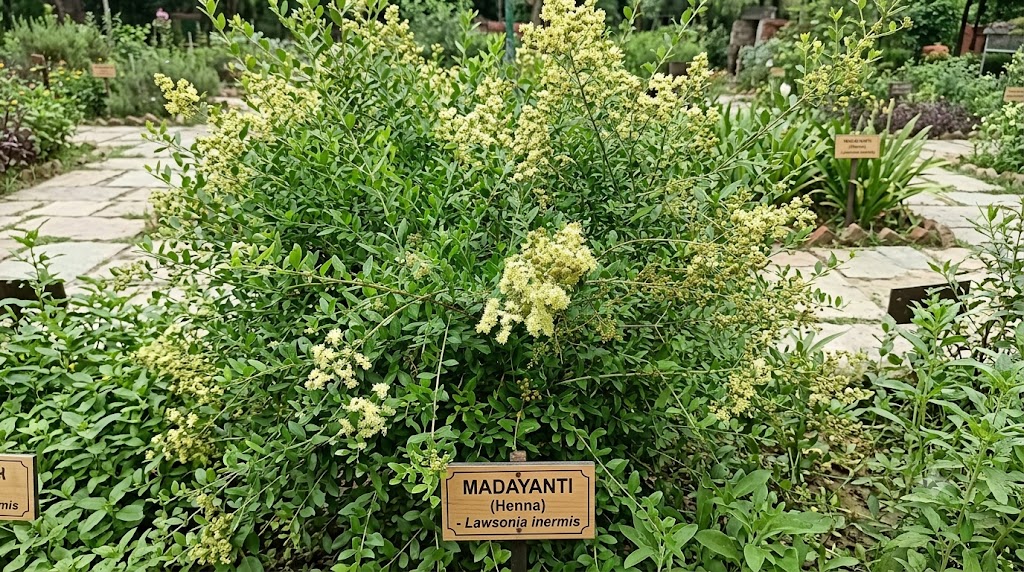
  • Madayanti

    Madayanti

    Botanical Name : Lawsonia inermis Linn.

    Family : Lythraceae

    Identification No.: SDACH/HG/074 

    Introduction :

    Latin name: Lawsonia = after Mr. M. A. Lowson. FRS, who assistedin preparation of flora of British India: nermis = smooth stemmed.without spines or alba = white.

    Names in different Indian languages :

    English : Henna, cypress shrub

    Hindi : Mehanti, Henna

    Kannada : Madurangi

    Malayalam : Mailancgi, mailanci

    Sanskrit : Madayanti, medhini

    Tamil : Marithondi, Marudum, mailanchi

    Telugu : Goranta

    Unani : Hinaa, Mehndi

    Synonyms :

    Madayanti, Madayantikaa, Mendika, Ranjaka.

    Lawsonia alba Lam.

    Morphology :

    It is a shrub with ‘sweet smelling white flowers.

    Leaves – simple, opposite, ovate-lanceolate, give a red colour on crushing.

    Fruits are of the size of peas, with small seeds inside

    Distribution & Habitat :

    Throughout India

    Chemical constituents :

    naphthoquinones, lawsone,  laxanthone, I, II and III

    Properties :

    Guna: laghu, ruksha;

    Rasa: tikta. kashaya;

    Vipaka: katu;

    Virya: sheeta;

    Karma :

    Kushtaghna, bhuta graham vinashana

    astringent, antihaemorrhagic, antispasmodic, oxytocic, antifertility, antifungal,  antibacterial

    Indication :

    Raktatisara, kusta,kasa,pandu, jwara, kandu, galaroga, hridroga, mutra krichra

    Ulcers, wounds, fever, skin disease, cough,

    Part used :

    Whole part

    Dosage :

    Leaf juice 10-15 ml

    Powder 2-4 g

    Decoction 50-100 ml

    Uses :

    It is an analgesic, reduces oedema, and is astringent. anti-inflammatory and antidermatosis.

    It improves complexion and hair growth and reduces burning sensation.

    External application of the paste is useful for burning of hands and feet, headache, joint pains, inflammation, ulcer and skin diseases. Decoction is used for gargling in stomatitis and pharyngitis

    (as an astringent). A combination of henna and lndigofera tinctoria is used  for dying the hair black. Flowers are used as refrigerant and in insomnia.

    Seeds – Extract of seeds stimulates the spleen and liver and hence used in dysentery..

    The juice of the leaves is given orally in jaundice.

    Flowers – Since the flowers are useful in heart conditions, its hot infusion is used in heart diseases.

    Leaves – The juice or decoction of the leaves is used in diseases of the blood. The leaf juice is’

    Since it is a diuretic, leaf juice + sugar are used in dysuria and pyuria. It reduces burning in the urine and soothes the urinary tract. The decoction of the leaves is used in dermatoses and syphilis. Hot infusion of the flowers is given in fever.

    Formulations : Madayantyadi churna

    IUCN Status: Least Concern. 

    Research Updates: 

    1. Wound healing activity (2019, J. Ayurveda Integr. Med.) 

    2. Antioxidant flavonoids (2021, Phytochem. Anal.) 

    3. Anti-inflammatory effects (2022, IJPR) 


    About Madayanti

    Botanical Name

    Lawsonia inermis L.

    Family

    Lythraceae

    Identification No.

    SDACH/HG/074

    Parts Used

    Whole plant

    Habitat

    India

    IUCN Status

    Least Concern

    Plant Photos

    Ayurvedic Properties

    Rasa

    Tikta, Kashaya

    Guna

    Laghu, Ruksha

    Virya

    Sheeta

    Vipãka

    Katu

    Contact Now

    Have queries? Contact Us.

    Have queries? We’re here to help you every step of the way.

    Contact us to get the right guidance for your academic journey at Shri Dhanwantry Ayurvedic College.

    photo genrate

  • Nagdamani

    Nagdamani

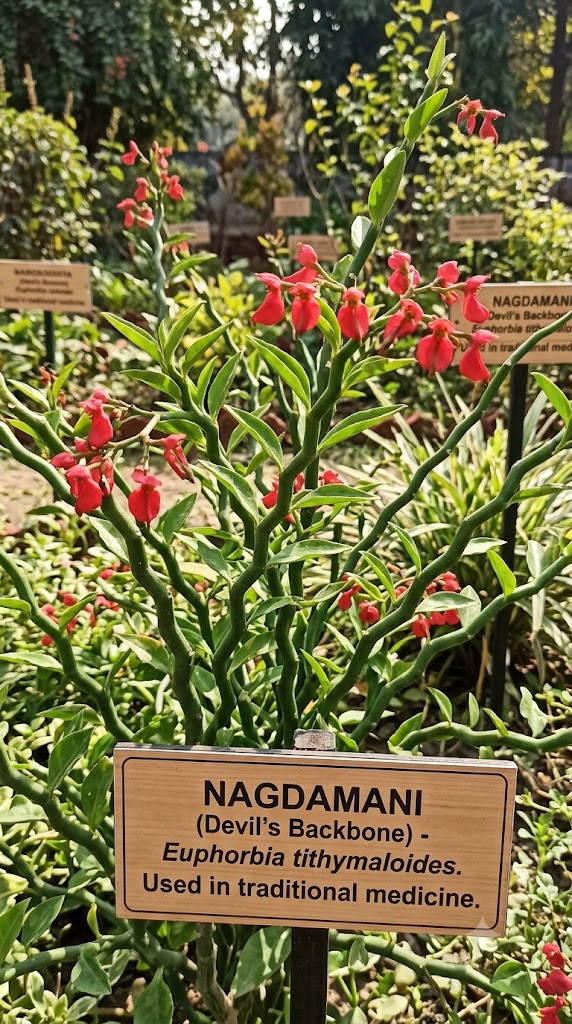
    Botanical Name : Sansevieria roxburghiana

    Family : Liliaceae

    Identification No.: SDACH/HG/073

    Introduction :

    Sansevieria roxburghiana J. & J. Schultes used as ‘murva’ in Bengal and north east region. Sansevieria cylindrical properties are similar to Sansevieria roxburghiana. And Ayurveda usage similar to murva

    Varieties & adulterants – (CV – controversy, AD – adulterants) :

    In south chronemorpha fragrans used as murva, In North Clematis triloba is used.

    Distribution & Habitat :

    North East

    Chemical constituents :

    aconitic acid, sansevierine

    Properties :

    Similar to ‘murva’

    IUCN Status  – Not Evaluated

    Research Updates

    1. 2020: Demonstrated significant anti-inflammatory and wound-healing properties (Journal of Ethnopharmacology). 

    2. 2021: Identified new saponins with anti-microbial activity (Phytochemistry). 

    3. 2022: Validated traditional use in snake bite management through rodent models (Ayurveda Research Paper). 


    About Nagdamani

    Botanical Name

    Sansevieria roxburghiana

    Family

    Liliaceae

    Identification No.

    SDACH/HG/073

    Parts Used

    Rhizome, Shoots, Whole plant

    Habitat

    North East India

    IUCN Status

    Not Evaluated

    Plant Photos

    Ayurvedic Properties

    Rasa

    Tikta, Kashaya

    Guna

    Laghu, Ruksha, Tikshna

    Virya

    Ushna

    Vipãka

    Katu

    Contact Now

    Have queries? Contact Us.

    Have queries? We’re here to help you every step of the way.

    Contact us to get the right guidance for your academic journey at Shri Dhanwantry Ayurvedic College.

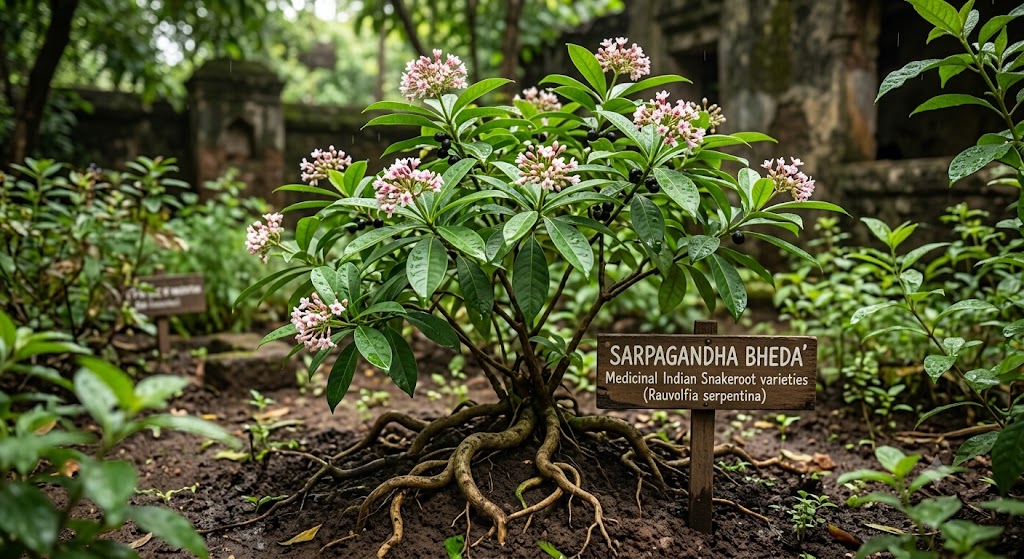
  • Sarpagandha Bheda

    Sarpagandha Bheda

    Botanical Name : Rauvolfia tetraphylla

    Family : Apocynaceae

     Identification No.: SDACH/HG/072

    Morphology : A small, much-branched woody shrub, 0.6-1.2 m high. Leaves whorled, ovate-elliptic. Flowers greenish-white or creamy-white in umbellate cymes. Fruits (drupes) ovoid, deep red or purple when ripe; seeds oblong, rugose.

     Uses :

    The latex, roots, leaves, bark and fruits are all used in traditional medicine in S. America.The roots are frequently used in India as a substitute of Rauvolfia serpentina for medicinal purposes.The latex in the plant is said to be cathartic, diuretic, emetic and expectorant.  It is used for treating dropsy and various other diseases. It is applied to granulated eyelids

    The plant is commonly used in the treatment of malaria in Guatemala, where it is also one of the reputed remedies for snake bites

    The plant contains two alkaloids, to which the names Chalcupine A and B have been given

    The plant is a good source of the alkaloid reserpine, which is used in making allopathic medicines. It is harvested commercially for this purpose

    The roots yield the alkaloid reserpine, which is an antihypertensive and tranquilizer

    IUCN Status: Vulnerable (due to overharvesting).

    Research Updates: 

    1. Hepatoprotective effects (2020, IJNPR) 

    2. Comparative alkaloid study (2022, Nat. Prod. Res.) 

    3. Sustainable harvesting (2023, J. Ethnopharmacol.) 


    About Sarpagandha Bheda

    Botanical Name

    Rauvolfia tetraphylla L.

    Family

    Apocynaceae

    Identification No.

    SDACH/HG/072

    Parts Used

    Roots, Leaves, Bark, Fruits, Latex

    Habitat

    India, Central America, South America

    IUCN Status

    Vulnerable

    Plant Photos

    Ayurvedic Properties

    Rasa

    Tikta

    Guna

    Ruksha

    Virya

    Ushna

    Vipãka

    Katu

    Contact Now

    Have queries? Contact Us.

    Have queries? We’re here to help you every step of the way.

    Contact us to get the right guidance for your academic journey at Shri Dhanwantry Ayurvedic College.

  • Sarpagandha

    photo genrate

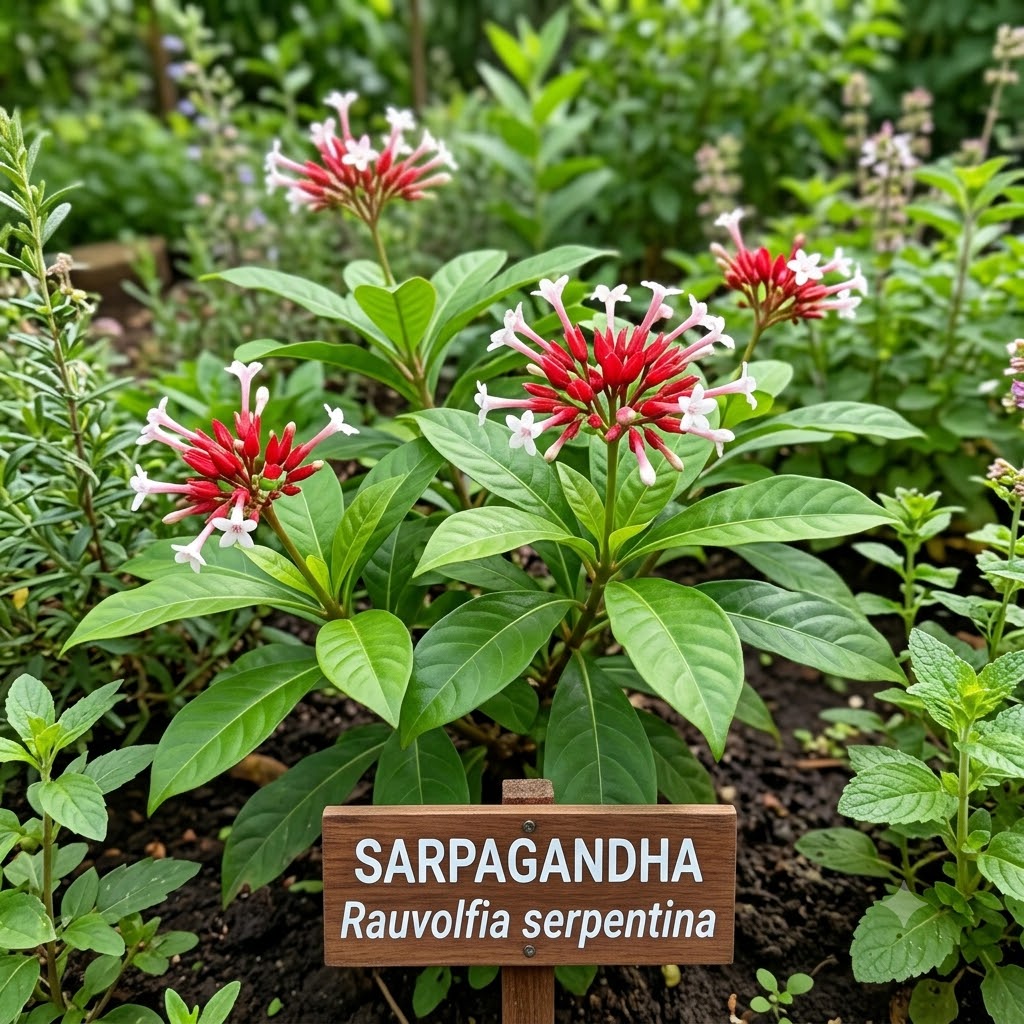
    Sarpagandha

    Botanical Name : Rauvolfia serpentine Benth. ex Kurz.

    Family : Apocynaceae

    Identification No.: SDACH/HG/071

    Introduction :

    This drug used in epilepsy,unmada etc. reserpine separated from this plant .

    Sarpagandhaa of Ayurvedic texts was not the Sarpagandhaa of modern medicine.

    Bapalalji reported that according to Bengali Kavirajas, Rauwalfia serpentina is one of the 3rd   types of  Rãsnã

    Names in different Indian languages :

    Hindi : Chotã chãnd, candrabhaga

    Telugu : patalagandhi

    Tamil : Sivan amalpodi

    English : Serpentina root

    Marathi : Adakayr

    Gujarathi : Amalpodi

    Kanada : sutranabi

    Malayalam : Amalpori, chuvanna amalpori

    Sanskrit : sarpagandha

    Folk : Chhotaa Chaand

    Synonyms :

    “Sarpagandha chandrika chandramarahitapriya | 

     Nakuli nakuleshta cha sarpadanshahara tatha ||”

    (Bhav Prakash Nighantu, Guduchyadi Varga, Shloka 180) 

    Nakuli , Sarpachhatrikaa, Varshaasu Chhatrikaaraa, Candramara, Dhavala , Sarpasugan Sugandha,  Muktã, Nakulestã

    Varieties & adulterants – (CV – controversy, AD – adulterants) :

    1. R. tetraphylla  – AD

    Morphology :

    Glabrous under-shrub with red pedicels and calyx.

    Leaves in whorls 3-4, rarely opposite, elliptic-lanceolate or obovate acute or acuminate.

    Flowers— white, tinged with violet in irregular corymbus cymes. Corolla is salver- shaped, tube cylindric, white or fanged with red.

    Fruits— obliquely avoid drupes, purple-black when ripe, Seeds ovoid.

    Flowers and fruits almost throughout the year but mainly during February-May.

    Distribution :

    Grows in waste places and shady forests in India. It is now considered as an endangered species in many parts of India.

    Habitat :

    All over India, mostly in Bihar. Bengal, Konkan and Uttar Pradesh. Also found in Burma, Sri lanka. Java and Andamans.

    Chemical composition :

    It contains salt, resin, white juice, gum, potassium carbonate, phosphate. calcium. cautic and manganese. In addition to these, there are about twenty five elements usually observed. Ajmalicidine, ajmalicine, rouhjmbiiie . Indobinine, reserpiline, reserpine, sarpagine, serpentine, serpentinine, yohimbine, ajmalimine, ajmaline, rauwolfinine (perakenine), sandwicolidine, serpinine etc. Reserpine (an indole alkoloid) is the antihypertensive principle having tranguillizing property also. Ajmaline in combination with other hypotensive agents, is used in the treatment of HTN complicated with sarrythmia.

    Properties :

    Rasa Tikta

    Guna Rüksa

    Virya Usna

    Vipãka Katu

    Karma : Kapha-vata hara, Nidrajánaka

    Laxative, anthelmintic, thermogenic,  diuretic, sedative

    Indications :

    Apäsmara, Unmãda, Sirãgata vãta, Anidra, Bhrama, süla, Raktasammarda.

    hypertension,  epilepsy, giddiness, fever, wounds, colic, insomnia, hypochondria, neuropsychiatric, disorders, psychosis, schizophrenia

    Part Used :

    Root

    Dosage :

    Insomnia 3-6 g; hypertension 1-2 g.. Schizophrenia 3- 6g.

    External uses :

    Juice of leaves can be applied to the eyes as a remedy for corneal opacity.

    Internal uses :

    Nervous Systems : Being analgesic, sedative koastashamak, it is used in insomnia and irrigative conditions of the nervous systems. As it is used in mental disturbance.

    Digestive System : Because of ushna vidrya and tikta guna, it acts as an appetizer; digestive, cholagogue, anthelmintic, Hence it is used in loss of appetite, helmnthiasis etc. For pain in abdomen; 1 part of sarpagandha roots +2 parts of bark of kutaja +3 parts of roots of castor mixed with milk is given.

    Circulatory System: salt reduces the heart rate and dilates the blood vessels with lowering of blood pressure. Because of this special property of reducing the blood pressure, it is a universally known medicine. Along with reducing blood pressure it causes drossiness, reduces giddiness and mental tension.

    Reproductive System : It reduces libido and increases menstrual bleeding. So it is used for priapism and excessive libido. It reduces pain of dysmenorrhoea. It is also used to increase uterine contraction during labour.

    Temperature : Because of its tikta rate it is amapachak as well as antipyretic. especially effective in lever caused by vata pitta, contageous fever and insomnia.

    Satmikaran : It is antidote to snake bite

    Precautions : It should be used only on established disease with mental disturbance. Ii should be used with caution in patients who are mentally as well as physically weak. The result of the medicine is expected within a week but within 3 to 6 weeks results are definitely seen. After stopping the medication its effect is washed out in into 3 weeks. The blood pressure fluctuates according to change of body conditions, which does not happen with this medicine. It  causes diarrhoea and bad dreams if given in larger dose. Sarpagandha sometimes causes blocking of nose, weight gain, reduced libido and increased intestinal motility.

    Contraindications : Bronchial asthma. duodenal ulcer. hyperacidity, renal pain and mental instability.

    Important Yogas or Formations :

    Sarpagandhadi churna, Sarpagandha yoga. Sarpagandha vati (Maheshwari vats) Saragandhãdi cürna, Sarpagandhaghanavati

    Important research work going on :

    Anti cancerous activity

    Therapeutic Uses :

    (1) Visücikã- Sarpagandha should be given with warm water (Vai. Ma.)

    (2) Atisãra- Sarpagandha root and kutaja root are powdered and administered in diarrhoeal disorders .

    (3) Sarpa Visa- Root powder of Sarpagandha (10-20 g) is grinned with water and used internally. The same is applied locally as well.

    IUCN Status: Endangered.

    Research Updates: 

    1. Antihypertensive alkaloids (2019, J. Ayurveda Integr. Med.) 

    2. Neuroprotective reserpine (2021, Phytomedic

    3. Conservation status (2023, J. Threatened Taxa) 

    About Sarpagandha

    Botanical Name

    Rauvolfia serpentina (L.) Benth. ex Kurz

    Family

    Apocynaceae

    Identification No.

    SDACH/HG/071

    Parts Used

    Root

    Habitat

    India, Myanmar, Sri Lanka, Java

    IUCN Status

    Endangered

    Plant Photos

    Ayurvedic Properties

    Rasa

    Tikta

    Guna

    Ruksha

    Virya

    Ushna

    Vipãka

    Katu

    Contact Now

    Have queries? Contact Us.

    Have queries? We’re here to help you every step of the way.

    Contact us to get the right guidance for your academic journey at Shri Dhanwantry Ayurvedic College.

  • Katu Shigru

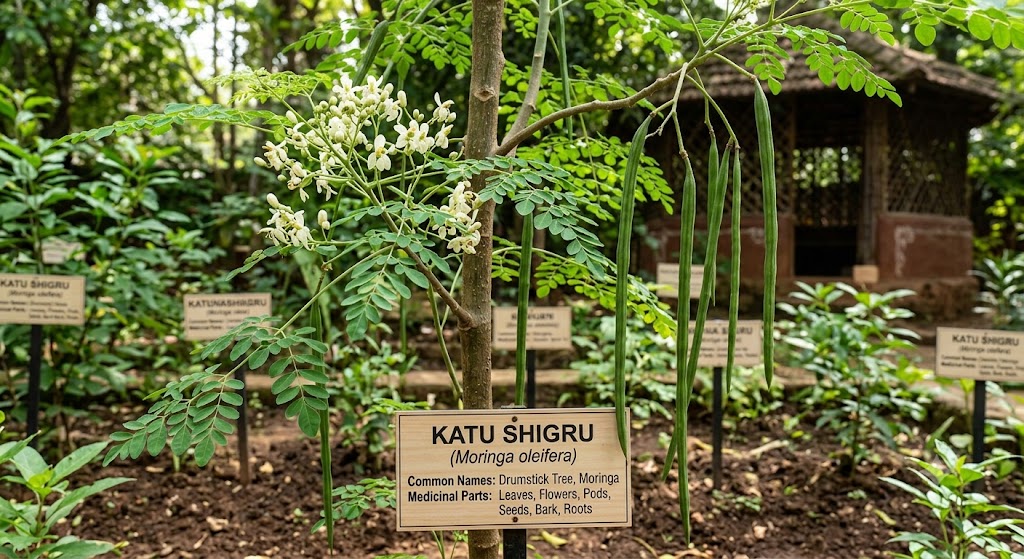
    Katu Shigru

    Botanical Name : Moringa oleifera Gaertn.

    Family : Moringaceae

     Identification No.: SDACH/HG/070

    Introduction :

    It is applied externally in krimi rogas . Leaves of Sigru are considered to be sukrala, chakusya, Vishaghna.

    Scientific classification: The horseradish tree belongs to the moringa family, Moringaceae. It is classified as Moringa pterygosperma.

    Names in different Indian languages :

    Hindi : Sahijana

    English : Drum stick plant, Horse-radish tree

    Telugu : Munaga chettu

    Tamil : Murungal

    Malayalam : muringa

    Kanada : Nuggi, Murunga

    Sanskrit : Sigru, sobhanjanah

    Unani : Sahajan

    Synonyms :

    Madhu Shigru, Sigra, Shobhaanjana, Haritashaaka. Raktaka, Murangi, Mochaka, Akshiva, Tikshnagandhaa.

    Moringa oleifera Lam

    Classification according to Charaka, Susrutha & Vagbhata :

    Charaka

    Krmighna. Svedopaga, Sirovircecanopaga, Katuka skañdha

    Susrutha

    Varunädi, sirovirecana

    Vagbhata

    Varunädi

    Varieties & adulterants – (CV – controversy, AD – adulterants) :

    1. Sveta Sigru & Madhu Sigru

    2. Rakta Sigru or Sigruka

    3. Moringa coñeanensis Nimmo

    4. M. oleifera Lam

    5. Sweet sigru

    6. Bitter sigru

    Types : Depending on the types of flowers, it is classified into two (1) white and (2) reddish white.

    Morphology :

    A small or medium-sized tree, growing upto 12m. Bark- corky, soft, thick, deeply fissured. Wood is soft.

    Leaves: tripinnate, Rachis slender, 30.5-61.0 cm long; leaflets elliptic.

    Flowers: bisexual, irregular, fragrant, white, in large panicles.

    Fruits:pod, triangular ribbed, pendulous, greenish, 25-50.00 cm

    Seeds : Trigonous, winged

    Distribution & Habitat :

    All over India.

    Chemical composition :

    Bark- sterols, terpenes (bayrenol)

    Leaves- amino acids viz., aspartic and glutamic acid, serine.

    Whole plant- moringine, moringinine, bayrenol, indole acitic acid, concanensis acid, pteregospermine, carotene etc.

    Seeds: contain stable, clean, colourless oil

    Root:  bad smelling volatile oil

    Flowers- Ouercetin, kaempferol.

    Properties :

    Rasa:  Katu, Tikta

    Guna:  Laghu, Ruksa, Tiksna

    Virya:  usna

    Vipaka: katu

    Karma : Kapha-vãtahara, sukrala, Grãhi, Dipana, Hridya, chaksusya

    Anti inflammatory (but irritates Kidney ) ,Cardiac and circulatory stimulant, antipyretic, anthelmintic, digestive, Anti allergic, carminative, laxative, diuretic. Cardiac tonic, antiepileptic.

    Indications :

    Krimi, Pimaroga, Galagama, sirahsãla, Kandü, sotha, Apaci, Vrana, Medo roga, Vidradhi, Gulma.

    Rheumatic arthritis, nervous debility, asthma, enlarged liver and spleen, deep-seated inflammation

    Part Used :

    Panchang

    Dosage :

    Root bark juice 25-50 ml, seed powder 2-4 g, stem bark

    Important Yogas or Formulations :

    Sigru pusparasayana,sigruvadi lepa.

    External uses :

    A paste of bark and leaves produces burning sensation, is anti-inflammatory and acts on abscesses. It is applied topically on inflammation and abscess. Seed powder is the best shirovirechana  nasya, Seed powder is administered nasally in headache and heaviness of the head produced by kapha. Seed oil is analgesic hence used in rheumatoid arthritis and painful diseases.

    Internal uses :

    Nervous system as it is tikshna and ushna, it is a nerve stimulant. The non crystalline part of the bark is very strong and it acts through afferent nerves on the body. Because of this, it cause hypertension, increases heart rate and contracts the blood vessels. It towers the function of muscles in respiratory as well as digestive system. Dilatation of pupil occurs similar to the action of adrenalin and ephedrine. Tender plant root is useful in epilepsy.

    Digestive system : As it is pungent and tikshna, it improves appetite, is digestive,Vidahi, grahi Induces motility), analgesic, antibacterial and de-worming agent. Madhu shigru is viscous and sweet and so it is purgative. In unassimilated internal abscess. madhu shigru is used in lunch, drink and in external application also. It is useful in lose of appetite, tastelessness, pain in abdomen, ascites, gulma and worms.

    Circulatory system : Due to ushna guna it acts as a stimulant to heart, creates hypertension and is anliinflamrnatonj. It is used in weakness of heart and inflammation.

    Respiratory system : Kaphaghna. Useful in kaphaja kasa. Seed powder is useful for shodhana nasya.

    Urinary system : As it is ushna & tikshna. it stimulates the kidneys and increases the quantity of urine. It is useful in dysuria and in increased acidity in urine. In calculi its decoction is useful. It is not used in hydronephorsis, as it irritates the kidneys and increases inflammation.

    Reproductive system : It stimulates menstruation and as it is ushna and anti inflammatory, it is useful in dysmenorrhoea and obstructed menstruation.

    Satmikaran : It controls medoroga and reduces effects of poison. It reduces shukra therefore one should not use it in conditions involving reduced shukra. It acts on shukra but reduces it.

    Skin : Tikshna and ushna, induces sweating. Therefore its hot infusion is used in skin diseases. If there are maggots in the wound fresh bark paste is applied and bandoged on the wound. Due to its smell, all maggots come out. (Turpentine and resin ad similarly).

    Temperature : Since it is a diaphoretic, its hot infusion is used in fever associated with rigors caused by obstruction of sweat. The legumes of shigru are used as diet in post . pyrexial conditions.

    Eyes : The seeds are used for topical application in the eyes: It is useful in eye disorders produced by kapha.

    Excess intake : As it is ushna, tikshna, it produces raktapitta and burning sensation if taken in excess dose. It is contraindicated in pitta prakriti and, raktapitta. (According to some experts, it is superior to penicillin in preventing inflammation and suppuration in traumatic ‘wounds without any side effects as in penicillin).

    Important research work going on :

    (1) Antimicrobial and antibacterial activity

    (2) Action on Eye.

    (3) Antifungal activity

    (4) Antiviral activity

    (5) Anti-inflammatory activity

    Therapeutic Uses :

    (1) Pratisyãya- Root of Sigru should be taken with ghee oil as Anupãna (G.N.)

    (2) Krimi- Decoction of Sigru stem bark is given with Vidanga

    & honey (V.S.).

    (3) Netraroga- Eyes are cleansed with the juice Sigru leaves

    (4) Dadru Kustha- Sigru root bark paste is applied locally

    IUCN Status: Least Concern. 

    Research Updates: 

    1. Antidiabetic effects (2020, J. Food Sci.) 

    2. Nutritional supplementation (2021, IJNPR) 

    3. Anti-inflammatory activity (2023, AJAY) 
     

    About Katu Shigru

    Botanical Name

    Moringa oleifera Gaertn.

    Family

    Moringaceae

    Identification No.

    SDACH/HG/070

    Parts Used

    Panchang (Whole plant)

    Habitat

    India

    IUCN Status

    Least Concern

    Plant Photos

    Ayurvedic Properties

    Rasa

    Katu, Tikta

    Guna

    Laghu, Ruksha, Tikshna

    Virya

    Ushna

    Vipãka

    Katu

    Contact Now

    Have queries? Contact Us.

    Have queries? We’re here to help you every step of the way.

    Contact us to get the right guidance for your academic journey at Shri Dhanwantry Ayurvedic College.

  • Madhushigru

    Madhushigru

    Botanical name :Moringa concanensis

    Family :Moringaceae

     Identification No.: SDACH/HG/069

    Morphology

    M. concanesis is a   evergreentree with a spreading crown, upto 8 feet.

    Leaves alternate, 2-3- pinnate, obovate,caducous.

    Flowers large, white,hermophrodite, irregular in axillarypanicles.

    Calyx thinly tomentose, long,segments white, oblong, reflexed. Petalsyellow, veined with red, oblong.

    Stamens 5 fertile and 4-5 staminodes.

    Capsule straight, actively triquetrous,slightly contsricted between the seeds.

    Seeds white or pale yellow 3- angled.

    Therapeutic Uses

    Eye care – Leaves

    Leaves of M. concanensis werecollected, washed and cooked asa vegetable and taken internallytwice in a week will produce cooling effect of eyes and prevent sore eyes.

    Thyroid Problems – Flower50 gms of juice of fresh flowers is to be taken twice a day for 30days. It will cure the thyroid problems in human being specially in women.

    Fertility in women – Leaves30 gms of juice of fresh leaves is to be taken internally on empty stomach.

    Tiredness –  Leaves Decoction of the leaf is mixedwith sugar and taken internallyin the early morning in an empty stomach for 7 days.

    To reduce Blood Pressure –   Leaves50 gms of leaves were boiledwith 1g of Milagu (Pipernigrum) on 200ml of water.Then filtered and taken internally for 7 days in the early morning.

    About Madhushigru

    Botanical Name

    Moringa concanensis Nimmo ex Dalzell & A.Gibson

    Family

    Moringaceae

    Identification No.

    SDACH/HG/069

    Parts Used

    Leaves, Flowers, Root, Bark

    Habitat

    India, Pakistan

    IUCN Status

    Not Evaluated (NE)

    Plant Photos

    Ayurvedic Properties

    Rasa

    Katu, Madhura, Tikta

    Guna

    Laghu, Ruksha, Tikshna

    Virya

    Ushna

    Vipãka

    Katu

    Contact Now

    Have queries? Contact Us.

    Have queries? We’re here to help you every step of the way.

    Contact us to get the right guidance for your academic journey at Shri Dhanwantry Ayurvedic College.

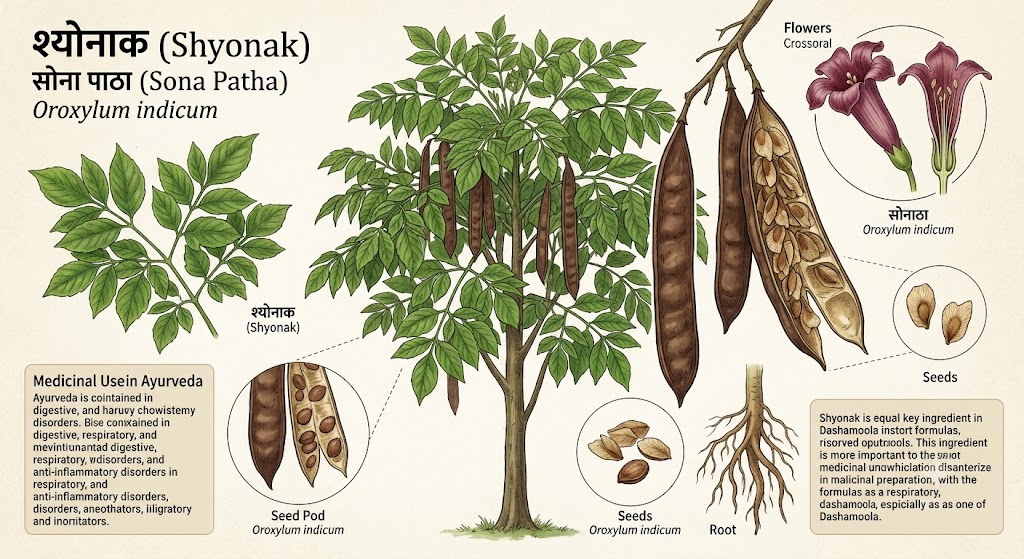
  • Shyonak

    Shyonak

    Botanical Name : Oroxylum indicum Vent.

    Family : Bignoniaceae

     Identification No.: SDACH/HG/068

    Introduction :

    It is one of the important trees included under Dasamula group.

    Names in different Indian languages :

    Hindi : Sonapatha, syona, arlu, pharkhat

    Telugu : Dundilum, pampana

    Tamil : palaiyudaycci

    English : Indian trumpet tree

    Marathi : Tentu

    Gujarat : Tentu

    Bengali : Sona

    Kanada : tattuna

    Malayalam : Palakappyani, payyalanta

    Sanskrit : Syonakah, tuntukah

    Synonyms :

    Shoshana, Tuntuka, Kutannata,Madhukparna, Patrorna, Bhalluka, Prthushimba, Nata

    Classification according to Charaka, Susrutha & Vagbhata :

    Charaka

    sothahara, Sitaprasamana, Anuvãsanopaga

    Susrutha

    Rodhrãdi, Viratarvãdi, Brhat pancamula

    Vagbhata

    Rodhrãdi, Viratarvãdi

    Varieties & adulterants – (CV – controversy, AD – adulterants) :

    Calosanthes indica  [AD]

    Ailanthus malabarica – CV

    Morphology :

    A tree about 8-15 m high.

    Leaves— Opposite, very large 90 -180 cm, ternately bipinnate; leaflets ovate entire acuminate peduncle, rachis very soft.swollen at the junction of joints.

    Flowers— in racemes (25 cm long: approx), foetid; fleshy, reddish purple outside, pale yellow within.

    Fruits— Flat capsule, large- linear compressed capsules, septicidally bivalved.

    Seeds— discoid thin, wing hyaline and broad.

    Flowers and fruits during July-November.

    Distribution & Habitat :

    Found in the warmer parts of India (upto 1200 m.). Also cultivated, as an avenue tree.

    Chemical composition :

    Its root bark contains oroxylin. Besides this, one bitter principle, pectin, fats, wax, chlorophyl, astringent principle, citric add. Baicalein, Tetulin, oroxindin, aloe-emodin, Chrysin, 6- methylether of baicalein oroxylium A; p-coumaric acid,.scutellarein-7-rutinoside, prunetin, -sitosterol etc.

    Properties :

    Rasa Madhura, Tikta, Kasaya

    Guna Laghu, Ruksa

    Virya Usna

    Vipãka Katu

    Karma : Kapha-vatahara, Dipana, Grãhi

    Digestive, constipative, diuretic, carminative, stomachic, spasmolytic, astringent, antidiarrhoeal

    Part Used :

    Root bark.

    Dosage :

    Powder 3-6 g, decoction 50-100 ml

    Indications :

    Amavãta, Atisãra, Aruci, Kãsa, Basti vikãra, Vataroga, sotha,

    dropsy, cough, asthma, anorexia, flatulence, gout, vomiting, rheumatoid arthritis, fever, dysentery.

    Important Yogas or Formations :

    Shyonak putpak, Brihatpanchamooladi decoction (decoction of bark is not done).  arista, Dasamuladi Kvãtha, syoñaka puapãka, syonãkadi yoga, Mulaka taila, syonaka taila, Himsrãdi yoga.

    Important research work going on :

    (1) diuretic activity

    (2) Spasmogamic action.

    (3) action on ADH

    Therapeutic Uses :

    Nasaroga— Dhuma with satapuspa, Tvak, Balãmüla, syonãka, Eranda, Bilva and Aragvadha mixed with ghee, vasã and bee-wax (A.H.Ut. 20).

    IUCN Status: Least Concern. 

    Research Updates: 

    1. Anti-arthritic effects (2020, J. Ethnopharmacol.) 

    2. Antioxidant properties (2021, Phytomedicine) 

    3. Antimicrobial activity (2022, IJPR) 


    About Shyonak

    Botanical Name

    Oroxylum indicum Vent.

    Family

    Bignoniaceae

    Identification No.

    SDACH/HG/068

    Parts Used

    Root bark

    Habitat

    India, Bangladesh, Sri Lanka, Myanmar

    IUCN Status

    Least Concern

    Plant Photos

    Ayurvedic Properties

    Rasa

    Madhura, Tikta, Kashaya

    Guna

    Laghu, Ruksha

    Virya

    Ushna

    Vipãka

    Katu

    Contact Now

    Have queries? Contact Us.

    Have queries? We’re here to help you every step of the way.

    Contact us to get the right guidance for your academic journey at Shri Dhanwantry Ayurvedic College.

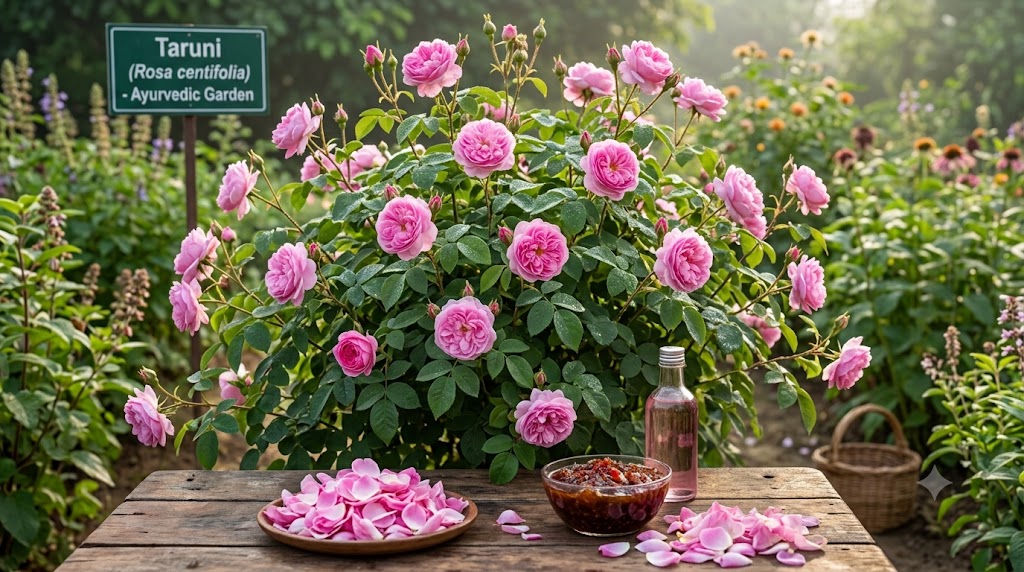
  • Taruni

    Taruni

    Botanical Name : Rosa centifolia Linn.

    Family : Rosaceae

    Identification No.: SDACH/HG/067

    Introduction :

    Latin name : Rosa = Latin name, a root word for colour in many languages; centifolia = hundred petals

    Scientific classification: Roses make up the family Rosaceae of the order Rosales. The representative genus is Rosa. Hybrid perpetuals, or remontant roses, are derived mainly from the hybrid species Rosa borboniana; polyantha roses from the hybrid species Rosa rehderana;tea roses from Rosa odorata; and China roses from Rosa odorata andRosa chinensis.

    There were a believe, Prior to the world war scientists artificially created a ‘black rose’,  some people said that would  be a misfortune.

    Names in different Indian languages :

    English : Cabbage Rose, Provence Rose, Hundred-leaved Rose

    Hindi : Gulab

    Kannada : Gulabi,

    Malayalam : Paninir, rosappu

    Sanskrit : Taruni

    Tamil : Iroja, Rajapoo, eros

    Telugu : Gulabi, Rajapoo

    Unani : Gul-e-Surkh

    Synonyms :

    Shatapatri, Shatapatrika, Taruni, Devataruni, Karnikaa, Chaarukesharaa, Laakshaa, Gandhaaddhyaa.

    Varieties & adulterants – (CV – controversy, AD – adulterants) :

    Out of the innumerable varieties of rose, twelve are of Indian origin. Others are of foreign origin. They are classified on the basis of their fragrance, urban or wild origin and many other factors.

    Rose, common name for a medium-size family of flowering plants with many important fruit and ornamental species, and for its representative genus. Worldwide in distribution, the rose family contains about 107 genera and 3100 species.

    The rose family is placed in an order with 24 other families. This order is sometimes referred to as the rose order. Other important members of the order include the saxifrage family and the stonecrop family. Another family, the coco-plum family, occurs in the lowland Tropics and contains about 400 species, several of which are used locally for their timber, oilseeds, and fruits. Perhaps the best-known member of the family is the coco plum, found in southern Florida on sandy beaches and swamps; its sweet fruits are made into jelly or preserves.

    Plants of the rose order may vary greatly in habit, from trees to shrubs or often perennial herbs. The leaves usually have stipules (leaflike appendages at the base of the leafstalk) and are often compound. The flowers usually have five sepals (outer floral whorl) and five petals (inner floral whorl) and numerous stamens (male floral organs). The female portion of the flower consists of from one to many pistils, which are free from one another or are variously fused. The ovary or ovaries (egg-producing portion of the pistil) are hypogynous or, more often, perigynous (half-inferior), with the sepals, petals, and stamen borne on the rim of a tubular structure surrounding the ovary base

    Morphology :

    Many varieties have emerged out of hybridization. The shrub is 25 cm. to 3 mt. in height, branches bear

    thorns. Leaves – have serrated margins.

    Flowers have many shades of colours.

    Fruit – oval and becomes red on ripening.

    Distribution & Habitat :

    Garden plant

    Chemical constituents :

    saponin , methionine sulphoxide,citronellol, geraniol, nerol, phenylethanol, linalool,citral.

    Properties :

    Guna : laghu, singdha;

    Rasa : tikta, katu, kashaya. madhur;

    Vipaka : madhur,

    Virya : sheeta

    Karma :

    Ruchya, mukhsopha hara, varnya, cashkuksya

    Cardio tonic, carminative, digestive, astingent,cooling, diuretic

    Indication :

    Daham, peenasa, swasa, kasa

    Ulcers, wounds, fever, skin disease, cough, piles, leucorrhoea, mouth ulcers

    Part used :

    Whole plant

    Dosage :

    Leaf juice 10-15 ml

    Powder 2-4 g

    Decoction 50-100 ml

    External uses :

    It improves complexion and acts as wound healing, deodorant and anti inflammatory. It is therefore useful in disorders of complexion and inflammatory diseases. It removes foul smell of sweat.

    Internal Uses :

    It acts as a brain tonic as well as increases the tone of the gastrointestinal tract. It is a hepatoprotective and is useful in all digestive disorders like diarrhoea and dysentery. It is useful in diseases of the heart, bleeding disorders and other blood diseases, It is useful in fever and burning sensation. Rose buds increase the bulk of solid excrete It is also useful in impotency

    IUCN Status: Not Evaluated


    About Taruni

    Botanical Name

    Rosa centifolia Linn.

    Family

    Rosaceae

    Identification No.

    SDACH/HG/067

    Parts Used

    Whole plant

    Habitat

    India

    IUCN Status

    Not Evaluated (NE)

    Plant Photos

    Ayurvedic Properties

    Rasa

    Tikta, Katu, Kashaya, Madhura

    Guna

    Laghu, Snigdha

    Virya

    Sheeta

    Vipãka

    Madhura

    Contact Now

    Have queries? Contact Us.

    Have queries? We’re here to help you every step of the way.

    Contact us to get the right guidance for your academic journey at Shri Dhanwantry Ayurvedic College.

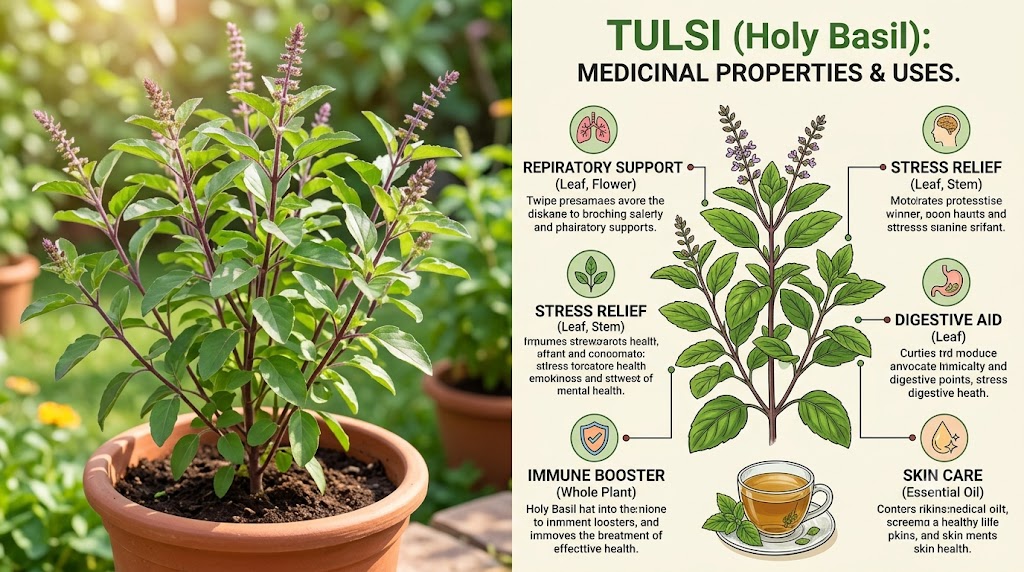
  • Tulsi

    Tulsi

    Botanical Name : Ocimum sanctum Linn.

    Family : Labiatae; Lamiaceae.

    Identification No.: SDACH/HG/066

    Introduction :

    Tulasi manily used for preparing cough syrup. It have mainly two variety.

    Scientific classification: Basil belongs to the family Lamiaceae (formerly Labiatae). Sweet basil is classified as Ocimum basilicum and bush basil as Ocimum minimum. Mountain mints are classified in the genus Pycnanthemum.

    Names in different Indian languages :

    English : Indian Basil/Holy basil, sacred Basil

    Hindi : Tulsi

    Malayalam : Tulsi, trittav, Krishna tulsi

    Sanskrit : Tulsi , surasah

    Tamil : Tulsi

    Telugu : Tulsi

    Unani : Tulsi

    Synonyms :

    Surasaa, Surasa, Bhuutaghni, Suravalli, Sulabhaa, Manjarikaa, Bahumanjari, Deva dundubhi, Apet-raakshasi, Shuulaghni, Graamya, Sulabhaa

    Ocimum  tenuiflorum Linn.

    Classification according to Charaka, Susrutha & Vagbhata :

    Charaka

    Svãsahara

    Susrutha

    Surasãdi

    Vagbhata

    Surasãdi

    Varieties & adulterants – (CV – controversy, AD – adulterants) :

    1. sukla Tulasi (O. americanum Linn.)

    2.  Krisna Tulasi (O. sanctum Linn.)

    3. O. basilicum— rama tulasi

    4. O. minimum

    5. O. gratissirnum Linn

    6. O. klimendScharicum.—  karpoora tulasi

    Morphology :

    Branched, aromatic under shrub 30-50 cm high, sometimes  woody, hairy.

    Leaves—simple, opposite,  oblong or ovate-oblong, obtuse or acute, – entire or subserrate. Petioles slender hairy

    Flowers— very small, borne in terminal and axillary racemes.

    Fruits— subglobose or broadly oblong nutlets.

    Flowers and fruits almost throughout the year (mainly during September-February).

    Habitat & Distribution :

    Found throughout India. Now being cultivated extensively.

    Chemical Constituents :

    eugenol, carvacrol, nerol, eugenolmethylether, Bornyl acetate, cadinene, camphene, camphor, carvacrol, beta-caryophellene, eugenol, eugenol methyl ether, humelene, methyl chavicol, limonene etc.

    Properties :

    Rasa- Katu, Tikta

    Guna -Laghu, Rüksa

    Virya –  Usna

    Vipäka-  Katu

    Karma Kapha-vãtahara Dipana, Krimighna Putigandhahara

    Digestive, diuretic, expectorant, febrifuge, aromatic, carminative, stomachic, antispasmodic, antiasthmatic, antirheumatic, stimulant, hepatoprotective, antiperiodic, antipyretic and diaphoretic

    Indications :

    Hikkä, Kãsa, svãsa, Visaroga, Parvasüla, Krimi, Visama Jvara.

    asthma, cardiopathy, otalgia, bronchitis, hiccough, fever, vomiting, lumbago,skin disease, fever, cough, psychosis

    Part Used :

    Leaf, root, seed.

    Dosage :

    Fresh juice 10-20 ml, root decoction 50-100 ml, seed 3-6 g.

    External uses :

    Because of its insecticidal, deodorant, stimulant, vatahara and oedema relieving actions, the paste of the leaves is useful in chronic ulcers, oedema and pain. Scrubbing of the juice on the skin improves the intradermal circulation. Juice is also used as eardrops in earache.

    Internal uses :

    Digestive system : Being an appetizer, digestive, laxative and anthelmintic. it is used in anorexia. abdominal pain and helminthiasis. Tulsi seeds are soaked in water and slimy kheer is prepared from it which is given in dysentery. Tulsi leaves should be chewed in pyorrhoea.

    Circulatory system : Since it is a cardiac stimulant, blood purifier and anti-inflammatory, it is used in cardiac debility. vatakapha disorders of blood and inflammations.

    Respiratory system : Tulsi has a main action on respiratory system. When tulsi leaves are given with honey, they act as an expectorant and alleviate the symptoms like cough induced by kapha. dyspnoea and fever. Tulsi is a very good home remedy for common symptoms like lever, cold and cough.

    Urinary system : Tulsi seed is diuretic. It alleviates gonorrhoea, dysuria, burning micturation, cystitis, calculi and also urethritis.

    Skin : Diaphoretic, effective in skin diseases, Hence it is used in fever and particularly in ringworm infection, eczema and scabies. The paste of tulsi leaves and black pepper is effective in ringworm infection (It is worn with red. hibiscus flowers in a gadded for Ganeshpooja).

    Temperature : Febrifuge. Useful in fever with chills and intermittent fever. Decoction of tulsi leaves is also useful in chronic fever,

    Satmikaran : Seed is a tonic, Kheer prepared from the seeds should be used in debility due to pittadosha.

    Formulations : Tulsi leaves are being used for trituration in preparing many Ayurvedic formulations. (It may ad as a preservative).

    Important Yogas or Formations :

    Surasadigana Kasaya, Surasãdi taila, Tumburvãdi yoga, Nimbãdi lepa, Sahacarãdi taila, vilwadi gulika, tulasi patradi tailm.

    Important research work going on :

    (1) Antifertility activity

    (2) Biochemical clearance

    (3) Hypoglycaemic effect

    (4) Hypo- tensive effect

    (5) Mosquito larvicidal as well as mosquito-repellent action

    (6) Antibacterial activity

    (7) Antifungal activity

    (8) Antiviral activity

    (9) Anti-stress activity

    Therapeutic Uses :

    (1) Kaphaja Kasa— Fresh juice of Krishna Tulsi is given with honey (C.S.Ci. 18).

    (2) Makkalasula— juice of Tulasi leaves is taken with old jaggery and Manda (G.N.)

    (3) Paksmasãta— A copper vessel is impregnated with paste of Puspa Kãsisa mixed with Tulasi juice and left for 10 days. After wards that paste is collected and used as Añjana (A.H.Ut. 9/20).

    IUCN Status: Least Concern. 

    Research Updates : 

    1. Immunomodulatory effects (2020, J. Ethnopharmacol.) 

    2. Antidiabetic activity (2021, Phytomedicine) 

    3. Antiviral properties against respiratory viruses (2022, IJPR) 

    About Tulsi

    Botanical Name

    Ocimum sanctum Linn. (Ocimum tenuiflorum L.)

    Family

    Lamiaceae (Labiatae)

    Identification No.

    SDACH/HG/066

    Parts Used

    Leaves, Root, Seeds

    Habitat

    India

    IUCN Status

    Least Concern

    Plant Photos

    Ayurvedic Properties

    Rasa

    Katu, Tikta

    Guna

    Laghu, Ruksha

    Virya

    Ushna

    Vipãka

    Katu

    Contact Now

    Have queries? Contact Us.

    Have queries? We’re here to help you every step of the way.

    Contact us to get the right guidance for your academic journey at Shri Dhanwantry Ayurvedic College.

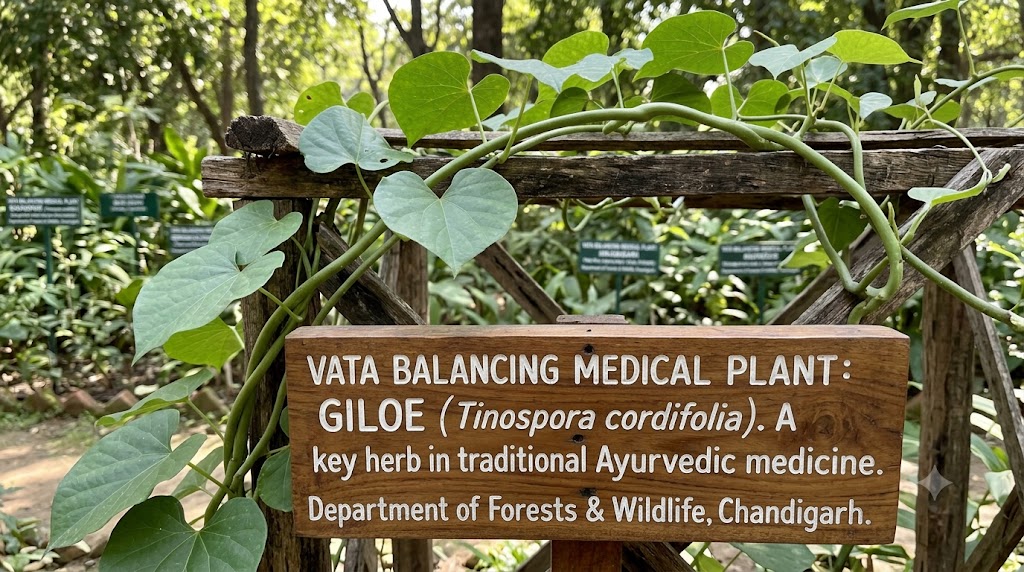
  • VATA

    VATA

    Botanical Name : Ficus benghalensis Linn

    Family : Moraceae

    Identification No.: SDACH/HG/065

    Introduction :

    It is one of the good medicine useful for skin disease. This is one of the plant can act as key stone species of the forest.

    Names in different Indian languages :

    English : Banyan tree

    Hindi : Bat, bargad

    Kannada : Ala

    Malayalam : Peral, vatavriksham

    Sanskrit : Nyagrodha

    Tamil : Alamaram, peral

    Telugu : peddamarri

    Unani : Bargad, Darakht-e-Reesh

    Synonyms :

    “Vaṭaḥ plakṣaḥ nyagrodhaḥ skandhajūṭaḥ kuṭumburuḥ” 

    (Bhav Prakash Nighantu, Vatadi Varga, Shloka 30) 

    Vata, Nyagrodha, Bahupaada, Dhruv.

    Varieties & adulterants – (CV – controversy, AD – adulterants) :

    Ficus Elastica

    ficus glomerata

    Morphology :

    Large sized tree grows up to 30 m height, it have aerial roots, to to this it can spread large number of branches even hectares.

    Leaves – simple, alternate, broadly elliptic

    Flower- hypanthodium  inflorescence

    Fruit – axillary , sessile , reddish when ripe

    Distribution & Habitat :

    All over India

    Chemical constituents :

    Phytosterolin, bengalenoside, flavonoid glycosides, leucocyanidin and leucopelargonidin

    Properties :

    RASA-kashaya, madhura

    GUNA-guru

    VIRYA-sitha

    VIPAKA-katu

    Karma :

    Grahi, stanbana,  vrana hara, sophahara, varnya, vataprakopanam

    Acrid, depurative, ophthalmic, antiarthritic , anti emetic

    Indication :

    diabetes, dysentery, and in seminal weakness, leucorrhoea, menorrhagia, nervous disorders, erysipelas, burning sensation

    Milky juice and seeds—applied topically to sores, ulcers, cracked soles of the feet, rheumatic inflammations.

    Buds—a decoction in milk is given in haemorrhages.

    Part used :

    Root, aerial root, leaves , bark, latex, fruit

    Important Yogas or Formations :

    Panchavalkaladi ghridha and taila, naalpamaradi kashya and taila

    Therapeutic Uses :

    Leaves— useful for promoting suppuration in abscess.

    Bark decoction useful in skin disease

    Fruit juice useful in stop vomiting.

    IUCN Status : Least Concern. 

    Research Updates: 

    1. Hypoglycemic effects (2020, J. Ayurveda Integr. Med.) 

    2. Wound healing latex (2021, IJNPR) 

    3. Anti-arthritic activity (2023, AJAY)

    About VATA

    Botanical Name

    Ficus benghalensis Linn.

    Family

    Moraceae

    Identification No.

    SDACH/HG/065

    Parts Used

    Root, aerial root, leaves, bark, latex, fruit

    Habitat

    India

    IUCN Status

    Least Concern

    Plant Photos

    Ayurvedic Properties

    Rasa

    Kashaya, Madhura

    Guna

    Guru

    Virya

    Sheeta

    Vipãka

    Katu

    Contact Now

    Have queries? Contact Us.

    Have queries? We’re here to help you every step of the way.

    Contact us to get the right guidance for your academic journey at Shri Dhanwantry Ayurvedic College.

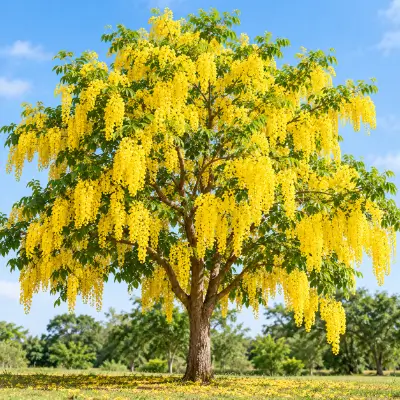
    Aragwadha

    Botanical Name: Cassia fistula Linn.

    Family: Caesalpiniaceae

    Identification No.: SDACH/HG/001

    Introduction: In Vedic literature the dried branches of Aragvadha are used for ritual performance Several external applications containing Aragvadha are mentioned in  Ayurveda ( psoriasis etc.)

    Scientific classification: Sennas belong to the subfamily Caesalpinioideae, family Fabaceae (formerly Leguminosae). Alexandrian senna is classified as Cassia acutifolia. The species from which tinnivelly, or Indian senna, is obtained is classified as Cassia angustifolia

    Names in different Indian languages:

    English : Indian Laburnum,Purging Cassia,Golden Shower

    Hindi: Amaltas,girimala

    Kannada: Phallus,kakke,kakke mara

    Malayalam: Konna,kanikonna

    Sanskrit: Aaragvadha

    Tamil: Sarakkonrai

    Telugu: Rela,kondrakaya,aragvadamu

    Synonyms:

    Chaturaangula, Kritamaala, Kritmaalaka, Karnikaara, Shampaaka, Praagraha, Raajvrksha, Nripapaadapa, Raajadruma, Vyaadhighaataka, Aarevata.

    Cassia rhombifolia Roxb

    Classification according to Charaka, Susrutha & Vagbhata:

    Charaka: Kusthaghna, Kandüghna, Tiktaskandha, Virechana

    Susrutha: Aragvadhadi, Syamadi, Slesmasamsamana, Adhobhagahara

    Vagbhata: Aragvadhãdi, syãmadi

     Varieties & adulterants – (CV – controversy, AD – adulterants):

    1.Karnikara

    2.Pãlevatam

    3. Madhura (sweet)

    4. Amla (sour)

    5. praravata-  Psidium guyava

    6. Garcinia mangostan.

    Cassia roxburghii – AD

    Morphology:

    It is moderate-sized tree, 10-12 m. in height.

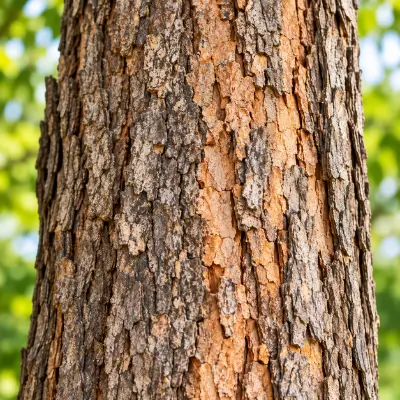
    Bark- greenish-grey, smooth when young then brick-red.

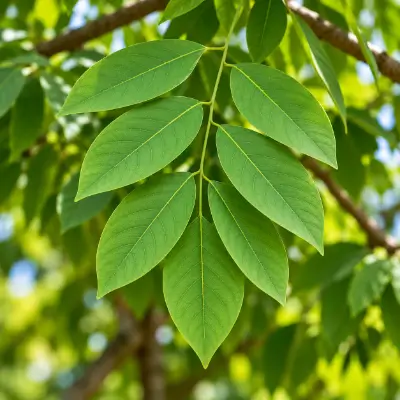
    Leaves- paripinnate, 4-8 pairs, ovate, acute, bright green, glabrous above, silvery pubescent beneath. 10-15 cm long

    Leaflets 4-8 pairs, about 2-5 cm, acuminate, ovate-lanceolate.

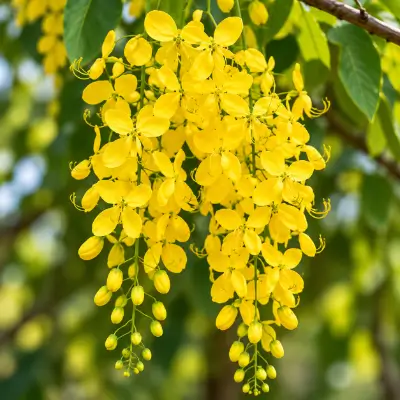
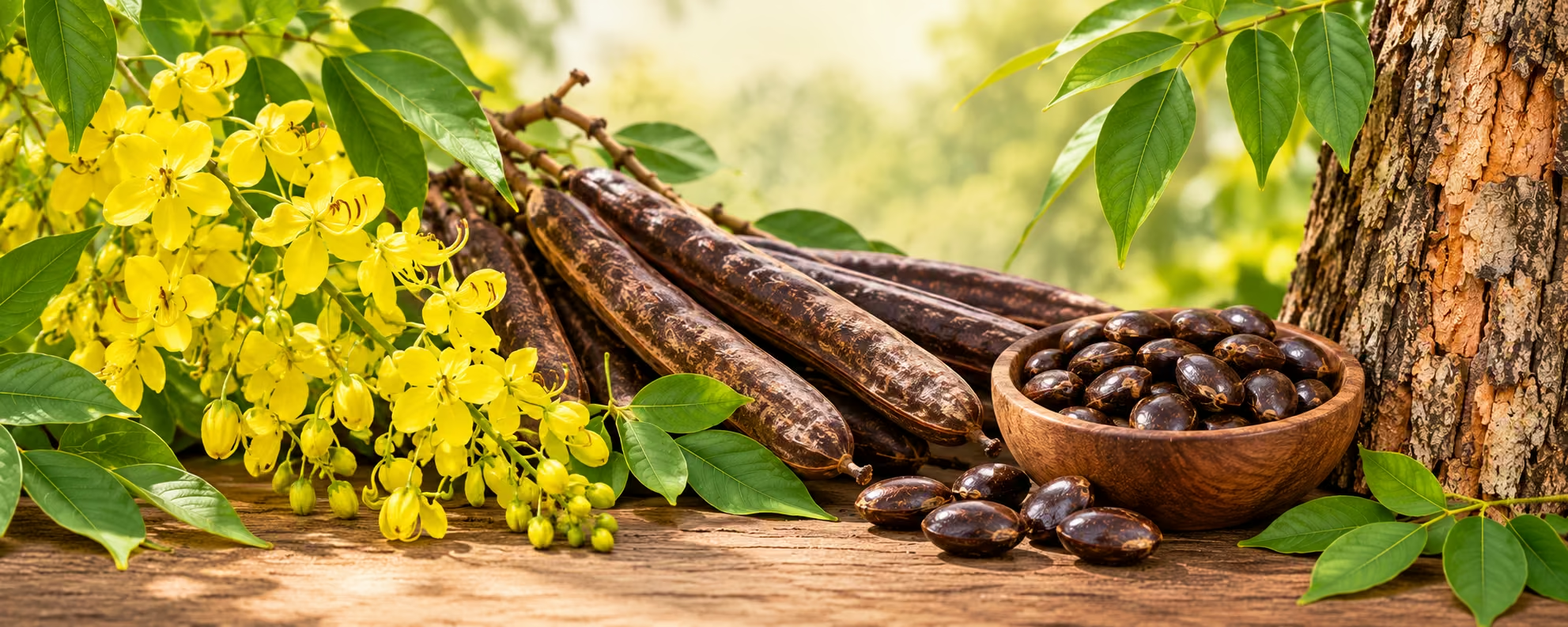
    Flowers- in lax pendulous racemes, yellow, fragrant.

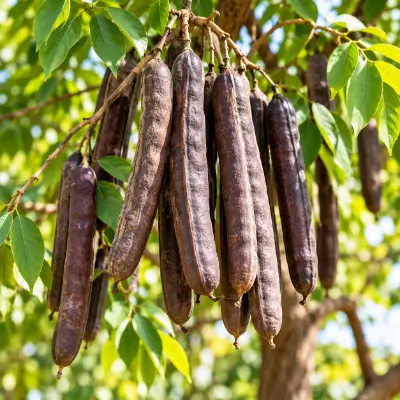
    Pods- cylindrical, pendulous, indehiscent, 25-30 cm long and 2-3.0 cm diam.

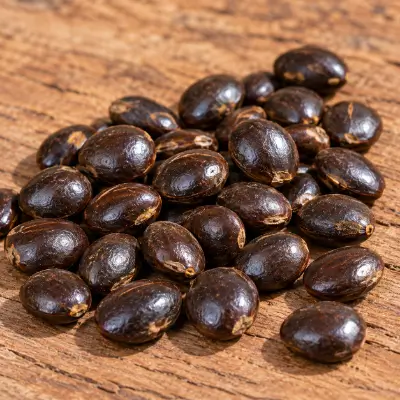
    Seeds- numerous, small, flat, smooth, yellowish-grey

    surrounded by black pulp when ripen pulp will be sweet.

    (Flowers in March-May and fruits in May).

    Habitat  & Distribution:

    All over India, Srilanka, Nepal

    Chemical composition:

    Anthraquinone glycosides, sennosides A and B, rhein

    Pulp glucose 60%, glutin. pectin, dyes, calcium oxalate. minerals. gum and water.

    Seeds- sugars, galactomannan

    Flowers- fistulin, leucopelargonidin tetrarner, kaempfer oil

    Pods- fistulic acid  Bark & Heart wood- barbl Oil, fistucacidin, etc.

     Leaves- Rhein, sennosides A & B

    Properties:

    Rasa :  Madhura

    Guna : Madura, Guru, Snigdha

    Virya : Sita

    (Usna: Dhanvañtari Nighandu)

    Vipãka: Madhura

     Karma : Kapha-pittahara , kushtaghna, arsoghna, vrana hara

    Laxative, blood purifier, febrifugal, astringent, antibilious.

    Indications:

     Kustha, Prameha, Hrdroga, Amavãta, Gandamãlã, Kãmalã, Udara, Udãvarta, Vatarakta, Sula, Jvara

    Constipation, colic, chlorosis and urinary disorders,gout, skin disease, psoriasis, fever

    External uses:

     It is anti-inflammatory,analgesic.

    The pulp and leaf paste are used in nodular oedema & gout. rheumatoid arthritis etc.

    The decoction is used for gargling in diseases of oral cavity and throat,

    Leaf paste is used in skin disease and itching.

    Internal uses:

    Nervous system: It is analgesic by vatahara property, so useful in vata diseases.

    Digestive system: It is bitter so improves taste, It is a liver stimulant and purgative by snigtha properties. It is a mild purgative drug and is useful in constipation and jaundice.

    Circulatory system: It is cardioprotective, antiinflammatory, purifies blood so useful in heart disease, haemorrhagic ditorders, gout and swellings.

    Respiratory system: As it is madhur, snigdha, removes kapha and soothes internal organs by mridu property, in dry cough and dyspnoea flower’s avaleha is given.

    Urinary system: Diuretic by sheeta properly. It  soothes the urinary tract. Seeds are antidiabetic

    Skin: Kushthaghna and refrigerant, so used in skin disease and burning.

    Temperature: It is antipyretic, so used in fever and purgation. Its bitter taste works in digestion and is pittashamak. Bark of root is used in fever.

    Srotogamitwa:

    Dosha : Pitta. kaphaghatna ,liver stimulant

    Mala: Purgative.

    Parts used: 

    Root bark, leaves, flowers,fruit pulp

    Dosage:

    Decoction of root bark 75-100 ml.

     Flower paste 6-10 g

    Important Yogas or Formulations:

    Aragvadhadi taila, Arngvadhadi leha, Aragvadharishta..

    Therapeutic Uses:

    1. Kãmalã- Aragvadha (fruit pulp) is given with the juice of sugarcane or vidari or Amalaki after fortifying with Trikatu. (A.H.)

    2. Gandamãlã- Root bark of Aragvadhã is grinded with rice-water and used for Nasya and lepa (V.M.)

    3. Kustha- Leaves of Aragvadhä are made into paste with Amãlaka and applied externally.

    IUCN Status  – Least Concern (Not threatened)

    Research Updates (Past 5 Years)

    1. Antidiabetic Activity (2021): Study confirmed hypoglycemic effect of C. fistula pulp extract.

    2. Antimicrobial (2022): Pod extract showed efficacy against Staphylococcus aureus.

    3. Hepatoprotective (2023): Bark extract reduced liver toxicity in animal models.

    About Aragwadha

    Botanical Name

    Cassia fistula Linn.

    Family

    Caesalpiniaceae

    Identification No.

    SDACH/HG/001

    Parts Used

    Root bark, Leaves, Flowers, Fruit pulp

    Habitat

    India, Sri Lanka, Nepal

    IUCN Status

    Least Concern

    Plant Photos

    Ayurvedic Properties

    Rasa

    Madhura

    Guna

    Madura, Guru, Snigdha

    Virya

    Sita

    Vipãka

    Madhura

    Contact Now

    Have queries? Contact Us.

    Have queries? We’re here to help you every step of the way.

    Contact us to get the right guidance for your academic journey at Shri Dhanwantry Ayurvedic College.

    VATA