Shri Dhanwantry Ayurvedic College

Category: Dravyaguna Vigyan Blogs

  • Palasha

    Palasha

    Botanical Name : Butea monosperma 

    Family : Papilionaceae; Fabaceae

    Identification No.: SDACH/HG/048 

    Introduction :

    It is the most important plants for the Yajna. Its gum (red coloured) is also described in vedic texts. it used in the management of Arsas, Atisãra, Raktapitta, Kustha, Raktaja Gulma etc.

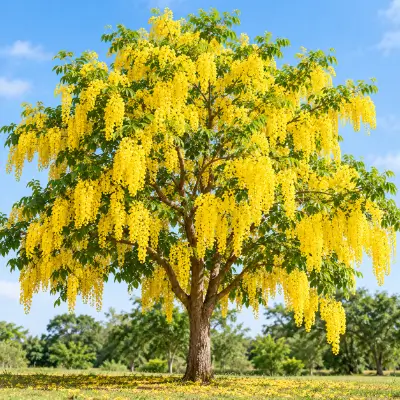
    The flame tree belongs to the subfamily Caesalpinioideae, family Fabaceae (formerly Leguminosae).

    The Chinese flame tree belongs to the Sapindaceae family and is classified as Koelreuteria bipinnata.

    Names in different Indian languages :

    English : Flame of the Forest,Butea Gum, Bengal Kino,bastard teak

    Hindi : Dhak,palash

    Kannada : muttagamara

    Malayalam : Plasu,chamata

    Sanskrit : palasah

    Tamil : Camata,purasus

    Telugu : moduga

    Unani : Dhaak,Samagh Dhaak,Kamarkas

    Folk : Tesu

    Synonyms :

    Kimsuka, Ksãrarestha, Brahmopanetra, Rakta puspa, Samidvara, Brahma Vrksa, Vãtapotha, Triparni  , Paalasha, Kimshuka, Raktapushpaka, Kshaarshreshtha, Brahmavriksha, Samidvar.

    B. frondosa Koenig ex Roxb.

    Classification according to Charaka, Susrutha & Vagbhata :

    Susrutha : Rodhrãdi, Muskakãdi, Ambasthãdi, Nyagrodhãdi

    Vagbhata : Rodhrãdi, Muskakãdi, Ambasthãdi, Nyagrodhãdi

    Varieties & adulterants – (CV – controversy, AD – adulterants) :

    1. Latapalsa – B. superb Roxb

    2. Rakta (red),

    3. Pita (yellow)

     4. Sveta (white)

    5. Neela (blue).

    Morphology :

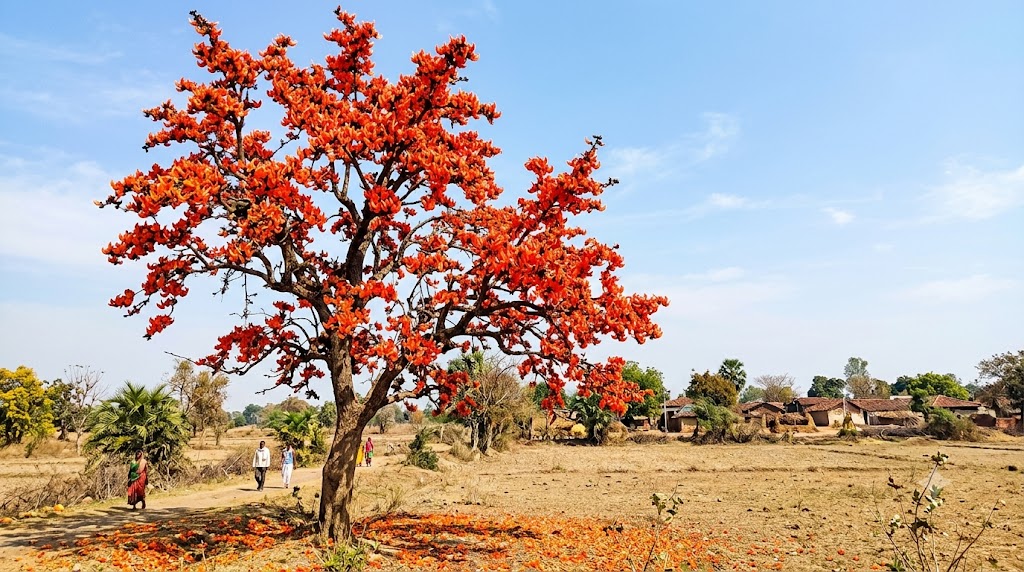
    A deciduous tree growing up to 15 m. height and 1.5-2 m in girth, trunk is crooked. Bark light-brown or bluish-grey, yielding a ruby-red vitreous gum(Butea gum or Bengal keno) Wood-white or yellow-brown.

    Leaves trifoliolate, large, unequal, 10.5-20.5 cm.

    Flowers- in racemes, brilliant orange-red, 4-6 cm. long; lower calyx-teeth deltoid.

    Fruits- pods, silvery-white, broad, dehiscent (by one suture).

    seeds- flat, elliptic, reddish-grey, 3 cm.

    Distribution & Habitat :

    Throughout India

    Chemical constituents :

    butin, butrin, isobutrin, palastrin, butrin, coreopsin, monospermoside , sulphurein, chalcones.

    Flowers— butin, isocorcopsin, monospermoide, butein (major glucoside), isomonospermoside, coreopsin, palasitrin.

    Roots— Glycine, Jalaric esters I, II, III & IV etc

    Gum— leucocyanidin, procyanidin etc.

    Seeds— monaspermin, palasonin, essential oil with myristic, palmitic acids etc.

    Properties :

    Rasa- Katu, Tikta, Kasaya

    Guna -Laghu, Snigdha

    Virya – Usna

    Vipaka – Katu

    Karma : Vãta-kapha hara, Grãhi, Krmighna, Dipana

    Bark—astringent, styptic (prescribed in bleeding piles, ulcers, haemorrhages, menstrual disorders), anthelmintic.

    Flowers—astringent, diuretic, emmenagogue (also given for leucorrhoea). A decoction of flowers is given in diarrhoea and haematuria, also to puerperal women.

    Seeds—clinical use of seeds as an anthelmintic drug is not considered safe in humans

    Indication :

    Krimi, Pliha roga, Gulma, Grahani, Arsaas. astringent, bleeding piles, ulcers, haemorrhages (menstrual disorders), anthelmintic.  diuretic, emmenagogue (also given for leucorrhoea).Antibacterial,antifungal

    Part used :

    stem bark, flowers, seeds, gum , ash

    Dosage :

    Bark decoction 50-100 ml, seed powder 5-8 g, flower powder 5-6 g, gum 2-4 g

    Important Yogas  or  Formulations :

    Krmimudgararas, Palãgaksãra taila   

    Amayaka prayog

    • External Analgesic and Anti inflammatory in nature. Flower, Bark and Resin has absorbent properties, seed has scraping action and Leaves Analgesic and Absorbent properties. In obstruction of urine palasa flower can be taken and can be used for tying over bladder area; which helps to relieve the symptom. Leaves after making hot can be used for tying over inflammatory areas. Bark decoction can be used for wound cleaning, in Hemorrhoids and in Leukorrhea. Seed paste is indicated in skin diseases, eye diseases etc. Oil can be used for external application in Erectile dysfunction. Seed powder can be used for nasya in Epilepsy. Oil is indicated in Animal poisoning.
    • Digestive System Carminative, Digestant, and liver stimulant. Flowers have absorbent properties. Alkali prepared out of it processes Bhedana and Anulomana action. Bark decoction is indicated in Malabsorption syndrome, Hemorrhoids, and in diminished digestive strength. Flower is indicated in Excessive thirst and in Diarrhea. Palasa kshara is beneficial in Ascites, Phantom tumor and in abdominal colic.
    • For three days, a dose of 3-6 grams of seed powder can be taken in the morning and at night. On the fourth day, purging with castor oil is done to get rid of roundworms. (Gandupada krimi). Circulatory System – Flower and Resin is beneficial in Bleeding disorders and Seed is indicated in vatarakta (Flower and Resin is rakta sthambaka and seed is Rakta sodhaka.
    • Excretory System – Flower is indicated in Dysuria and Seed in Diabetes.
    • Reproductive system – To improve the quantity of semen resin can be given. Flowers are beneficial in Menorrhagia.
    • Tvak – Both flower and seed are indicated in skin disorders. To control sweating resin is useful.
    • Tapakrama – Flower is indicated in fever associated with burning sensation.

    Therapeutic Uses :

    1. Slipada-Juice of Palãsa root and equal quantity of Sarsapa are given with oil (V.M). .

    2. Krimi- Seed paste or juice of Palãsa may be taken with butter milk (S.S.Ut.54)

    3. Pumsavana- The pregnant lady (2-3 months after conception) may be given paste of one palasa leave with milk (B. P).

    IUCN Status: Least Concern (LC)

    Research updates (past 5 years):

    1. A 2021 study validated the anti-diabetic and antioxidant effects of Palash bark extract.

    2. A 2022 paper highlighted wound healing and anti-inflammatory activities of Palash leaves and gum.

    3. A 2023 in vitro study demonstrated strong anthelmintic potential of Palash seed powder.
     

    About Palasha

    Botanical Name

    Butea monosperma (Lam.) Taub.

    Family

    Fabaceae (Papilionaceae)

    Identification No.

    SDACH/HG/048

    Parts Used

    Stem bark, flowers, seeds, gum, ash

    Habitat

    India

    IUCN Status

    Least Concern

    Plant Photos
    Ayurvedic Properties

    Rasa

    Katu, Tikta, Kashaya

    Guna

    Katu, Tikta, Kashaya

    Virya

    Ushna

    Vipãka

    Katu

    Contact Now

    Have queries? Contact Us.

    Have queries? We’re here to help you every step of the way.

    Contact us to get the right guidance for your academic journey at Shri Dhanwantry Ayurvedic College.

  • Nirgundi

    Nirgundi

    Botanical Name: Vitex negundo

    Family: Verbenaceae

    Identification No.: SDACH/HG/047

    Introduction :

    This leaves of nirgundi used for rubbing diseased part in leprosy. It classified under anusastra

    Names in different Indian languages :

    Hindi : Samhalu

    Telugu : Vavili,tellavalli

    Tamil : Nirkundi,nallanocci

    English : Five-leaved chaste

    Bengali : Nishinda

    Kanada : Niragundi,nekka,lakkagida

    Malayalam : karunocci

    Sanskrit : Nirgundi

    Unani : Sambhaalu,Fanjankisht

    Synonyms :

    Shephaalikaa, Sindhuka, Sindhuvaara, Suvahaa, Sugandhikaa. Nila, Nilanirgundi, Shveta nirgundi , Sinduvaara,

    Classification according to Charaka, Susrutha & Vagbhata :

    Charaka : Visaghna, Krmighna

    Susrutha : Surasadi

    Vagbhata : Surasadi

    Varieties & adulterants – (CV – controversy, AD – adulterants)  :

    Morphology :

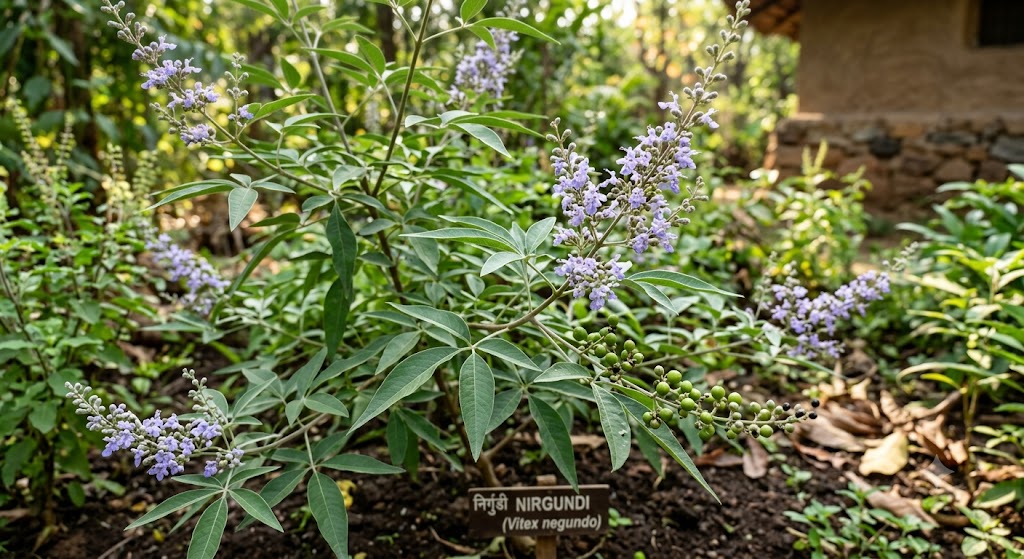
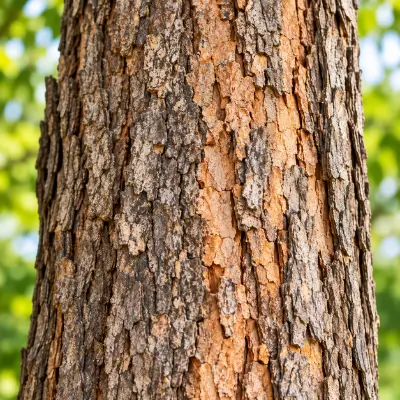
    A shrub or a small tree of about 3m height and underside of leaves pubescent.

    Leaves—Tri or penta-foliolate; leaflets lanceolate, middle one will be longer, entire or crenate, glabrate, dark above and pale be- heath.

    Flowers— in lateral cymes, small, bluish purple upto 30 cm long.

    Fruits— globose and black when ripe.

    Seeds— obovate or oblong.

    Flowering and fruiting between March-August

    Distribution & Habitat :

    All over India

    Chemical constituents :

    casticin , glucosides, luteolin-7-glucoside, vitricine, beta sitosterol, camphene, beta pinenes, angoside, aucubin

    Properties :

    Rasa : Katu, Tikta

    Guna: Laghu, Ruksa

    Virya : Usna

    Vipaka : Katu

    Karma : Vata-Kaphahara, Caksusya, Kesya, Krmi, Vranaropana, vishahara,Digestive, stomachic, anti-inflammatory, diuretic, expectorant, carminative

    Toxicity Studies :

     oil produces burning sensation and urticaria of used in excessive doses.

    Indication :

    sula, sotha,vata roga,  Amavãta, Krmi, Kustha, Aruci, Vrana, Grdhrasi, Snãyuka, Visarpa, Netra roga, Sãtikã roga, Visa roga, Gandamala,fever, spermatorrhoea, hair loss, cervical spondylosis, .A. , lumbago, cerpain, tuberculosis, leucoderma, cephalgia, memory lose, neural disoeder, skin diseases.

    Part used :

    Leaves, root, seeds, bark,Tree with serrated leaf type is preferable.

    Dosage :

    Leaf juice 10-15 ml

    Powder 2-4 g

    Decoction 50-100 ml

    Amayika Prayoga/Therapeutic Uses:

    External uses :

    Best analgesic. anti-inflammatory, antibacterial, cleaning and healing wounds. hair tonic. Heated nirgundi leaves are tied over the affected part (or poultice) in headache. scrotal swelling. Sinusitis, arthritic pain and rheumatic arthritis. Decoction prepared from leaves is used for tub bath in endometritis, colitis in these conditions it reduces the obstruction of blood and amakapha, increases perspiration. reduces oedema and also relieves pain. Gargles with decoction of leaves is useful in phatyngitis, stomatitis, difficulty in deglutition and inflammation. Smoke of leaves  is useful in headache, sinusitis and common cold. Nirgundi oil is best in wounds for cleaning, anti-infective and to remove foul smell. Oil is also useful in baldness. Nirgundi is also called a upanaha vriksha.

    Internal uses :

    Nervous system It is an analgesic, brain tonic and alleviates vata, therefore useful in headache. sciatica, rheumatic arthritis. synovitis, improves memory

    Digestive system : Since it has tikta, katu and ushna properties it improves appetite and digestion. It is useful in loss of appetite, anorexia. amadosha, hepatitis and is anthelmintic.

    Circulatory system : White flowered nirgundi is used in oedema induced by kaphavata. As it acts on the raktadhatu and alleviates vata and kapha. it is used in inflammatory conditions of liver and spleen. Mixture of leaf juice and cow’s urine is an effective remedy for ascites, Nirgundi is useful in all inflammatory conditions,

    Respiratory system : By removing kapha from respiratory passage, it improves ventilation therefore used in kapha kasa, asthma, pneumonia and pleurisy.

    Urinary system : Diuretic, hence useful in dysuria and anuria. In gonorrhoeal infection it helps in passing urine smoothly.

    Reproductive system : It improves menstrual flow therefore used in dysmenorrhoea and obstetric conditions.

    Skin : Valuable medicine in skin diseases; urticaria and eruptions.

    Temperature : It helps in digestion of ama, thus reducing fever. It is used as an anupan or a main drug in typhoid and malaria fever.

    Medovahasrotas : Decoction is used as a nasya in cervical lymythadenopathy and topical application at leaves also helps.

    Eyes : Leaf juice is installed in conjunctivitis, Surma is prepared from seeds.

    Ears : Nirgudi oil is useful (leaves + oil) in reducing pain, oozing, inflammation and fungal infection of ear.

    Satmikaran : Every part of the body is stimulated, therefore it acts as a rasayan in body. The combination of sheelajit + nirgudi is best rasayan.

    Antidote : Latex of Acacia arabica.

    Due to strong (pungent) odour, it is used as a mosquito and bed bug repellent. Also prevents insect growth in stored food grains (insecticidal). A parasitic plant grows on nirgundi in rainy season which is useful in mahakushtha. Also effective in guneaworm infestation.

    Important Yogas or Formulations :

    Nirgudikalpa, Nirguditail, Nirgudighrit. In large doses it vitiates pitta and therefore causes pitta disorders. Nirgundi taila, Nirgundi Kalpa. 

    Therapeutic Uses :

    1. Vãtavyãdhi— Nirgundi root powder shall be given with oil as Anupãna (R.R.S.).

    2. Kãsa,svãsa — Decoction prepared with Nirgundi, Gudüci, Haritaki and Marica (equal parts) is given with salt .

    3. Gandamãla— Nirgundi root is pounded with water and given as Nasya (V.M.).

    IUCN Status: Least Concern (LC)

    Research updates (past 5 years):

    1. A 2021 clinical trial showed significant anti-inflammatory effects in osteoarthritis patients.

    2. A 2020 pharmacognostic review confirmed antimicrobial and wound-healing activities of Nirgundi leaf extract.

    3. A 2023 in vivo study demonstrated neuroprotective and anti-arthritic properties in rodent models.


    About Nirgundi

    Botanical Name

    Vitex negundo L.

    Family

    Lamiaceae (formerly Verbenaceae)

    Identification No.

    SDACH/HG/047

    Parts Used

    Leaves, Root, Seeds, Bark

    Habitat

    India, Nepal, Bhutan, Pakistan, Sri Lanka

    IUCN Status

    Least Concern

    Plant Photos
    Ayurvedic Properties

    Rasa

    Katu, Tikta

    Guna

    Laghu, Ruksha

    Virya

    Ushna

    Vipãka

    Katu

    Contact Now

    Have queries? Contact Us.

    Have queries? We’re here to help you every step of the way.

    Contact us to get the right guidance for your academic journey at Shri Dhanwantry Ayurvedic College.

  • Pippali

    Pippali

    Botanical Name : Piper longum

    Family : Piperaceae   

    Identification No.: SDACH/HG/046

    Introduction :

    Pippali used as rasayana & treatment of piles, kasa. In Indian  mythology reveals that Pippali has its origin during Samdura mathana along with Amrta (elixer).

    Names in different Indian languages :

    Hindi : Pipala,pipal

    Telugu : pippallu

    Tamil : Tippili, pippili,Arisi thippili

    English : Long pepper

    Bengali : pipali

    Marathi : pipali

    Panjabi : Maghaun

    Kannada : Hipli

    Malayalam : Tippali

    Sanskrit : Pippali,magadhi

    Unani : Filfil Daraaz,Daarfilfil

    Synonyms :

    पिप्पली कणिनी चैव कृष्णा मगधिका लघु |

    वैढूर्या मुख वर्णा च तिक्ता कण्टक धारिणी ||

    Maagadhi, Maagadha, Maagadhaa, Maagadhikaa, Magadhodbhavaa, Vaidehi, Upkulyaa, Pippalikam, Chapalaa, Kanaa, Krishnaa. Uushnaa, Shaundi, Kolaa, Tikshna-tandulaa

    Classification according to Charaka, Susrutha & Vagbhata :

    Charaka : Dipaniya Kanthya, Asthapanopaga, sirovirecanopaga, sitaprasamana, süla prasamana, Kãsahara, Hikkanigrahana, Trptighna,Vamana.

    Susrutha : Pippalyãdi, urdhvabhagahana, Tryusana (Trikatu) Amalakäyãdi, sirovirecana

    Vagbhata : Pippalyãdi (A.S.)

    Varieties & adulterants – (CV – controversy, AD – adulterants) :

    1. Pippali – P. longum

    2. Gaja Pippali -P. chaba

    3. Simhali Pippali – Cylone variety

    4. Vana Pippali.

    5. Assam pippali

    6. Piper  salvelous

    Morphology :

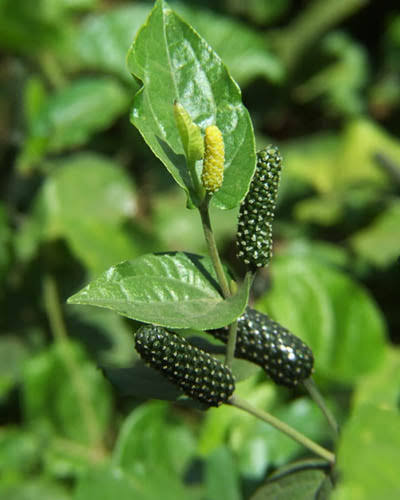
    An aromatic slender climber.

    Stems— Creeping, jointed, attached to other plants while climbing. swollen at nodes

    Leaves— alternate, 6-10 cm x 3-5 cm, subacute, entire, glabrous, reticulate venation, cordate at the base.  Lower one broadly ovate, cordate, upper one oblong, oval

    Flowers— in pendulate spikes. straight; male larger and slender; female 1.5-2.5 cm x 4-5 mm dia.

    Fruits— yellowish orange berries , aboid, sunk in fleshy spike.

    Flowers in rainy season and fruits in autumn.

    Distribution & Habitat :

    Found in the hotter parts of India, from central

    Himalayas to Assam, Khasi and Mikir hills. Also found in forests of western ghats from Konkan to Kerala.

    Chemical constituents :

    Piperine, aristolactams, dioxoaporphines, isobutyl amide, longamide, besides guineensine, the lignans, pluviatilol, methyl pluviatilol (fargesin), sesamin , asarinine, Essential oil, mono- and sesquiterpenes, caryophyllene  (mainly). piplartine, piperlongumine, pipercide. sesamin, – four aristohtctams (cepharanonle B. aristolactum All. piperlactum A and piperolactam B.) 

    Properties :

    Rasa : Katu

    Guna : Laghu. Snigdha. Tiksna (Ardra—Guru)

    Virya :  Usna (Ardra-Sita)

    Vipãka : Madhura

    Karma : (Ardra-Kapha vardhaka), Dipana, Vrsya, Rasayana

    digestive, appetizer, carminative, haematinic, expectorant, sedative

    Indication :

     Udara. Pliharoga, jvara, Kustha, Prameha, Gulma, Arsas,sula, Amavata .cough, bronchitis, asthma

     Roots are bitter, thermogenic, diuretic,  purgative, expectorant, digestive. Useful in gout, splenopathy, lumbago

    Pipali are thermogenic, laxative, carminative, digestive, anti septic. Useful in anorexia, colic, fever, epilepsy, haemorrhoids, gout

    Part used : Fruit, root

    Dosage :

    Powder 1-2 g.

    Amayika Prayoga/Therapeutic Uses:

    • Nervous system – Pacify vata dosha, improve intellect, Indicated in diseases of vata origin
    • Digestive system – It is spicy in taste so it acts as carminative, Anthelminthic. Mild purgative. Facilitate proper movement of vata dosha. Stimulate liver and indicated in splenomegaly. Also beneficial in abdominal cramp, bloating, loss of appetite, Constipation, splenic disorders etc.
    • Circulatory System – Indicated in Rheumatic heart diseases, Anemia. Increase blood pressure.
    • Respiratory System – Pacify kapha and Vata dosha. Indicated in kasa (Cough), hiccough and in breathing difficulties, Helps to expel out the excessive kapha from respiratory passage. Indicated in Tuberculosis.
    • Excretory system – Being Madhura vipaka, it increases urine production
    • Reproductive System – Its fruit is Aphrodisiac and root causes uterine contraction. Indicated in Amenorrhea and in Dysmenorrhea.
    • Indicated in fever (Jeerna jvara, and in vishama jvara) In Jirna jvara it can be administered along with Jaggery.
    • Satmikarana – Rejuvinative For Rasayana action Vardhamana pippali can be administered.

    Important Yogas  or  Formulations :

    Pippalyãdi ghrta, Pippalyasava, Vyosãdi

    Vati, Yakritplihãri loha, Yãkrta pippali yoga, Causastaprahara pippali, Pippalyãdi leha.

    Therapeutic Uses :

    (1) Kamala— Pippali is used as Nasya and Añjana (G.N.)

    (2) Rasayana— Ghee prepared with Pippali & milk will be useful (V.S.).

    IUCN Status: Data Deficient

    Recent research :
    (1) Antitubercular activity

    (2) Anti-inflammatory activity


    About Pippali

    Botanical Name

    Piper longum L.

    Family

    Piperaceae

    Identification No.

    SDACH/HG/046

    Parts Used

    Fruit, Root

    Habitat

    India

    IUCN Status

    Data Deficient

    Plant Photos

    Ayurvedic Properties

    Rasa

    Katu

    Guna

    Laghu, Snigdha, Tikshna

    Virya

    Ushna

    Vipãka

    Madhura

    Contact Now

    Have queries? Contact Us.

    Have queries? We’re here to help you every step of the way.

    Contact us to get the right guidance for your academic journey at Shri Dhanwantry Ayurvedic College.

  • Parnayavani

    Parnayavani

    Botanical Name : Coleus amboinicus

    Family : Lamiaceae  

    Identification No.: SDACH/HG/045

    Introduction :

    Latin name: Colens = Gk, koleos = a sheath (refering to the way the base of the stamens are combined); amboinicus ambo – pulpit = a raised platform.

    In folk it is using for kidney stone.

    Names in different Indian languages :

    English : Indian Borage

    Hindi : Patta ajavayin, patharcur

    Kannada : Karpurahalli

    Malayalam : Panikkurka, kannikurkka

    Sanskrit : Parna-yavaani,

    Tamil : Karpoorvalli

    Telugu : sugandhavalkam

    Synonyms :

    Pashanbhedi, karpura valli, sugandhavalkala

    Plectranthus amboinicus (Lour.) Spreng.

    Coleus amboinicus Lour.

    Varieties & adulterants – (CV – controversy, AD – adulterants) :

    Mexican mint – Coleus amboinicus

    Coleus vettiveroides

    Morphology :

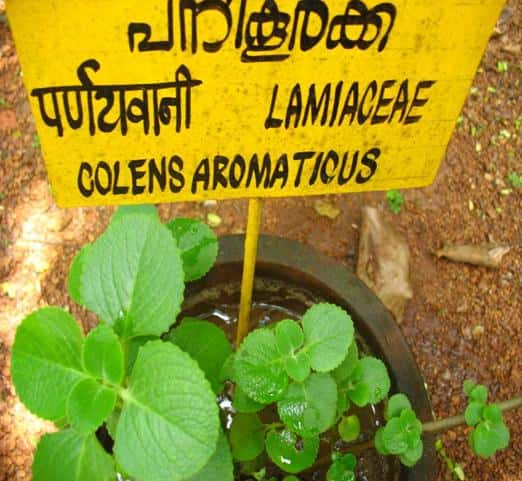
    A perennial, hairy shrub, very fragrant and with bristly hair. Trunk is 30 cm. to 1 mtrs. high and delicate.

    Leaves – simple, 6cm. long, ovate, dentate, thick with pungent smell.

    Flowers – small, violet, flowering at the end of winter and fruiting in summer.

    Distribution & Habitat :

    all over India, native to Malaya.

    Chemical constituents :

    thymol ,carvacrol and camphor,oxalacetic acid, flavonoid, cirsimaritin , betasitosterol.

    Properties :

    Guna: laghu ruksha,;

    Rasa: katu, tikta;

    Virya: ushna;

    Vipaka-katu

    Karma : carminative, digestive,astingent,cooling,diuretic, antimicrobial, antifungal, anthelmintic, antiviral, antipyretic, anti-inflammatory,

    Indication :

    fever, skin disease, cough, piles, leucorrhoea,vomiting, dysentery,gout, burning sensation,dyspepsia,cephalgia, worm infection

    Part used : Whole plant

    Dosage :

    Leaf juice 10-15 ml

    Powder 2-4 g

    Decoction 50-100 ml

    Amayika Prayoga/Therapeutic Uses:

    • External – Anti inflammatory and Analgesic. External application is indicated in Headache and Animal
    • poisoning.
    • Nervous System – Indicated in conditions like tremor, intoxication etc.
    • Digestive system – Improve taste, Carminative, digestive, Liver stimulant, Absorbent. Indicated in Liver diseases, Anorexia, Loss of appetite, Constipation, Abdominal cramp, Diarrhea, Malabsorption syndrome, Helminthiasis etc. It is one of the best medicines to prevent diarrhea and vomiting.
    • Circulatory System – Cardiac stimulant.
    • Respiratory System – Indicated in chronic cough, hiccough, breathing difficulty etc.
    • Excretory System -Indicated in renal calculi and Dysuria.

    IUCN Status: Not evaluated (NE)

    Research updates (past 5 years):

    1. A 2021 study showed antioxidant and antimicrobial properties of Coleus amboinicus leaf extract.

    2. A 2022 study evaluated its efficacy in reducing symptoms of bronchial asthma in children.

    3. A 2020 in vitro analysis confirmed significant anti-inflammatory potential of the essential oil.

    About Parnayavani

    Botanical Name

    Coleus amboinicus Lour.

    Family

    Lamiaceae

    Identification No.

    SDACH/HG/045

    Parts Used

    Whole plant

    Habitat

    India, Malaysia

    IUCN Status

    Not Evaluated

    Plant Photos

    Ayurvedic Properties

    Rasa

    Katu, Tikta

    Guna

    Laghu, Ruksha

    Virya

    Ushna

    Vipãka

    Katu

    Contact Now

    Have queries? Contact Us.

    Have queries? We’re here to help you every step of the way.

    Contact us to get the right guidance for your academic journey at Shri Dhanwantry Ayurvedic College.

  • Nimba

    Nimba

    Botanical Name:  Azadirachta indica

    Family : Meliaceae

    Identification No.: SDACH/HG/044   

     Introduction :

    This plant very useful in skin disease. it  used as biological pesticide. Seed oil using for hair fall.

    Names in different Indian languages :

    English : Neem tree,Margosa tree,Indian lilac

    Hindi : nim

    Kannada : Turakabevu,huccabevu,cikkabevu

    Malayalam : Veppu,aryaveppu,kaippanveppu

    Sanskrit : Nimbah,prabhadrah

    Tamil : Vempu,veppu,Arulundi

    Telugu : Kindavepu,turakavepu

    Unani : Aazaad

    Synonyms :

    Arita, Picumarda, Picumanda, Sarvatobhadra, Hinguniryasa, Yavanesta,Sukapriya, Netã, Subhadra, Prabhadra, Sutiktã, Nimba, Nimbaka,Arishtaphala, Pichumarda, Pichumanda, Pichumandaka, Tiktaka, Paaribhadra,Melia azadirachta Linn

    Classification according to Charaka, Susrutha & Vagbhata :

    Charaka : Kandughna, Tiktaskandha

    Susrutha : Aragvadhadi, Gudücyãdi, Lãksãdi

    Vagbhata : Aragvadhadi, Gudücyãdi, Lãksãdi

    Varieties & adulterants – (CV – controversy, AD – adulterants) :

    1. Nimba = Azadirachta indica

    2. Mahã Nimba = Ailanthus exelsa.

    Morphology :

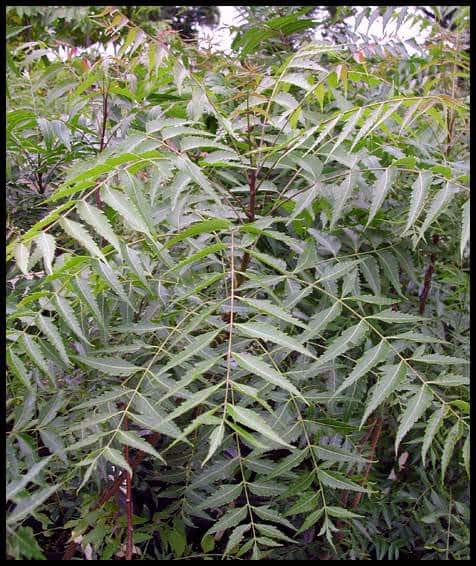
    It is a large tree growing up to 20-25 m. high

    Leaves- imparipinnate, crowded at the ends, of branches; leaflets 9-17, opposite, sub opposite; lanceolate, acuminate, serrate or dentate, glabrous.

    Flowers-numerous, white, honey-scented.

    Fruits- 1- seeded drupes, oblong, yellow when ripe.

    Seeds contain oil. (Flowers in February-April and fruits during June-August)

    Distribution & Habitat :

    Commonly found in various parts of India.

    Chemical constituents :

     Leaves— Azadirachtin, azadirachtanin, azadirone, nimbandiol, nimbin, nimbolide etc.

    Stem bark— nimbin, nimbidin, nimbinin, sitosterol, kulinone, margosinolide etc.

    Root bark—nimbin, nimbidin.

    Fruits—Azadirachtin, azadirachtol, azadirachnol, melianone, nimbiol, nimocin etc.

    Seed oil—Tocopherol, azadirone, azadiradione, nimbinin, salannol, nimbin, nimbidin etc.

    Flowers—Azadiradione, margosene, linoleic acid, arachidic acid etc.

    Properties :

    Rasa: Tikta, Kasaya

    Guna: Laghu, Rüksa

    Virya : Sita

    Vipäka : Katu

    Karma : Kapha-pittahara, Dipana, Grãhi, Krmighna, Netrya,Leaf, bark—antimicrobial, antifungal, anthelmintic, insecticidal, antiviral, antipyretic, antimalarial, antiperiodic, mosquito larvicidal, anti-inflammatory, antifertility, spermicidal, hypoglycaemic,Oil—used

    Indication :

    Kãsa, Chardi, Kustha, Krimi, Prameha, Vrana, Arsas,gulma, Netra roga, Kandu.

    Eczema,T.B, tumour,pruritus, diabetes ,leucoderma,anorexia  

    used in inflammation of gums, gingivitis, periodonitis, sores, boils, enlargement of spleen, malarial fever, fever during childbirth, measles, smallpox, head scald and cutaneous affections.

    Oil—used as a contraceptive for intravaginal use, for the treatment of vaginal infections, and as a mosquito repellent.

    Part used :

    Leaves, bark,oil, seed

    Dosage :

    Dried leaf—2–4g powder; 12–15 g for decoction;

    stembark— 5–6 g powder decoction for external use.

    Leaf juice— 10–15ml;

    oil—1–3 drops;

    bark decoction—50–100 ml.

    Aamayaka prayoga

    Internal uses :

    Digestive system : By its astringent and bitter property it improves taste and is constipative.

    Fruit is purgative.

    Leaves are stimulant of liver. Its bark decoction with honey is useful In jaundice, anorexia, vomiting, dysentery, intestinal worms, liver diseases. Ointment prepared from seeds is applied in piles.

    Respiratory system : Its property of tikta reduces the kapha from respiratory passage. Leaves are more useful in excessive mucous secretion, Bark decoction is used in chronic cough. 30- 60 cc of liquid collected from the trunk is given in TB.

    Urinary system : It is effective in diabetes.

    Reproductive system : its seed uterine stimulant. Seed powder is used in dysmenorrheal. Continuous use of leaves leads to a decrease in the shukra dhatus. it is a uterine Ionic. Since it is excreted in human milk, it is useful in preventing cough and skin diseases in infants.

    Skin : It is useful in all skin conditions specially in burning sensation.

    Satmikaran : In general debility, young leaves and gum is useful. The concept behind chewing nimbo leaves on Marathi is to prevent kapha disease. watery discharge from nimba is useful in emaciation and TB. Nimba is best rasayan in medo -roga (fat disorders)

    Temperature : Antipyretic. useful in chronic kapha jwara. malarial fever & fever.

    Eyes : Tender leaves anti flowers are useful in many skin disorders,

    Important Yogas  or  Formulations :

    Nimbadichurna. Nimbarishta. Nimbadi kashaya,Arogyavardhini Rasa (Bhãvana dravya), NimbaHaridra khanda, nimbadi taila           

    Therapeutic Uses :

    (1) Skin diseases –  leaves and Amalaki dried fruit are mixed with ghee and given regularly.

    (2) jwara—leaf juice

    IUCN Status:

    Least Concern (LC)

    Recent research updates

    • Anticancer Properties of Neem Leaf Extract
    • Antiviral Activity Against Dengue Virus
    • Antibacterial Potential Against Drug-Resistant Uropathogens
     

    About Nimba

    Botanical Name

    Azadirachta indica A.Juss.

    Family

    Meliaceae

    Identification No.

    SDACH/HG/044

    Parts Used

    Leaves, Bark, Oil, Seeds

    Habitat

    India

    IUCN Status

    Least Concern

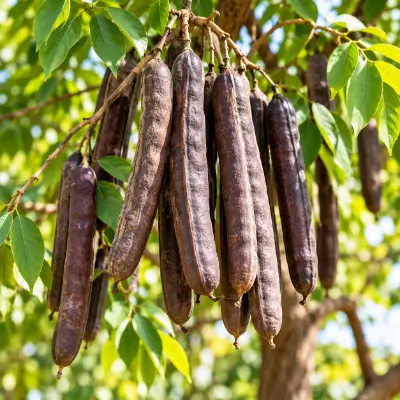
    Plant Photos
    Ayurvedic Properties

    Rasa

    Tikta, Kashaya

    Guna

    Laghu, Ruksha

    Virya

    Shita

    Vipãka

    Katu

    Contact Now

    Have queries? Contact Us.

    Have queries? We’re here to help you every step of the way.

    Contact us to get the right guidance for your academic journey at Shri Dhanwantry Ayurvedic College.

  • Kaidarya

    Kaidarya

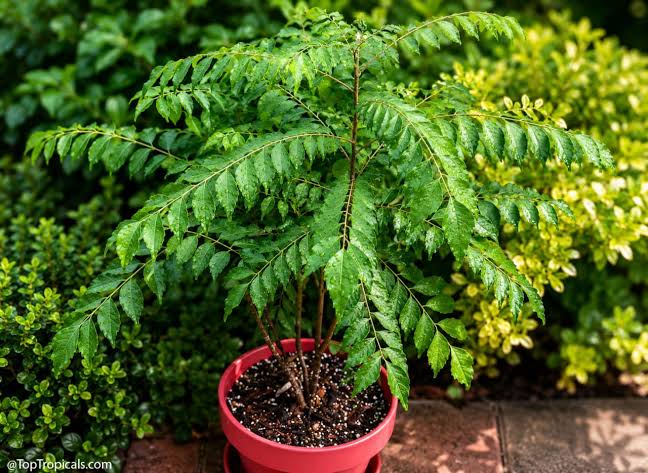
    Botanical Name : Murraya koenigii

    Family : Rutaceae

    Identification No.: SDACH/HG/043

    Introduction : Its properties similar to Murraya koenigii (Linn.) Spreng., but mainly using in folk and siddha.

    Names in different Indian languages :

    English : China box,honey bush,mock orange,lake view jasmine

    Malayalam : Kattu kari veppu, maramulla,paanamar,

    Sanskrit : Tamil,Palkanni,vellakkalthirukan

    Synonyms :

    Murraya  paniculata (Linn.)

    Morphology :

    It is Medium sized evergreen tree,grows 3-4 m height

    Leaves – compound, leaflets are ovate –pointed,

    Flower – white

    Fruit – berry

    Distribution & Habitat :

    All over India, forests

    Chemical constituents :

    coumarins, murrangatin, Mexolide , phebalosin , carbazole alkaloids and flavonoids

    Amayika Prayoga/Therapeutic Uses:

    • In diarrhea, green leaves of Murraya koenigii are eaten raw.
    • In morning sickness curry leaves are used along with lime juice.
    • Murraya koenigii leaves paste used to treat boils.
    • Root juice of Curry leaf is used to relieve renal pain.
    • Roots and bark of curry leaf is used to treat poisonous animal bite.
    • Curry leaves infusion is used to treat vomiting.
    • Curry leaf paste with buttermilk is taken for empty stomach is beneficial in stomach upsets.
    • Fresh Curry leaf juice can be used to prevent development of cataract.

    IUCN Status:

    Least Concern (LC)

    Recent research

    • Antioxidant and Antimutagenic Activity – A research study done to evaluate antioxidant and
    • antimutagenic activities of Murraya koenigii leaves.
    • Antidiabetic Activity – A study done on Anti-Diabetic potential of Murraya koenigii (L.) and its Antioxidant capacity in Nicotinamide-Streptozotocin induced diabetic rats have proved that Murraya koenigii possesses significant antidiabetic activity and antioxidant activity.

    About Kaidarya

    Botanical Name

    Murraya koenigii (L.) Spreng.

    Family

    Rutaceae

    Identification No.

    SDACH/HG/043

    Parts Used

    Leaves, Root, Bark

    Habitat

    India

    IUCN Status

    Least Concern

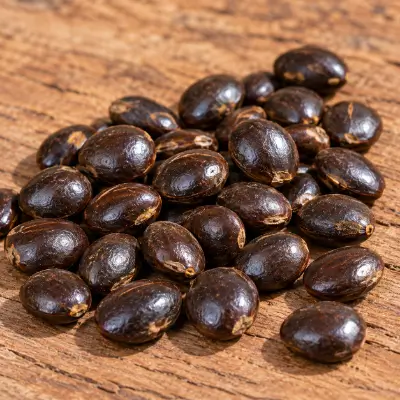
    Plant Photos
    Ayurvedic Properties

    Rasa

    Katu, Tikta, Kashaya

    Guna

    Laghu, Ruksha

    Virya

    Sheeta

    Vipãka

    Katu

    Contact Now

    Have queries? Contact Us.

    Have queries? We’re here to help you every step of the way.

    Contact us to get the right guidance for your academic journey at Shri Dhanwantry Ayurvedic College.

  • Jhandu

    Jhandu

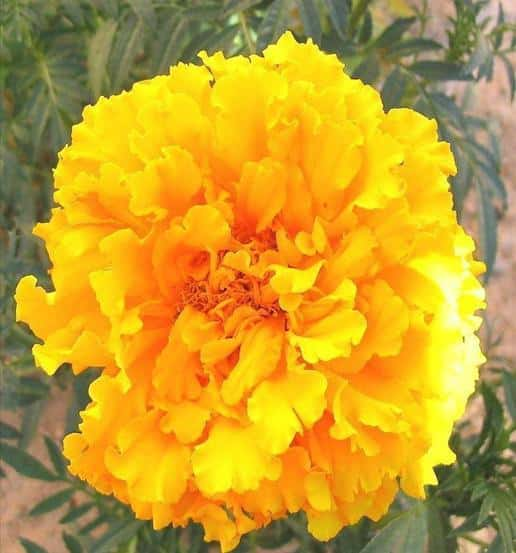
    Botanical Name: Tagetus erecta

    Family :  Compositeae 

    Identification No.- SDACH/HG/042

    Introduction :

    Latin name : Tagetus = marigold, tages an Etruscan God; erecta = straight.

    Sanskrit names : Zandu, Salpushpa, Zenduk.

    Morphology :

    This is a small plant. Its stalk and branches are angular and bear bristle hairs.

    Leaves – regularly placed, foliated and with hairs.

    Flowers – dark yellow. Seeds- black and oblong. flowering – in October (around Dassera).

    Many varieties are found.

    Habitat : Though imported from Mexico, it is found all over India.

    Properties :

    Guna : laghu, ruksha

    Rasa: tikta, kashaya

    Virya : sheeta

    Vipaka Katu

    Dosha : kaphapittashamak.

    Part used : Flowers or leaf juice.

    Dosage : Juice 10 to 20 gms.

    Amayika Prayoga/Therapeutic Uses:

    • The paste of the leaf is applied over the area affected with boils, carbuncles, muscle pain and rheumatism.
    • Cold infusion of the whole plant is given in a dose 30-40 ml to treat bronchitis, asthma and cough.
    • The paste of the leaf and flowers are applied over the external pile mass to reduce it.
    • The distillate obtained from the flowers is used to treat asthma. 4-5 drops are added with a glass of hot water and consumed.
    • The cold infusion prepared from the leaves and flowers is given in a dose of 50-60 ml to treat burning micturition.
    • The paste prepared from the leaves and flowers are applied over fresh wounds to control bleeding or in wounds associated with pus as treatment.
    • Nasya (Nasal administration) of the fresh juice of the leaf is done in epistaxis.
    • The paste of the leaf is fried in clarified butter or oil and consumed to control bleeding in piles, excessive blood flow during menstruation.

    IUCN Status: 

    Not Evaluated (Cultivated widely) 

    Research Updates (Past 5 Years): 

    1. 2020: Antimicrobial properties of Tagetes erecta against skin pathogens. 

    2. 2021: Lutein extraction for eye health benefits. 

    3.2022: Wound-healing efficacy in animal models.


    About Jhandu

    Botanical Name

    Tagetes erecta L.

    Family

    Asteraceae

    Identification No.

    SDACH/HG/042

    Parts Used

    Flowers, leaves

    Habitat

    Mexico, India

    IUCN Status

    Not Evaluated

    Plant Photos

    Ayurvedic Properties

    Rasa

    Tikta, Kashaya

    Guna

    Laghu, Ruksha

    Virya

    Sheeta

    Vipãka

    Katu

    Contact Now

    Have queries? Contact Us.

    Have queries? We’re here to help you every step of the way.

    Contact us to get the right guidance for your academic journey at Shri Dhanwantry Ayurvedic College.

  • Japa

    Japa

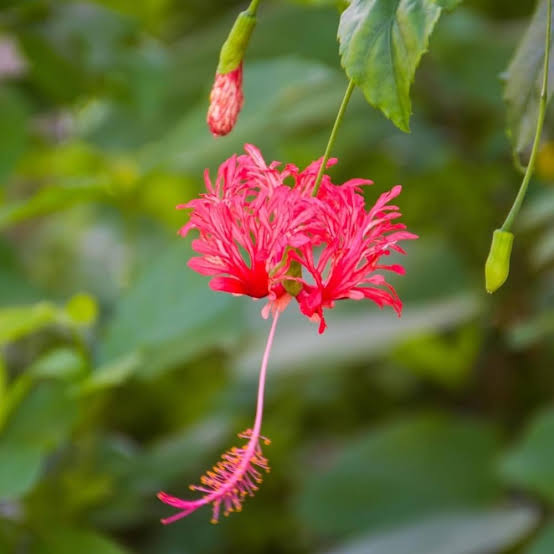
    Botanical Name: Hibiscus rosa-sinensis

    Family:   Malvaceae 

    Identification No.: SDACH/HG/041

    Introduction : Hibiscus rosa-sinensis is a bushy, evergreen shrub or small tree growing 2.5–5 m (8–16 ft) tall and 1.5–3 m (5–10 ft) wide, with glossy leaves and solitary, brilliant red flowers in summer and autumn. The 5-petaled flowers are 10 cm (4 in) in diameter, with prominent orange-tipped red anthers.

    The flowers of Hibiscus rosa-sinensis are edible and are used in salads in the Pacific Islands.[citation needed] The flower is additionally used in hair care as a preparation. It is also used to shine shoes in certain parts of India. It can also be used as a pH indicator. When used, the flower turns acidic solutions to a dark pink or magenta color and basic solutions to green. It is also used for the worship of Devi, and the red variety is especially prominent, having an important part in tantra. In Indonesia, these flowers are called “kembang sepatu”, which literally means “shoe flower”. In several countries the flowers are dried to use in a beverage, usually tea.

    Pink Hibiscus in South India

    Hibiscus rosa-sinensis is considered to have a number of medical uses in Chinese herbology. It may have some potential in cosmetic skin care; for example, an extract from the flowers of Hibiscus rosa-sinensis has been shown to function as an anti-solar agent by absorbing ultraviolet radiation

    Names in different Indian languages :

    English : Rose-of-China, Shoe flower, Chinese Hibiscus.

    Hindi : Jasum, java, odhul

    Kannada : dasavala

    Malayalam : chemparatti

    Sanskrit : Japaa

    Tamil : semparatti

    Telugu : Dasana, mandara

    Unani : Gul-e-Gurhal

    Synonyms :

    Japaa, Javaa, Odrapushpa, Rudrapushpa, Arunaa

    Amayika Prayoga / Therapeutic Uses:

    Internal uses :

    used in impotency, bronchial catarrh  emmenagogue. Leaf stimulates expulsion of placenta after childbirth; laxative, anodyne, used in menorrhagia.

    Chemical constituents :

    cyclopropanoids, methyl sterculate, methyl- hydroxysterculate, hydroxysterculate, malvalate and beta-sitosterol.

    IUCN Status: Not Evaluated

    Research Updates (Past 5 years):

    1. 2023 – Journal of Herbal Medicine: Hibiscus extract studied for its potential in reducing oxidative stress in diabetic patients.

    2. 2021 – Evidence-Based Complementary and Alternative Medicine: Japa flowers showed wound-healing activity in excision wound models.

    3. 2019 – Pharmacognosy Reviews: Detailed review on Hibiscus rosa-sinensis highlighting its anti-fertility and hair growth-promoting effects.


    About Japa

    Botanical Name

    Hibiscus rosa-sinensis L.

    Family

    Malvaceae

    Identification No.

    SDACH/HG/041

    Parts Used

    Leaves, Flowers

    Habitat

    India

    IUCN Status

    Not Evaluated

    Plant Photos

    Ayurvedic Properties

    Rasa

    Kashaya, Tikta

    Guna

    Laghu, Ruksha

    Virya

    Sheeta

    Vipãka

    Katu

    Contact Now

    Have queries? Contact Us.

    Have queries? We’re here to help you every step of the way.

    Contact us to get the right guidance for your academic journey at Shri Dhanwantry Ayurvedic College.

  • Haridra

    Haridra

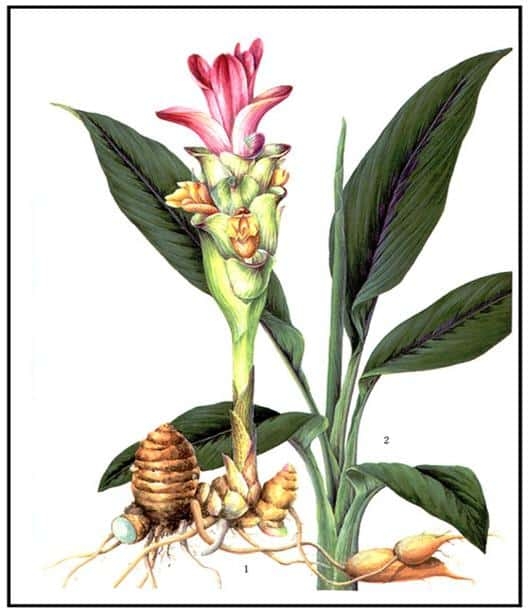
    Botanical Name: Curcuma longa Linn.

    Family:   Zingiberaceae 

    Identification No.: SDACH/HG/040

    Introduction : It used for skin diseases& prameha. it is considered as an important anti diabetic and anti-oxidant drug.

    Scientific Classification : Gingers make up the family Zingiberaceae in the order Zingiberales. The flavoring ginger is classified as Zingiber officinale, East Indian arrowroot as Curcuma angustifolia, and tumeric as Curcuma longa. The banana belongs to the family Musaceae and is classified as Musa paradisiaca. The traveler’s tree, classified as Ravenala madagascariensis, and the bird-of-paradise flower, classified as Strelitzia reginae, belong to the family Strelitziaceae (sometimes Musaceae). The false bird-of-paradise belongs to the genus Heliconia of the family Musaceae (sometimes Heliconiaceae)

    Names in different Indian languages :

    English : Turmeric

    Hindi : Haldi

    Kannada : Arisina

    Malayalam : Mannal,manjal,varattu mannal, pachamannal

    Sanskrit : Haridraa

    Tamil : Manzal

    Telugu : pasupu

    Unani : Zard Chob

    Synonyms :

    Priyaka, Haridruma, Kshanda, Gauri, Kaanchani, Krimighna, Varavarnini, Yoshitapriyaa, Hattavilaasini, Naktaahvaa, Sharvari,Curcuma  domestica Val.

    Classification according to Charaka, Susrutha & Vagbhata :

    Charaka : Lekhaniya, Kustaghna, Kandaghna, Krmighna, Sirövirecana

    Susrutha : Haridrãdi, Mustädi,

    Vagbhata : Haridrãdi, Mustädi,

    Varieties & adulterants – (CV – controversy, AD – adulterants)  :

    1. C. Domestica

    2. Amragandhi Haridra (Karpura Haridrã)

    3. Vana Haridrã

    Morphology :

    Annual herb; root stock large, ovoid; sessile tubers thick, cylindrical, bright yellow inside.

    Leaves— long petiole; oblong, narrow at the base.

    Flower— bracts pale green; flowers as long as the bracts, pale green. Flowers during rainy season.

    Distribution & Habitat :

    Cultivated throughout India.

    Chemical constituents :

    1% volatile oil, resin, curcumin is responsible for its colour. Turmeric oil has a peculiar odour and taste. Curcumene, Curcumenone, curcone, curdione, cineole, curzerenone, epiprocurcumenol, eugenol, camphene, camphor, borneol, procurcumadiol, procurcumenol, curcumins, ukonan A, B & D, sitosterol etc.

    Properties :

    Rasa : Tikta, Katu

    Guna :  Rüksa, Laghu

    Virya :  Usna

    Vipaka :  Katu

    Karma : Kapha-vãtahara, Lekhana, Visaghna, Varnya

    Anti-inflammatory, anti diabetic, cholagogue, hepatoprotective, blood-purifier, antioxidant, detoxifier and regenerator of liver tissue, antiasthmatic, anti-tumour, anticutaneous, antiprotozoal, stomachic, carminative

    Indication :

    Prameha, Kusta, Krimi, Kandu, Vrana, Pãndu, Kãmalã

    Diabetes, skin disease, skin disease, fungal infection, wounds, ulcers, anaemia, jaundice, epilepsy, syphilis

    Part used :

    Rhizome

    Dosage :

    Fresh juice 10-20 ml, powder 2-4 g.

    Important Yogas  or  Formulations :

    Haridrã Khanda, Vrana södhana tailam ,Nisamalaki,Haridrãdidhüma varti

    Amayika Prayoga / Therapeutic Uses :

    1. Vyanga— Haridra and Rakta Cañdana are made into paste with buffalo’s milk and applied externally (R.R.S.).

    2. Slipada & Dadru Kutha— Haridra powder is taken with jaggery and Cow’s urine (V.M. & B.P.).

    3. Pitameha— Haridrã and Dãruharidrã Kasãya (S.S.Ci. 11).

    IUCN Status: Least Concern

    Research Updates (Past 5 years):

    1. 2022 – Journal of Ethnopharmacology: Curcumin investigated for its anti-inflammatory and neuroprotective effects.

    2. 2021 – Phytotherapy Research: Clinical trial on Haridra in managing type-2 diabetes showed positive glycemic control.

    3. 2020 – Frontiers in Pharmacology: Turmeric extract evaluated for its role in improving skin barrier function and eczema.

    About Haridra

    Botanical Name

    Curcuma longa Linn.

    Family

    Zingiberaceae

    Identification No.

    SDACH/HG/040

    Parts Used

    Rhizome

    Habitat

    India

    IUCN Status

    Least Concern

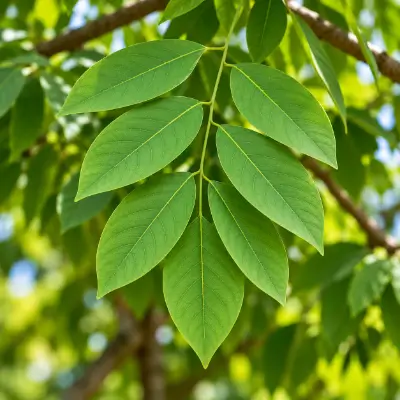
    Plant Photos
    Ayurvedic Properties

    Rasa

    Tikta, Katu

    Guna

    Ruksha, Laghu

    Virya

    Ushna

    Vipãka

    Katu

    Contact Now

    Have queries? Contact Us.

    Have queries? We’re here to help you every step of the way.

    Contact us to get the right guidance for your academic journey at Shri Dhanwantry Ayurvedic College.

  • Guduchi

    Guduchi

    Botanical Name : Tinospora cordifolia

    Family :  Menispermaceae

    Identification No.: SDACH/HG/039

    Introduction :

    It is one of the non-controversial drug used in Ayurvedic medicine. It used for Grãhi, Väta hara, Dipaniya, Kapha-Raktahara and Vibandhahara , Medhya Rasayãnas

    Names in different Indian languages :

    English : Tinospora,gulancha tinospora

    Hindi : Gulanca,giloy, amrta

    Kannada : Amrtaballi,yuganiballi,madhuparni

    Malayalam : Chittamrtu,amrtu

    Sanskrit : Guduci,amrta

    Tamil : Amrutavalli,cintilikkoti

    Telugu : Tippantiga,amrta

    Unani : Gilo,Gulanchaa. Sat-e-Gilo (extract)

    Synonyms :

    Ayurvedic, Guduuchi, Guduuchikaa, Guluuchi, Amrita, Amritaa, Amritalataa, Amritavalli, Chinnaruuhaa, Chinnodbhavaa, Madhuparni, Vatsaadani, Tantrikaa, Kundalini. Guduuchi sattva (extract), chakrika

    Classification according to Charaka, Susrutha & Vagbhata :

    Charaka : vayahathapana, daha prasamana, trshna nigraha, stanya sodhana

    Susrutha : guducyadi, patoladi, valli pancamula, kakolyadi, aragvadhadi

    Vagbhata : guducyadi, patoladi, aragvadhadi

    Varieties & adulterants – (CV – controversy, AD – adulterants)  :

    1. Gudüci

    2. Kandodbhavã Gudüci. – Tinospora sinensis / T. malabarica  – [AD]

     3. Padmã Guduci

    4. T. Crispa –  [CV]

    Morphology :

    T . cordifolia

    It is a large climber with succulent, corky and grooved stems; branches possess slender pendulous fleshy roots.

    Leaves- membranous, glabrous, 5-10 cm long, cordate; petiç.2.5-7 cm long.

    Flowers- in racemes of about 5 cm; axillary, terminal or from the old wood, pale yellowish white in colour.

    Fruits- carpels, dorsally convex, ventrally flat, size of a large pea.

    Distribution & Habitat :

    Both species are distributed almost throughout India.

    Cultivation— Propagated by cuttings of stem. It can be grown in almost any types of soil and under varying climatic conditions.

    Chemical constituents :

    Berberine,columbin, chasmanthin, palmarin, tinosporon, tinosporic acid, tinosporol,diterpenoid , tinosporin ,Tinosporide ,cordifolide ,Tinosporidine ,beta sitosterol isolated stems; cordifol, heptacosaflol , octacosanol , furanoid diterpene, tinosporide , 1, 8-norclerodene glucosie— tinosporaside, glycosider, cordifolisides A-E and two phenyl propane glycosides ,Isocolumbin, tetrahydropalmatine, magnoflarine and palmatine

    Properties :

    Rasa – Tikta, Kasãya (leaf is considered as Madhura by Kaiyadeva)

    Guna – Guru, Snigdha

    Virya – Usna

    Vipãka – Madhura

    Karma : Tridosa amaka, Medhya, Rasãyan, Dipaniya, Grãhi, Medohara, Kadüghna, Jvara hara, Dãha-prasamana,antipyretic, diuretic,  antiperiodic, anti-inflammatory, antirheumatic, spasmolytic, hypoglycaemic, hepatoprotective

    Indication :

    Jvara, Trsnã, Vtarakta, Pãndu, Kämalã, Dãha, Prameha, Kushta, Chardi, Krmi, Kandü, Raktãras, Medoroga, Visarpa,  Kãsa, Jarã Vyãdhi.Fever, rheumatism, body pain, cold, skin disease, urinary tract infections, cough, asthma, diabetes, hyper lipidimea, seminal weakness, jaundice, ulcer, liver and spleen disorder

    Part used :

    Stem, leaf, areal roots.

    Dosage :

    Stem powder 3-6g; decoction (1/20) – 50-100 mI; Infusion (1/10) – 30-60 ml; fresh juice 10-20m1; Gudüci Sattva 1-2g;

    Amayika Prayoga / Therapeutic Uses

    Internal uses :

    Digestive system: Useful in thirst, vomiting, loss of appetite, abdominal pain, liver disorders. jaundice, acid-peptic disorder, dysentery  and worms. It increases appetite.

    Circulatory system : Raktavahasrotogami. Guduchi satva is effective in cardiac debility, blood — disorders. rheumatoid arthritis, splenomegaly. gout and anaemia.

    Respiratory system : Useful in cough

    Reproductive system : Aphrodisiac being shukragami. snigdha and madhur vipak.

    Urinary system : Effective in prameha, mainly in diabetes and disorders of urinary bladder.

    Skin : It is used in skin disorders like dermatomes and erysipelas etc. It is also useful in syphilitic ulcer.

    Temperature : Juice of Guduci is used in chronic lever and typhoid fever. It reduces burning. normalizes temperature, improves appetite and increases the strength.

    Satmikaran : Useful in weakness and good rasayana for all seven dhatus.

    Important Yogas  or  Formulations:

      Guduchyadi churna, Guduchyadi kwath. Guduci swathva, Ameutarishta, Guduchi Taila       

    Therapeutic Uses :

    1. Medhya.— The fresh juice of Guduci (20m1 twice daily) may be used (C.S.Ci.1/1).

     2. Jvara.—

    (a) Guduci Svarasa (juice) + Satãvari svarass equal parts (l0 ml each) are mixed together and given along with jaggary in vãta jvara (S.S.Ut. 39/174)2.

    (b) Decoction prepared with Guduci, Parpata & Amalaki (500- l00 ml) may be administered in case of Pitta Jvara (Ha. Sam.3/ 2/71).

    3. Prameha— Guduci Svarasa with honey (A.H.Ci.1216)4.

    4. Slipada— Guduci Svarasa along with ginger oil (Taila) is given orally (C.D.42/1 6).

    5. Amlapitta— Leaves of Gudüci, Nimba and Patola are made into juice and administered along with honey (B. P.Ci.10/16)’.

    6. Chardi— Gudüci Hima Kasãya may be given orally along with honey (Bha.Pra,Ci. 17/21).

    7. Vãtarakta— Chronic administration of Guduci in either juice or paste or powder or decoction form will definitely cure Vãtarakta (B.P.Ci. 29/41 & V. M. 23/10)

    IUCN Status: Least Concern

    Research Updates (Past 5 years):

    1. 2023 – Journal of Ayurveda and Integrative Medicine: Guduchi extract found effective in reducing symptoms in mild COVID-19 patients due to its immunomodulatory properties.

    2. 2021 – Frontiers in Pharmacology: Tinospora cordifolia showed anti-diabetic and hepatoprotective effects in animal models.

    3. 2020 – Phytomedicine: Evaluation of Guduchi as a potential adaptogen and immunostimulant in stress-induced models.


    About Guduchi

    Botanical Name

    Tinospora cordifolia (Willd.) Hook. f. & Thomson

    Family

    Menispermaceae

    Identification No.

    SDACH/HG/039

    Parts Used

    Stem, leaves, aerial roots

    Habitat

    India

    IUCN Status

    Least Concern

    Plant Photos
    Ayurvedic Properties

    Rasa

    Tikta, Kashaya

    Guna

    Guru, Snigdha

    Virya

    Ushna

    Vipãka

    Madhura

    Contact Now

    Have queries? Contact Us.

    Have queries? We’re here to help you every step of the way.

    Contact us to get the right guidance for your academic journey at Shri Dhanwantry Ayurvedic College.